
Animal
Spectacled bear
The spectacled bear lives in the mountains of South America. Many have pale rings around their eyes, like glasses. It climbs trees and eats lots of fruit.
The spectacled bear, or Andean bear, is the only bear that lives in South America. It is named for the pale markings that ring the eyes of many bears, like a pair of glasses. It lives in the forests of the Andes Mountains, climbs trees, builds platforms in branches and eats mostly fruit and bromeliads.
Tremarctos ornatus, the Andean or spectacled bear, is South America's only bear and among the most arboreal and herbivorous of all bears. It ranges along the Andes from Venezuela to Bolivia. The IUCN lists it as Vulnerable, with 2,500 to 10,000 mature individuals and a decreasing trend, mainly because of habitat loss and killing by people.
Photo: Jonathan Candil Méndez, CC BY 4.0, via Wikimedia Commons
Meet the spectacled bear
The spectacled bear is a black or brown bear.
Many have pale rings around their eyes. They look a bit like glasses, called spectacles. That is how the bear got its name.
The spectacled bear is the only bear that lives in South America. It is also called the Andean bear, after the Andes Mountains where it lives.
Its thick coat is usually black or brown. Many bears have cream or whitish markings around their eyes that look like spectacles, often running down the throat and chest. Every bear's markings are different, and a few bears have hardly any. It is a medium-sized bear: males can weigh up to 154 kilograms, about twice as much as a grown-up person.
Tremarctos ornatus is the only bear native to South America. The Smithsonian's National Zoo gives a head-and-body length of 1.5 to 1.8 meters and a shoulder height of 0.6 to 0.9 meters; males are up to 30 percent larger than females and weigh up to 154 kilograms, while females rarely exceed 81.
The coat is black or brown, sometimes tinged with red. Cream to white markings around the eyes, extending variably onto the throat and chest, form an individual 'fingerprint'; Animal Diversity Web notes they can be absent altogether. The bear is stocky, with small round ears, a thick short neck, a stout muzzle and a tail about 7 centimeters long that is often hidden in fur.
Quick facts
- Group
- Mammal
- Length
- 1.5 to 1.8 m
- Height
- 0.6 to 0.9 m
- Weight
- up to 154 kg
Where it lives
Spectacled bears live high in the Andes Mountains.
They live in misty forests full of moss. Sometimes they walk out onto the grassy slopes nearby.
Spectacled bears live in the Andes Mountains and nearby ranges of western South America, from Venezuela south to Bolivia. Many live between about 1,800 and 2,700 meters above sea level, though some live lower down.
Their homes include rainforest, misty cloud forest, mossy elfin forest of short, twisted trees, and thorny dry forest. They also look for food in grasslands next to the forest.
The IUCN Red List (assessed 2016, published 2017) lists the species as extant in Bolivia, Colombia, Ecuador, Peru and Venezuela, with presence uncertain or vagrant in Argentina. The National Zoo adds a few reports from eastern Panama and extreme northern Argentina, and notes that the species no longer lives in Chile.
Many bears live between 1,829 and 2,682 meters, but others use lower elevations. Habitats range from rainforest, cloud forest and stunted, moss-covered elfin forest to thorny dry forest, with foraging in grasslands bordering forest. Shading on the map is by country; the bears live only in the Andean parts of each.
Continent

Where can you find this animal?
- Lives here naturally · Countries and seas named by a scientific source
- Sightings recorded · Records of wild sightings (GBIF)
Lives here naturally · Countries and seas named by a scientific source
Cloud forests, rainforests, elfin forests, dry forests and nearby grasslands of the Andes and outlying ranges, from western Venezuela to Bolivia. The bears live only in the mountain regions of each country shown. Argentina, where presence is uncertain, is not shown.
Places: Venezuela, Colombia, Ecuador, Peru and Bolivia.
Source: iucn-red-list · checked October 2026
Sightings recorded · Records of wild sightings (GBIF)
Counts of GBIF records of wild observations (human and machine) and preserved specimens. Records include introduced populations, vagrants, escaped or released animals and misidentifications, so a country with records is not necessarily part of the native range.
Wild sightings have been recorded in Colombia, Ecuador, Peru, Bolivia, Germany, United States, Venezuela, Japan and 2 more places.
Source: gbif · checked October 2026
Range maps show where scientists say an animal lives, often country by country. An animal may live in only part of a country shown, and sightings records can include animals that wandered far from home.
What it eats
Spectacled bears eat mostly plants.
They love fruit and leafy plants called bromeliads. Sometimes they eat berries, grass and small animals.
Apart from the giant panda, spectacled bears probably eat more plants than any other bear. Their favorite foods are fruit and plants called bromeliads. They also eat berries, grasses, bulbs, cactus flowers, moss, bamboo and honey, and sometimes small animals like rodents, rabbits and birds.
They use their sharp claws to tear open clumps of bromeliads. To reach fruit high up, they build platforms of sticks in the trees. Near villages, they sometimes raid cornfields.
Animal Diversity Web describes the species as probably the most herbivorous bear apart from the giant panda. Fruit and bromeliads are preferred; other foods include berries, grasses, bulbs, cactus flowers, moss, orchids, bamboo, palms, honey, invertebrates, small mammals and birds. Bears readily scavenge carcasses but have rarely been seen killing livestock.
Foraging combines climbing and ground work: bears tear open bromeliad masses with their claws and build stick platforms to reach food in the canopy. Crop raiding, especially of maize, brings them into conflict with farmers.
Did you know?
A mother bear's body waits until the right time to grow her cub.
Thanks to delayed implantation, spectacled bear cubs are born when food is plentiful, months after their parents mated.
Delayed implantation times births to periods of abundant food; if resources are insufficient, the embryo does not implant.
A climbing bear
Spectacled bears are great climbers.
They have sharp claws for pulling apart plants. They build beds of sticks up in the trees.
The Smithsonian's National Zoo calls the spectacled bear the most tree-loving bear species. It climbs to find food and builds platforms and nests in the branches for eating and sleeping. Sharp claws help it tear open tough plants.
Its body is stocky, with a short, thick neck, small round ears and a short, strong muzzle. Its coat is thick and of medium to long length. Its tail is so short, about 7 centimeters, that it is often hidden by fur.
Described by the National Zoo as the most arboreal bear species, the Andean bear builds stick platforms to reach elevated food and nests in trees to sleep. Its sharp claws tear open masses of bromeliads.
Animal Diversity Web describes a stocky build, small round ears, a thick short neck, a stout muzzle and a coat of medium to long length. The facial markings are highly variable and unique to each animal; the National Zoo uses them to tell its own bears apart.
Growing up
Baby spectacled bears are called cubs.
They are born tiny, with almost no fur and their eyes closed. They stay in the den with their mother until they are about three months old.
Spectacled bears mate between April and June. The tiny embryo does not settle in and grow right away: the mother's body waits, so that cubs are born when there is plenty of food, usually between November and February. She usually has one or two cubs.
Newborn cubs weigh only about 280 to 510 grams and are nearly bald, toothless and blind. Their eyes open at four to six weeks, they soon take their first steps, and at about three months they leave the den for the first time. Females are old enough to have cubs at four to seven years.
Breeding occurs from April to June, when pairs stay together for a week or two. Females have delayed implantation, so the embryo implants only when conditions allow, and births occur when food is abundant, usually from November to February, after two to three months of development following implantation. If resources are insufficient, the embryo does not implant. Animal Diversity Web links delayed implantation to the wide range of gestation times recorded in captive bears, 160 to 255 days.
The National Zoo gives litters of one or two cubs (Animal Diversity Web reports one to four in the wild), weighing 10 to 18 ounces (about 280 to 510 grams), nearly bald, toothless and blind. Eyes open at four to six weeks and cubs leave the den at about three months. Females mature between four and seven years. Wild longevity is unknown; in human care the average age is around 20 years, and some live into their late twenties or early thirties.
A quiet forest life
Spectacled bears usually live alone.
They are busy mostly at night. In the day they sleep in a tree, a hollow or a little cave.
Spectacled bears usually live alone, except for mothers with cubs, but several may gather where there is lots of food. They are active mostly at night.
In the daytime, they sleep in quiet, hidden places: in hollow trees, on their tree platforms, between big tree roots or in dens dug into cliffs. Reported average home areas range from about 7 to 27 square kilometers.
The species is mostly solitary, but individuals gather where food is plentiful and are probably not strongly territorial. The National Zoo describes it as active primarily at night, sleeping by day in tree cavities, on platforms, among large exposed roots or in dens dug into cliffs; Animal Diversity Web notes disagreement, with some researchers describing activity by day and at dawn and dusk and others including the night.
Some sources report seasonal and sex-based differences in home range: averages of 23 square kilometers for males in the wet season and 27 in the dry season, and 10 and 7 square kilometers for females.
Did you know?
Spectacled bears build platforms up in the trees.
Spectacled bears build platforms of sticks high in trees, so they can reach fruit and take naps.
The construction of canopy feeding platforms is one of the species' most distinctive behaviors.
Protecting the Andean bear
There are not many spectacled bears.
Their forests are being cut down, and some people hunt them. People are working to protect the bears and their mountain home.
The IUCN lists the spectacled bear as Vulnerable. There are only about 2,500 to 10,000 adults, and their numbers are going down. The biggest dangers are the loss of their forests and hunting.
Some people kill bears that raid cornfields, or because they wrongly believe the bears kill farm animals. Numbers have fallen sharply in Venezuela, Colombia and Peru, but healthy populations remain in Ecuador and Bolivia. Protecting bear forests can also help animals like the mountain tapir and Andean condor.
The IUCN lists Tremarctos ornatus as Vulnerable (criteria A3c+4c), with 2,500 to 10,000 mature individuals and a decreasing trend. The National Zoo identifies habitat destruction and hunting as the greatest threats: bears are poached for parts sold to traditional medicine dealers and for meat, and killed for raiding maize or in the mistaken belief that they prey on livestock.
Numbers have declined dramatically in recent decades in Venezuela, Colombia and Peru, while healthy populations remain in Ecuador and Bolivia. Conservationists hope that protecting Andean bear habitat will also protect animals that share it, such as the Andean coati, mountain tapir, jaguar and Andean condor.
IUCN Red List
How is the spectacled bear doing in the wild?
- Least Concern
- Near Threatened
- Vulnerable (this animal)
- Endangered
- Critically Endangered
- Extinct in the Wild
- Extinct
Vulnerable
At high risk of disappearing from the wild.
See the IUCN Red List assessment · The IUCN Red List of Threatened Species 2022.2
Amazing facts
-
No two spectacled bears have the same face marks.
The pale markings on a spectacled bear's face, throat and chest are different on every bear, like a fingerprint.
Facial and chest markings are individually distinctive, and keepers use them to tell bears apart.
-
Spectacled bears build platforms up in the trees.
Spectacled bears build platforms of sticks high in trees, so they can reach fruit and take naps.
The construction of canopy feeding platforms is one of the species' most distinctive behaviors.
-
A mother bear's body waits until the right time to grow her cub.
Thanks to delayed implantation, spectacled bear cubs are born when food is plentiful, months after their parents mated.
Delayed implantation times births to periods of abundant food; if resources are insufficient, the embryo does not implant.
-
Spectacled bears eat mostly plants.
Apart from the giant panda, the spectacled bear may eat more plants than any other bear.
Animal Diversity Web ranks it as probably the most herbivorous bear after the giant panda.
Words to know
- spectacles
- an old word for glasses
- bromeliad
- a spiky plant that often grows on trees in the tropics
- cloud forest
- a mountain forest that is often wrapped in mist and cloud
- arboreal
- living in trees
- delayed implantation
- when a baby animal waits before it starts to grow inside its mother
- herbivorous
- eating mostly plants
Discovery challenge
-
Why is it called the spectacled bear?
Where does the spectacled bear's name come from?
Which feature gives Tremarctos ornatus the name 'spectacled bear'?
- Pale rings around its eyes
- It wears hats
- Its very long tail
Show the answer
Pale rings around its eyes
Pale rings around its eyes look like glasses.
Cream or white markings around the eyes look like spectacles, or glasses.
Pale periocular markings, which vary between individuals and may be absent.
-
Where do spectacled bears live?
On which continent do spectacled bears live?
Which continent's only bear is the spectacled bear?
- Africa
- South America
- Antarctica
Show the answer
South America
They live in South America.
South America, in the Andes Mountains.
South America; it is the continent's only native bear.
-
What do spectacled bears eat most?
Which foods do spectacled bears like best?
Which foods are favored in the Andean bear's mostly herbivorous diet?
- Fish and seals
- Fruit and bromeliads
- Only insects
Show the answer
Fruit and bromeliads
They love fruit and leafy bromeliad plants.
Fruit and bromeliads, plus berries, grasses and sometimes small animals.
Fruit and bromeliads, with a wide range of other plants and occasional animal food.
-
What do spectacled bears build in trees?
What do spectacled bears build in trees?
Which structures do Andean bears build in the canopy?
- Platforms of sticks
- Mud huts
- Spider webs
Show the answer
Platforms of sticks
They build platforms of sticks to sit and eat.
Stick platforms to reach food and nests to sleep in.
Stick feeding platforms and sleeping nests.
Places where you might see it
-
 Watch
 Country
Peru
Peru is a country on the Pacific coast of South America. It has a dry desert coast, the high Andes mountains and the Amazon rainforest, and about 34 million people lived there in 2025, many of them in the capital, Lima.
-
 Watch
 Country
Ecuador
Ecuador is a country in northwestern South America, named after the equator, which crosses it. In a small space it holds Pacific beaches, high snowy volcanoes of the Andes, part of the Amazon rainforest and the Galápagos Islands, whose wildlife helped Charles Darwin develop his ideas.
-
 Watch
 Country
Colombia
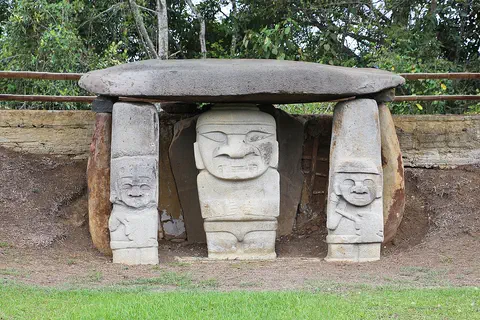
Colombia is in the northwest of South America, with coasts on both the Caribbean Sea and the Pacific Ocean. Three ranges of the Andes run through it, and most people live in the cool mountains, where the capital, Bogotá, sits on a high plateau. About 53.4 million people lived there in 2026, according to DANE, the national statistics office.
-
 Watch
Natural wonder
Andes
The Andes run down the whole western side of South America, from the Caribbean coast to the continent's southern tip, through seven countries. Britannica measures them at about 8,900 kilometers, and their highest peak, Aconcagua, rises to 6,959 meters. They are still growing as one plate of Earth's crust slides under another, which is why the Andes have so many volcanoes and earthquakes.
Explore next
-
 Watch
Animal
Sun bear
The sun bear is the smallest of the world's eight kinds of bear, and it has the longest tongue. It lives in the forests of Southeast Asia, climbs trees with long curved claws, and rips open logs to find insects and honey. Every bear has its own chest patch, like a fingerprint.
-
 Watch
Animal
Giant panda
The giant panda is a black-and-white bear that lives in misty mountain forests in China. About 99 percent of its food is bamboo, and it spends up to 16 hours a day eating. Pandas were once endangered, but protecting their forests has helped them, and they are now listed as Vulnerable.
-
 Watch
3D
Animal
Brown bear
The brown bear lives in more places than any other bear, from European forests to the mountains of Asia and the rivers of Alaska. It eats almost anything, from berries to salmon, and spends the long winter asleep in a cozy den. Grizzly bears and Kodiak bears are brown bears too.
-
Watch
Country
Peru
Peru is a country on the Pacific coast of South America. It has a dry desert coast, the high Andes mountains and the Amazon rainforest, and about 34 million people lived there in 2025, many of them in the capital, Lima.
-
Watch
Country
Ecuador
Ecuador is a country in northwestern South America, named after the equator, which crosses it. In a small space it holds Pacific beaches, high snowy volcanoes of the Andes, part of the Amazon rainforest and the Galápagos Islands, whose wildlife helped Charles Darwin develop his ideas.
-
 Watch
Animal
Andean condor
The Andean condor is one of the largest flying birds in the world. With wings up to 3.2 meters across, it soars over the Andes Mountains of South America, barely flapping, as it searches for dead animals to eat. It is a vulture, nature's clean-up crew.
-
Watch
Country
Colombia
Colombia is in the northwest of South America, with coasts on both the Caribbean Sea and the Pacific Ocean. Three ranges of the Andes run through it, and most people live in the cool mountains, where the capital, Bogotá, sits on a high plateau. About 53.4 million people lived there in 2026, according to DANE, the national statistics office.
-
Watch
Natural wonder
Andes
The Andes run down the whole western side of South America, from the Caribbean coast to the continent's southern tip, through seven countries. Britannica measures them at about 8,900 kilometers, and their highest peak, Aconcagua, rises to 6,959 meters. They are still growing as one plate of Earth's crust slides under another, which is why the Andes have so many volcanoes and earthquakes.
For parents & teachers
What children will learn
- Describe the spectacled bear's features and how its markings make each bear unique.
- Explain what the bear eats and how it climbs and builds platforms to feed.
- Locate the Andes and describe the cloud forest habitat.
- Understand why the species is Vulnerable and how protecting it helps other animals.
Recommended ages: 3 to 17 · About 15 minutes
Talk about it
- Why might a bear that eats fruit spend so much time in trees?
- How could farmers protect their corn without harming bears?
- Why does protecting one animal's forest help many other animals?
Try at home or in class
- Draw a bear face and invent its own 'spectacles' pattern; compare with others to see they are all different.
- Build a small platform from twigs or craft sticks between two cups, and see how much weight it can hold.
Key vocabulary: spectacles, bromeliad, cloud forest, arboreal, delayed implantation, herbivorous
Where these facts come from
- The IUCN Red List of Threatened Species , International Union for Conservation of Nature (IUCN terms of use (no redistribution of Red List data or range maps))
- GBIF Backbone Taxonomy and GBIF Occurrence Search , Global Biodiversity Information Facility (CC0 1.0 (backbone); occurrence counts are facts derived from records under CC0, CC BY and CC BY-NC)
- Tremarctos ornatus (Andean Bear), 2016 assessment (errata version 2018) , IUCN Red List of Threatened Species
- Andean bear , Smithsonian's National Zoo and Conservation Biology Institute
- Tremarctos ornatus , Animal Diversity Web, University of Michigan Museum of Zoology
- Wikidata , Wikimedia Foundation (CC0 1.0)
- Wikimedia Commons , Wikimedia Foundation (Per file: Public domain, CC0, CC BY or CC BY-SA only (credited on each page))
Checked, not yet human-reviewed. Last updated October 24, 2026. Spotted a mistake? Tell us.