
Animal
Brown bear
The brown bear is a big, strong bear with a hump on its back. It eats berries, roots and fish, and sleeps all winter in a den.
The brown bear lives in more places than any other bear, from European forests to the mountains of Asia and the rivers of Alaska. It eats almost anything, from berries to salmon, and spends the long winter asleep in a cozy den. Grizzly bears and Kodiak bears are brown bears too.
Ursus arctos has the widest range of any bear, across North America, Europe and Asia, from sea level to about 5,500 meters. It is an omnivore whose diet shifts with the seasons, and it survives winter in a deep, low-energy sleep in a den. Grizzlies and Kodiak bears are populations of this one species. The IUCN lists it as Least Concern overall.
Photo: Robert F. Tobler, CC BY-SA 4.0, via Wikimedia Commons
Meet the brown bear
The brown bear is a big, furry bear.
It has a round hump on its shoulders and long, strong claws. Some brown bears are light like sand. Others are almost black.
The brown bear is one of the biggest meat-eating animals on land, although most of what it eats is actually plants. A big male can weigh as much as about nine grown-ups, and it stands 0.9 to 1.2 meters tall at the shoulder, as high as a kitchen counter or higher.
Grizzly bears and the giant Kodiak bears of Alaska are both brown bears. They belong to one species with lots of local variety. Brown bears come in shades from pale cream to nearly black. 'Grizzly' means 'streaked with gray', because many have fur tipped with white or tan.
Ursus arctos is among the largest land carnivores. Adult males weigh roughly 150 to 680 kilograms and females 97 to 300 kilograms, with head-and-body lengths of 1.8 to 3 meters and a shoulder height of about 0.9 to 1.2 meters. Size varies enormously by region and diet.
North America was once thought to hold dozens of brown and grizzly bear species; today they are treated as one species with several subspecies. Kodiak bears (U. a. middendorffi) have been isolated on their archipelago since the last ice age, about 12,000 years ago, while mainland grizzlies are U. a. horribilis. Coastal Alaskan bears grow largest, thanks to fatty salmon each summer.
Quick facts
- Group
- Mammal
- Length
- 1.8 to 3 m
- Height
- 0.9 to 1.2 m
- Weight
- 150 to 680 kg
- Top speed
- up to 64 km/h
- Lifespan in the wild
- up to 25 years
Where it lives
Brown bears live in many places.
They live in forests, on mountains and near rivers. You can find them in North America, Europe and Asia.
Brown bears live in more kinds of places than any other bear: forests, mountains, open tundra and even dry, semi-desert land. They are found across Russia, parts of Europe and Asia, northern Japan, western Canada and the northwestern United States, especially Alaska.
Long ago they lived in many more places, including most of the United States, northern Mexico and northern Africa. People hunted them until they disappeared from those areas. Today the biggest populations are in Russia, Alaska and Canada.
The species has the largest range of any bear, from sea level to about 5,500 meters. The IUCN's 2016 global assessment lists more than 40 countries with resident bears, across Europe, the Caucasus, Central and South Asia, China, Mongolia, Russia, Japan, Canada and the United States. Many European and Asian populations are small and isolated, while the largest populations are in Russia, Alaska and Canada.
The range has shrunk greatly. The same assessment records the species as extinct in Mexico, North Africa, the British Isles and much of western and central Europe. The map shows present range countries in one color and countries where brown bears have disappeared as a separate historical layer; within each country, bears live only in suitable wild areas.
Continents
Its habitats


Where can you find this animal?
- Used to live here · Countries and seas named by a scientific source
- Lives here naturally · Countries and seas named by a scientific source
- Sightings recorded · Records of wild sightings (GBIF)
Used to live here · Countries and seas named by a scientific source
Countries where the IUCN records the brown bear as extinct: bears once lived here but were lost, mostly to hunting.
Places: Algeria, Belgium, Denmark, Egypt, Germany, Hungary, Ireland, Jordan and 9 more places.
Source: iucn-red-list · checked October 2026
Lives here naturally · Countries and seas named by a scientific source
Forests, mountains, tundra and dry uplands across northern and central Asia, Europe and northwestern North America. In much of Europe and Asia the bears live only in a few mountain or forest areas of each country shown.
Places: Afghanistan, Albania, Armenia, Azerbaijan, Belarus, Bosnia & Herz., Bulgaria, Canada and 35 more places.
Source: iucn-red-list · checked October 2026
Sightings recorded · Records of wild sightings (GBIF)
Counts of GBIF records of wild observations (human and machine) and preserved specimens. Records include introduced populations, vagrants, escaped or released animals and misidentifications, so a country with records is not necessarily part of the native range.
Wild sightings have been recorded in Norway, United States, Sweden, Canada, France, Russia, Switzerland, Estonia and 50 more places.
Source: gbif · checked October 2026
Range maps show where scientists say an animal lives, often country by country. An animal may live in only part of a country shown, and sightings records can include animals that wandered far from home.
What it eats
Brown bears eat lots of different foods.
They eat berries, grass and roots. They dig for bugs. Some brown bears catch salmon in rivers.
Brown bears are omnivores: they eat plants and animals. Most of their food is plants, such as grasses, berries and roots, and they use their long claws to dig for roots, insects and ground squirrels. They also eat animals that have already died.
In Alaska and Russia, many bears gather at rivers every summer when salmon swim upstream to lay their eggs. The bears catch the fish in the water. Once they are less hungry, they eat only the fattiest parts, like the eggs and skin, to build up fat for winter.
Brown bears are opportunistic omnivores whose diet tracks the seasons. In Alaska, the Department of Fish and Game lists salmon, berries, grasses, sedges, cow parsnip, ground squirrels, carrion and roots as common foods, and in many areas the bears are effective predators of moose and caribou, especially newborn calves.
At salmon streams, hungry bears early in the run eat most of each fish; later they select the most energy-rich parts, eggs, brain and skin. Bears also cache carrion under grass and moss. Their foraging spreads seeds in their scat and turns over soil as they dig for bulbs, tubers and rodents, which affects the plants around them.

A powerful body
The hump on a brown bear's back is made of strong muscle.
It helps the bear dig. Brown bears have a super nose. They can run fast, and they swim well too.
The big hump on a brown bear's shoulders is not fat; it is muscle. It powers the front legs for digging and for quick bursts of speed. The front claws are long and fairly straight, which makes them great for digging but not good for climbing trees.
A brown bear's sense of smell is even better than a dog's. Its eyesight and hearing are about as good as yours. And although bears look slow, a brown bear can sprint at up to about 64 kilometers per hour, as fast as a car on a country road.
The shoulder hump is muscle and bone structure adapted for digging and for the bursts of speed needed to catch moose or caribou. Compared with American black bears, brown bears have a more prominent hump, less prominent ears and longer, straighter claws, which suit excavation more than climbing; adults rarely climb, though cubs may climb for safety.
The Alaska Department of Fish and Game describes their sense of smell as exceeding a dog's, while eyesight and hearing are comparable to a person's; bears are not nearsighted, as is often said. They can sprint at up to about 64 kilometers per hour and are strong swimmers. Like other bears, they walk with their feet turned slightly inward.
Growing up
Baby brown bears are born in the winter den.
They are tiny and have no fur yet. They drink their mother's milk and grow. In spring they come outside and follow their mom.
Brown bears mate in late spring and early summer. The tiny cubs are born in the winter den in January or February, usually as twins. A newborn cub weighs only about half a kilogram, has almost no fur and cannot see.
The cubs drink milk and snuggle in their mother's fur while she sleeps. When they leave the den in spring, they have thick fur and teeth. Cubs stay with their mother for two to three years or more, learning where to find food.
Mating occurs from May to July. Implantation is delayed, so the whole pregnancy lasts about 6 to 8 months, and one to four cubs, most often twins, are born in the den in January or February, weighing about 454 to 709 grams. They are nearly hairless and toothless with sealed eyes, which open at about six weeks. Nursing cubs hum loudly, a sound thought to stimulate milk flow.
In Alaska, cubs weigh up to about 7 kilograms when they leave the den, and fewer than half survive. Families usually stay together two to three years, and up to six in some populations; a female does not breed again until her young are independent. Most bears mature at about 5 years. The oldest known wild Alaskan brown bears reached 38 and 39 years.
Winter sleep and bear life
In winter, brown bears sleep in a den.
The den can be a cave or a hole in a hill. They sleep for months! They do not eat or drink until spring.
When winter comes and food runs out, brown bears dig or find a den, in a cave, a hillside or under tree roots, and sleep through the cold months. This winter sleep can last four to six months, or up to eight in the far north. Their heartbeat slows down a lot, and they do not eat, drink, pee or poop until spring.
Brown bears usually live alone. But at rich feeding places, such as salmon rivers, many bears gather, and they sort out who fishes where using body language and sounds.
Brown bears den when food is scarce. Their winter sleep is not true hibernation, because body temperature does not fall drastically, but heart rate slows from about 70 to about 10 beats per minute, metabolism drops, and bears do not eat, drink, urinate or defecate. Denning lasts four to six months in many areas and up to eight in the far north, while in mild places such as Kodiak some males stay active all winter. Pregnant females den first and emerge last.
Though mostly solitary, brown bears gather at salmon streams, sedge flats and whale carcasses. A social hierarchy, signaled by posture and calls, decides access: large males take the best fishing spots, then females with cubs, then lone females and young bears.
Did you know?
Some brown bears sleep in their dens for months.
Brown bears can spend four to six months a year asleep in their dens, a third to half of their lives.
Denning for four to six months a year means a brown bear may spend a third to half of its life in winter dormancy.
Sharing space with bears
There are still many brown bears in the world.
But in some places only a few are left. People protect the wild places where bears live. Keeping food put away keeps bears and people safe.
Brown bears are listed as Least Concern worldwide, because there are still many in Russia, Alaska and Canada. But in parts of Europe and Asia only small groups are left, and the bears have vanished from many countries where they once lived.
In the past, hunting was the biggest threat. Today it is losing wild land as towns grow, people take resources from the land, and the climate changes. People help by protecting habitat, making hunting rules, and storing food and trash so bears are not tempted into camps and towns.
The IUCN's global assessment lists the brown bear as Least Concern with a stable trend, reflecting large populations in Russia, Alaska and Canada. The overall picture hides small, isolated populations in southern Europe, the Middle East and Asia that are at much greater risk, and the species is gone from Mexico, North Africa and much of western Europe.
Unregulated hunting caused the steepest declines in the early twentieth century; today habitat loss and fragmentation, from resource extraction, human population growth and climate change, are the main pressures, alongside illegal trade in bear parts in parts of Asia. Storing food and garbage properly keeps bears from being drawn to camps and homes, which reduces conflict between bears and people.
IUCN Red List
How is the brown bear doing in the wild?
- Least Concern (this animal)
- Near Threatened
- Vulnerable
- Endangered
- Critically Endangered
- Extinct in the Wild
- Extinct
Least Concern
Not at risk of disappearing from the wild right now.
See the IUCN Red List assessment · The IUCN Red List of Threatened Species 2022.2
Amazing facts
-
A brown bear's nose works even better than a dog's.
A brown bear's sense of smell is even sharper than a dog's, which helps it find food from far away.
The Alaska Department of Fish and Game describes the brown bear's sense of smell as exceeding a dog's, while its eyesight and hearing are about like a person's.
-
Baby bears hum while they drink milk.
Newborn cubs make a loud, steady humming sound while they nurse, so loud it can be heard outside the den.
Nursing cubs produce a continuous hum audible outside the den, believed to stimulate the mother's milk production.
-
Brown bears can run as fast as a car on a small road.
In short bursts, a brown bear can run at up to about 64 kilometers per hour.
Brown bears can sprint at up to about 64 kilometers per hour over short distances, powered partly by the musculature of the shoulder hump.
-
Some brown bears sleep in their dens for months.
Brown bears can spend four to six months a year asleep in their dens, a third to half of their lives.
Denning for four to six months a year means a brown bear may spend a third to half of its life in winter dormancy.
Words to know
- omnivore
- an animal that eats both plants and animals
- den
- a sheltered place, like a cave or a hole in a hill, where a bear sleeps
- hibernation
- a deep winter sleep that saves energy when food is scarce
- subspecies
- a group within a species that looks or lives a little differently in one area
- carrion
- the body of an animal that has already died
- salmon run
- the time when many salmon swim up a river to lay their eggs
Discovery challenge
-
What is the hump on a brown bear's back?
What is a brown bear's shoulder hump made of?
What is the shoulder hump an adaptation for?
- Strong muscle
- Stored water
- A baby bear
Show the answer
Strong muscle
The hump is strong muscle that helps it dig.
It is muscle that powers the front legs for digging and bursts of speed.
Musculature and bone structure for digging and for sudden bursts of speed.
-
What does a brown bear do in winter?
How do brown bears get through the winter?
Which happens to a brown bear during winter dormancy?
- Flies south
- Sleeps in a den
- Swims in the sea
Show the answer
Sleeps in a den
It sleeps in a cozy den until spring.
It sleeps in a den for months, living on stored fat.
Heart rate falls from about 70 to 10 beats per minute and the bear neither eats nor excretes, though body temperature stays fairly high.
-
What fish do some brown bears catch?
Which fish do bears gather at rivers to catch?
Why do Alaska's coastal brown bears grow so large?
- Salmon
- Goldfish
- Sharks
Show the answer
Salmon
They catch salmon in rivers.
Salmon swim up rivers each summer, and bears gather to catch them.
Seasonal access to fat-rich spawning salmon, plus rich coastal vegetation and a milder climate.
-
Is a grizzly bear a brown bear?
What is a grizzly bear?
How are grizzlies and Kodiak bears classified?
- A kind of brown bear
- A kind of panda
- A kind of polar bear
Show the answer
A kind of brown bear
Yes! A grizzly is a brown bear.
Grizzlies are brown bears from inland North America whose fur is tipped with white or tan.
Both are subspecies of Ursus arctos: mainland grizzlies U. a. horribilis and Kodiak bears U. a. middendorffi.
Places where you might see it
-
 Watch
 Country
Slovenia
Slovenia is a small country in central Europe where the Alps meet the Mediterranean. Forests cover much of the land, the Karst region is full of caves and underground rivers, and about 2.1 million people lived there in 2026.
-
 Watch
 Country
Russia
Russia is the largest country in the world. It stretches across eastern Europe and all of northern Asia, through 11 time zones, from the Baltic Sea to the Pacific Ocean. It has frozen tundra, huge forests, Lake Baikal and the big cities of Moscow and Saint Petersburg.
-
 Watch
Natural wonder
Banff National Park
Banff National Park lies in the Rocky Mountains of Alberta, in western Canada. It began in 1885 around a group of hot springs, which makes it Canada's first national park. Today it covers 6,641 square kilometers of jagged peaks, glaciers, forests and turquoise lakes such as Lake Louise and Moraine Lake, and it is home to grizzly bears, wolves, elk and many more animals.
-
 Watch
 Country
Croatia
Croatia is a crescent-shaped country in southeastern Europe. Its long coast on the Adriatic Sea is fringed by more than 1,100 islands, limestone mountains rise behind it, fertile plains lie in the north, and about 3.87 million people lived there in mid-2025.
-
 Watch
 Country
Romania
Romania is a country in southeastern Europe. The Carpathian Mountains curve around its middle, the Danube River runs along its southern edge to a huge delta on the Black Sea, and about 19 million people lived there at the start of 2026.
-
 Watch
Natural wonder
Mount Elbrus
Mount Elbrus is the highest peak of the Caucasus Mountains, in southwestern Russia. It is an old volcano with two snow-covered tops, the higher one 5,642 meters tall. Twenty-two glaciers cover its slopes and feed rivers below. Whether it counts as Europe's highest mountain depends on where you draw the line between Europe and Asia.
-
 Watch
 Country
Bosnia and Herzegovina
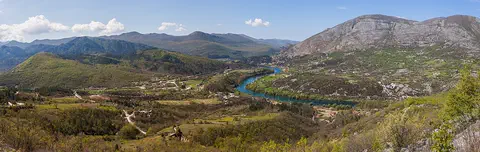
Bosnia and Herzegovina is a mountainous country in southeastern Europe. It has forests, limestone hills and many rivers, and famous old stone bridges cross some of them. Its capital is Sarajevo. It touches the Adriatic Sea along only about 20 kilometers of coast.
-
 Watch
 Country
Slovakia
Slovakia is a landlocked country in central Europe. The Carpathian Mountains cover much of it, with the High Tatras in the north, and about 5.4 million people lived there at the end of 2025. Its capital, Bratislava, sits on the Danube River.
-
 Watch
 Country
Greece
Greece is a country in southern Europe, at the bottom of the Balkan Peninsula, with sea on three sides and more than 2,000 islands. Most of it is mountains. About 10.4 million people lived there at the start of 2025, and its capital is Athens, a city with ruins more than 2,400 years old.
-
 Watch
Natural wonder
Ural Mountains
The Ural Mountains run about 2,500 kilometers from north to south through Russia, and they form most of the traditional boundary between Europe and Asia. They are very old mountains that have been worn down over a very long time; their highest peak, Mount Narodnaya, is 1,895 meters tall. The Urals stretch from icy Arctic tundra to dry steppe and are rich in metals and gems.
-
 Watch
 Country
Georgia
Georgia is a country at the eastern end of the Black Sea, below the high, icy Greater Caucasus mountains. It has warm, wet coasts, dry eastern plains and old monasteries, and about 3.9 million people lived there at the start of 2026.
-
 Watch
 Country
Finland
Finland is a northern European country covered mostly by forest and dotted with tens of thousands of lakes. About a third of it lies north of the Arctic Circle, where the summer sun shines all night. About 5.7 million people live there, most of them in the south.
Explore next
-
 Watch
Animal
Polar bear
The polar bear is a huge bear that lives on the frozen sea of the Arctic. Thick fur and a layer of fat keep it warm, its amazing nose finds seals under the snow, and it can swim for many hours. It needs sea ice to hunt, so a warming Arctic is a big problem for it.
-
 Watch
Animal
American black bear
The American black bear is the most common bear in North America. It lives mostly in forests, climbs trees with its short, curved claws, eats mainly plants, and spends the winter in a den. Not all black bears are black: some are brown, cinnamon, blue-gray or even white.
-
 Watch
3D
Animal
Sockeye salmon
The sockeye salmon is a Pacific salmon that usually grows up in a lake, spends a few years in the North Pacific Ocean, and then returns to the place it hatched to lay its eggs. On the way home it turns bright red with a green head.
-
 Watch
Animal
Moose
The moose is the largest member of the deer family. It lives in northern forests, wades and even dives into lakes to eat water plants, and bull moose grow enormous new antlers every year. In Europe it is called an elk.
-
 Watch
3D
Animal
Gray wolf
The gray wolf is the largest member of the dog family and the wild ancestor of pet dogs. Wolves live in family packs that hunt big animals like elk and moose together, and their howls can carry about 10 kilometers. After being wiped out in many places, wolves are coming back in parts of North America and Europe.
-
Watch
Country
Slovenia
Slovenia is a small country in central Europe where the Alps meet the Mediterranean. Forests cover much of the land, the Karst region is full of caves and underground rivers, and about 2.1 million people lived there in 2026.
-
Watch
Country
Russia
Russia is the largest country in the world. It stretches across eastern Europe and all of northern Asia, through 11 time zones, from the Baltic Sea to the Pacific Ocean. It has frozen tundra, huge forests, Lake Baikal and the big cities of Moscow and Saint Petersburg.
-
Watch
Natural wonder
Banff National Park
Banff National Park lies in the Rocky Mountains of Alberta, in western Canada. It began in 1885 around a group of hot springs, which makes it Canada's first national park. Today it covers 6,641 square kilometers of jagged peaks, glaciers, forests and turquoise lakes such as Lake Louise and Moraine Lake, and it is home to grizzly bears, wolves, elk and many more animals.
For parents & teachers
What children will learn
- Describe how the brown bear's body (hump, claws, nose) helps it find food.
- Explain what an omnivore is and how a bear's diet changes with the seasons.
- Describe winter denning and how it differs from true hibernation.
- Understand why brown bears have disappeared from many countries and how people share land with them.
Recommended ages: 3 to 17 · About 15 minutes
Talk about it
- Why might a bear eat only the fattiest parts of a salmon once it is no longer very hungry?
- What would you need to do to get ready for a winter with no food?
- How can people who camp or live near bears keep both people and bears safe?
Try at home or in class
- Make a seasonal bear menu: draw four boxes for spring, summer, fall and winter and fill each with what a brown bear eats then.
- Count your heartbeats for one minute sitting still, then compare with a sleeping bear's 10 beats a minute.
Key vocabulary: omnivore, den, hibernation, subspecies, carrion, salmon run
Where these facts come from
- The IUCN Red List of Threatened Species , International Union for Conservation of Nature (IUCN terms of use (no redistribution of Red List data or range maps))
- GBIF Backbone Taxonomy and GBIF Occurrence Search , Global Biodiversity Information Facility (CC0 1.0 (backbone); occurrence counts are facts derived from records under CC0, CC BY and CC BY-NC)
- Brown bear , San Diego Zoo Wildlife Alliance
- Brown Bear Species Profile , Alaska Department of Fish and Game
- Ursus arctos (Brown Bear), 2016 global assessment , IUCN Red List of Threatened Species
- Wikidata , Wikimedia Foundation (CC0 1.0)
- Wikimedia Commons , Wikimedia Foundation (Per file: Public domain, CC0, CC BY or CC BY-SA only (credited on each page))
Checked, not yet human-reviewed. Last updated October 28, 2026. Spotted a mistake? Tell us.