
 Country
Europe
Monaco
Monaco is a tiny country by the sea. The whole country is one small, crowded town on hills by the sea.
Monaco is a very small country on the Mediterranean coast, with France all around it on land. It covers just over 2 square kilometers, about 38,900 people lived there at the end of 2025, and it has been ruled by princes of the Grimaldi family since 1297.
Monaco is a sovereign principality of 208 hectares on the Côte d'Azur, bordered on land only by France. Its statistics institute counted 38,857 residents of 144 nationalities on 31 December 2025, a density of 18,681 people per square kilometer, and the Grimaldi family has reigned there, with interruptions, since 1297.
Photo: Tobi 87, CC BY-SA 3.0, via Wikimedia Commons
Discover Monaco
Monaco is a very small country.
It sits by the blue Mediterranean Sea. France is all around it on land. Tall buildings crowd onto the hills. A prince is the head of the country.
Monaco is one of the smallest countries in the world. It lies on the Mediterranean coast of Europe, between the French city of Nice, about 15 kilometers to the west, and the Italian border, about 8 kilometers to the east. On land, France surrounds it completely.
The whole country covers about 2 square kilometers. Of all the independent countries, only Vatican City is smaller. About 38,900 people lived in Monaco at the end of 2025, packed onto a set of hills and a rocky headland above the sea. Monaco is a principality: its head of state is a prince.
Monaco is a sovereign principality on the Côte d'Azur (French Riviera). Its territory, 208 hectares according to Monaco Statistics (IMSEE), occupies densely built hills and a headland facing south over the Mediterranean; among independent states only Vatican City, at 0.44 square kilometers, is smaller. The principality is a single administrative unit, so no separate capital is distinguished within it.
IMSEE's register-based census counted 38,857 residents on 31 December 2025, 434 more than a year earlier (+1.1 percent), with an average density of 18,681 people per square kilometer. Monaco is a constitutional monarchy: Prince Albert II has been head of state since 2005, legislative power is shared between the prince and the elected National Council, and the government is led by a minister of state. Monaco joined the United Nations in 1993 and uses the euro, although it is not a member of the European Union.
The Rock, the harbor and famous places
The old town sits on a big rock by the sea.
The prince's palace is there. A big museum about the sea is there too. Boats fill the harbor below.
Monaco has several districts. Monaco-Ville, known as "the Rock," is the old town on a headland that juts into the sea. The Prince's Palace stands there, and so does the Oceanographic Museum, a museum all about the ocean, built in 1910.
La Condamine, beside the natural harbor, is the business district, Monte-Carlo is the district where the most people live, and Fontvieille is a newer area. In December 2024 a brand-new district called Mareterra opened.
Britannica describes four historic quarters: Monaco-Ville, "the Rock," a headland carrying the old town; La Condamine, the business district on the west of the bay with its natural harbor; Monte-Carlo; and the newer zone of Fontvieille, where light industries developed. Since 2013 the territory has been divided by Sovereign Order into seven ordered districts plus two reserved sectors. Monte-Carlo, with 8,318 residents in 2025, is the most populous; Monaco-Ville, with 1,022, is the least.
On the Rock stand the Roman Catholic cathedral, the prince's Genoese and Renaissance palace (the Place du Palais is 62.2 m above sea level) and the Oceanographic Museum, built in 1910. Monaco has also grown seaward: its government says about 40 hectares have been reclaimed from the sea, the first caisson of the Anse du Portier extension was laid in 2018, and the new Mareterra district was inaugurated on 4 December 2024.
Hills, sea and sunshine
Monaco is built on hills by the sea.
Winters are mild. Summers are hot and sunny. It does not rain very often. The sea is right at the bottom of the hills.
Monaco is squeezed between hills and the sea. At its longest it is only about 3.3 kilometers, and at its widest just over 1 kilometer. Its coast is less than 5 kilometers long.
Monaco has a Mediterranean climate, with mild winters, hot summers and plenty of sunshine. The average temperature over the year is about 16 °C: about 10 °C in January and about 24 °C in August. Rain falls on only about 60 days a year. A breakwater and a sea wall shelter the Bay of Monaco from strong winds from the east and west.
Monaco's territory is a set of densely clustered hills and a headland looking south over the Mediterranean. According to Monaco en chiffres 2026, the coastline outside the ports and beaches is 4,856 m long and the land border with France 5,469 m, shared with the French communes of Cap-d'Ail, La Turbie, Beausoleil and Roquebrune-Cap-Martin. The greatest length is 3,344 m and the greatest width 1,140 m. The highest point on the ground, 164.5 m, is at the access to the Patio Palace on the D6007 road.
The climate is mild Mediterranean: Britannica gives an annual average of about 16 °C, monthly averages from about 10 °C in January to 24 °C in August, and only about 60 days of rain a year. The government notes that a breakwater and a semi-floating sea wall shelter the Bay of Monaco from strong easterly and westerly winds.
Life under the sea
Monaco has special places in the sea.
There, sea plants grow like a green meadow. Red coral and sea urchins live on the rocks. Fish called groupers swim there too.
Monaco protects two areas of its sea. The first, the Larvotto marine protected area, was set up in 1975. Its sea floor is covered by a thick meadow of Posidonia, a kind of seagrass, and the seagrass meadow is listed as a wetland of international importance.
A second protected area, the Tombant des Spélugues, was created in 1986 on an underwater cliff. Red coral, sponges and diadem sea urchins live on its rocks, and fish such as groupers live there.
Monaco protects two marine areas. The Larvotto marine protected area, created in 1975 on the initiative of Prince Rainier III, covers 33.6 hectares at depths of 0 to 39 m; its sea floor is mainly a dense meadow of Posidonia oceanica seagrass, with several submerged artificial reefs, and the seagrass part is a Ramsar site, a wetland of international importance. The Tombant des Spélugues, protected since 1986, covers 1.9 hectares at 0 to 42 m on a submerged rock face covered with coralligenous formations: communities of animals and plants fixed to hard rock.
Monaco en chiffres 2026 lists emblematic Mediterranean species there, including red coral, sponges, diadem urchins and several kinds of prized fish, among them groupers. Monaco is also a party to CITES, the Washington Convention on international trade in endangered species.
People and languages
About 38,900 people live in Monaco.
They come from many different countries. Most people speak French. Children learn the old Monegasque language at school.
About 38,900 people lived in Monaco at the end of 2025, and they hold 144 different nationalities. About a quarter are Monegasque citizens; the next largest groups are French and Italian.
French is the official language, and many people also speak English and Italian. Monaco also has its own traditional language, Monegasque. Today it is spoken mostly by older people, but children learn it in school: Prince Rainier III made it a required subject in state primary schools in 1976. Roman Catholicism is the state religion, and freedom of religion is guaranteed.
IMSEE's 2025 census report counts 144 nationalities among 38,857 residents. Monegasques, 9,333 people or 24.0 percent, have been the largest group since 2023, followed by French (8,270) and Italian (7,559) nationals, then more than 3,000 Britons. Some residents hold several nationalities, so the shares sum to more than 100 percent. The French share has fallen from nearly 60 percent in 1962 to 21.3 percent; women make up 50.8 percent of residents.
French is the official language, and English and Italian are widely spoken. The Monegasque language is used mainly by older people; Prince Rainier III made it compulsory in state primary schools from 1976 and in public schools from 1988, and it is now compulsory up to the end of middle school. Roman Catholicism is the state religion and freedom of religion is guaranteed, and the government notes that many faiths are practiced.
Seven centuries of princes
People lived in Monaco in the Stone Age.
Long ago, people from far away knew its rocky point. The same family has ruled Monaco for hundreds of years. Today Prince Albert II is its head.
People lived in Monaco as far back as the Stone Age, and long ago Phoenicians, Greeks and Romans knew its rocky headland. In 1191 people from Genoa, in Italy, took possession of it, and in 1297 the Grimaldi family began to rule. The Grimaldi family has ruled Monaco for most of the time since then, with a few breaks.
In 1861 a treaty with France restored Monaco's independence. In the 1900s Monaco opened its Oceanographic Museum, protected its sea and joined the United Nations in 1993. Prince Albert II has been head of state since 2005.
Evidence of Stone Age settlement is kept in Monaco's Museum of Prehistoric Anthropology, and the headland was known to Phoenicians, Greeks, Carthaginians and Romans. Genoa took possession of it in 1191, and the long reign of the Grimaldi family began in 1297. The Grimaldis allied themselves with France except from 1524 to 1641, when they were under Spanish protection. In 1793 the French Revolutionary regime dispossessed them and annexed Monaco; they returned after Napoleon's fall, and the Congress of Vienna (1815) placed Monaco under Sardinian protection.
Monaco lost Menton and Roquebrune in 1848 and ceded them to France in the Franco-Monegasque treaty of 1861, which restored its independence; a customs union followed in 1865. A 1911 constitution created an elected National Council, and a new constitution was granted in 1962. A 2002 revision added women and their children to the line of succession. Monaco joined the UN in 1993 and replaced the French franc with the euro by 2002. Prince Rainier III, who marked 50 years on the throne in 1999, died in 2005 and was succeeded by his son Albert II.
Monaco on the map
Find Monaco on the globe.
Look at the south coast of France, by the Mediterranean Sea. Monaco is a tiny spot there. Italy is very close by.
Monaco is in southern Europe, on the Mediterranean coast between France and Italy. On land it touches only France; to the south is the open sea. The French city of Nice is about 15 kilometers to the west, and the Italian border is about 8 kilometers to the east.
Monaco is so small that on most maps of Europe it is just a dot. Its whole land border with France is about 5.5 kilometers long, a little longer than its coast.
Monaco lies on the Côte d'Azur, about 15 km east of Nice and 8 km west of the Italian border, with France as its only land neighbor. The Oceanographic Museum, a reference point in the official figures, stands at 43°43'49" N, 7°25'36" E. IMSEE gives a land border of 5,469 m, divided among the French communes of Cap-d'Ail, La Turbie, Beausoleil and Roquebrune-Cap-Martin, and a coastline of 4,856 m outside the ports and beaches; maritime boundaries make up 41.2 percent of the total boundary length and the land border 58.8 percent.
The territory stretches 3,344 m at its longest and 1,140 m at its widest. The ground rises from the sea to 164.5 m at its highest point, at the access to the Patio Palace on the D6007 road; the highest built point, at the top of the Tour Odéon, is 232.4 m above sea level, higher than any natural ground in the country.
- Area
- 208 hectares (about 2.08 km²)
- Land border (all with France)
- 5,469 m
- Coastline (outside ports and beaches)
- 4,856 m
- Greatest length and width
- 3,344 m long, 1,140 m wide
- Highest point on the ground
- 164.5 m
Amazing facts
-
Monaco is about 3 kilometers long.
At its longest, Monaco measures only about 3.3 kilometers, and at its widest just over 1 kilometer.
Monaco en chiffres 2026 gives the principality's greatest length as 3,344 m and its greatest width as 1,140 m, for a total area of 208 hectares.
-
A tall building in Monaco is higher than its highest hill.
The highest built point in Monaco, the top of the Tour Odéon tower, is 232.4 meters above the sea, while the highest natural ground is only 164.5 meters.
The highest built point in Monaco, the Tour Odéon, stands at 232.4 m above sea level, about 68 m above the highest point on the ground (164.5 m).
-
People from 144 countries live in Monaco.
Monaco's 2025 census counted 144 different nationalities among fewer than 39,000 residents.
IMSEE's 2025 census counted 144 nationalities among 38,857 residents; Monegasques, at 24.0 percent, are the largest group.
-
Monaco counted its people long ago, in 1757.
Monaco held its first census, a count of everyone who lives there, in 1757.
Monaco's census dates back to 1757; since 2023 it has been register-based, built from administrative records and updated every year.
-
Children in Monaco learn an old language at school.
Monaco's own language, Monegasque, has been a required school subject in state primary schools since 1976.
Prince Rainier III made Monegasque compulsory in state primary schools from 1976 and in public schools from 1988; pupils from the last year of primary school to the end of high school can enter a Monegasque language competition each May.
Words to know
- principality
- a country whose head of state is a prince
- headland
- a high point of land that sticks out into the sea
- seagrass
- a flowering plant that grows in meadows on the sea floor
- marine protected area
- a part of the sea where nature is protected by law
- census
- an official count of all the people who live in a place
- land reclamation
- making new dry land where there was water before
- nationality
- the country a person officially belongs to as a citizen
Discovery challenge
-
Which country is all around Monaco on land?
Which country is Monaco's only neighbor on land?
Monaco's 5,469-meter land border is shared with which single country?
- Spain
- France
- Germany
Show the answer
France
France is all around Monaco on land. The sea is on the other side.
France surrounds Monaco on land; the Mediterranean Sea lies to the south.
The whole land border runs with France, through the communes of Cap-d'Ail, La Turbie, Beausoleil and Roquebrune-Cap-Martin.
-
Who is the head of Monaco?
Monaco is a principality. Who is its head of state?
In Monaco's constitutional monarchy, who has been head of state since 2005?
- A president
- A prince
- A queen
Show the answer
A prince
A prince is the head of Monaco. His name is Albert.
Monaco's head of state is a prince. Prince Albert II, of the Grimaldi family, has led Monaco since 2005.
Prince Albert II succeeded Prince Rainier III in 2005; legislative power is shared between the prince and the elected National Council.
-
What grows like a green meadow in Monaco's sea?
What covers the sea floor in Monaco's Larvotto marine protected area?
Which habitat makes the Larvotto marine protected area a Ramsar site?
- Seagrass
- Cactus
- Ice
Show the answer
Seagrass
Seagrass grows like a green meadow under the sea.
A thick meadow of Posidonia seagrass covers the sea floor at Larvotto, protected since 1975.
The dense Posidonia oceanica meadow at Larvotto is listed under the Ramsar Convention as a wetland of international importance.
-
Which language do most people in Monaco use?
What is the official language of Monaco?
Which language is official in Monaco, alongside the traditional Monegasque taught in schools?
- Russian
- French
- Arabic
Show the answer
French
Most people in Monaco speak French.
French is Monaco's official language, and many people also speak English and Italian.
French is the official language; Monegasque has been compulsory in state primary schools since 1976.
-
Which country is even smaller than Monaco?
Monaco covers about 2 square kilometers. Which country is smaller still?
Which is the only independent country smaller than Monaco's 2.08 square kilometers?
- Vatican City
- Malta
- Italy
Show the answer
Vatican City
Vatican City is even smaller than Monaco.
Vatican City, inside Rome, covers just 0.44 square kilometers, so it is smaller than Monaco.
Vatican City, at 0.44 km², is the only independent state smaller than Monaco; Malta covers about 316 km².
Places to discover in Monaco
Explore next
-
 Watch
 Country
France
France is a country in northwestern Europe, between the Atlantic Ocean and the Mediterranean Sea. It has high mountains such as the Alps and the Pyrenees, long rivers such as the Loire and the Seine, and about 69.1 million people (2026). Its capital is Paris.
-
 Watch
 Country
Vatican City
Vatican City is the smallest independent country in the world, just 0.44 square kilometers in the middle of Rome, Italy. It is the home of the Pope, who leads the Catholic Church, and it holds famous buildings and art such as St. Peter's Basilica and the Sistine Chapel.
-
 Watch
Natural wonder
Alps
The Alps are Europe's great mountain range, an arc about 1,200 kilometers long that runs from the Mediterranean coast near Nice, in France, to Vienna, in Austria. Their highest peak is Mont Blanc, which Britannica gives as 4,807 meters. The Alps rose when the plate carrying Africa pushed north into Europe, and Ice Age glaciers carved their sharp peaks and deep valleys.
- Watch Geography Population density Population density tells you how crowded a place is. You find it by dividing the number of people by the area of land they live on, usually as people per square kilometer. Among countries, World Bank figures for 2024 range from more than 18,000 people per square kilometer in Monaco to about 2 in Mongolia. People cluster where there is water, farmland and work, and leave harsh places almost empty.
- Watch Geography National parks and protected areas Countries set aside land and sea as national parks and other protected areas, so that wildlife, forests, reefs and wonderful landscapes are looked after. Yellowstone became the first national park in 1872. Today about 18 percent of the world's land is protected, and countries have agreed to aim for 30 percent by 2030.
-
 Watch
 Country
San Marino
San Marino is a very small country on the slopes of Mount Titano, completely surrounded by Italy. It is one of the oldest republics in the world, and its capital, with walls and fortress towers, sits high on the mountain. About 34,000 people live there.
-
 Watch
 Country
Belarus
Belarus is a landlocked country in eastern Europe. Ice sheets of the last ice age shaped its low hills and wide plains, it has more than 10,000 lakes and one of Europe's largest wetlands, and about 9.1 million people lived there in 2025.
-
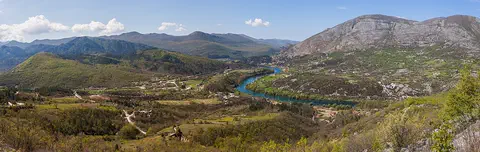 Watch
 Country
Bosnia and Herzegovina
Bosnia and Herzegovina is a mountainous country in southeastern Europe. It has forests, limestone hills and many rivers, and famous old stone bridges cross some of them. Its capital is Sarajevo. It touches the Adriatic Sea along only about 20 kilometers of coast.
For parents & teachers
What children will learn
- Locate Monaco on the Mediterranean coast and name its only land neighbor.
- Compare Monaco's size and population density with a place the child knows, using real numbers.
- Explain what a marine protected area is and what Monaco protects in its sea.
- Outline Monaco's history, from the Grimaldi family in 1297 to joining the UN in 1993.
Recommended ages: 3 to 17 · About 15 minutes
Talk about it
- Monaco is about 3.3 kilometers long. What places near you are about that far apart?
- Monaco has built new land out into the sea. What do you think people should think about before doing that?
- People of 144 nationalities live in Monaco. What might children learn from classmates who come from other countries?
Try at home or in class
- On a map of your town, mark a rectangle about 3.3 kilometers long and 1.1 kilometers wide to see how big Monaco is.
- Count everyone who lives in your home and everyone on your street, like a small census, and make a simple chart.
Key vocabulary: principality, headland, seagrass, marine protected area, census, land reclamation, nationality
Where these facts come from
- Wikidata , Wikimedia Foundation (CC0 1.0)
- Natural Earth vector data , Natural Earth (NACIS) (Public domain)
- Population census (2025 population) , Monaco Statistics (IMSEE)
- 2025 Population Census report (May 2026) , Monaco Statistics (IMSEE)
- Monaco en chiffres 2026, chapitre 1: Territoire et environnement , Monaco Statistics (IMSEE)
- Monaco , Encyclopaedia Britannica
- Vatican City , Encyclopaedia Britannica
- Destination Monaco , Embassy of Monaco in the United Kingdom (Government of Monaco)
- Monegasque language , École des Révoires (Government of Monaco)
- PlayOwl region table, version 1 , PlayOwl (PlayOwl original data)
- flag-icons 7.5.0 , Panayiotis Lipiridis and contributors (MIT)
- Wikimedia Commons , Wikimedia Foundation (Per file (public domain, CC0, CC BY or CC BY-SA); see each media record)
Checked, not yet human-reviewed. Last updated October 24, 2026. Spotted a mistake? Tell us.