
 Country
Asia
Oman
Oman is a hot, sunny country in Arabia. It has rocky mountains, big deserts and long beaches. Its sailors once sailed very far.
Oman is a country on the southeastern corner of the Arabian Peninsula, with long coasts on the sea and the huge Empty Quarter desert inland. People have watered their farms with ancient channels called aflaj for more than 2,000 years, and Oman was famous for frankincense. About 5.4 million people lived there in 2026.
Oman, a sultanate at the junction of the Persian Gulf and the Arabian Sea, combines the rugged Hajar Mountains, the monsoon-watered Dhofar coast and the sands of the Rub' al-Khali. Once an Indian Ocean maritime power and long a source of frankincense, it holds five UNESCO World Heritage Sites and had about 5.4 million people in mid-2026 (National Centre for Statistics and Information).
Photo: Davide Mauro, CC BY-SA 4.0, via Wikimedia Commons
Discover Oman
Oman is a country in Arabia.
The sea is on two sides. Inland there are mountains and a big sandy desert. The capital city is called Muscat.
Oman sits on the southeastern corner of the Arabian Peninsula, where the Persian Gulf meets the Arabian Sea. It has long coasts, rugged mountains and, inland, part of the Rub' al-Khali, the Empty Quarter, one of the great sand deserts.
It is hot almost everywhere, and very little rain falls. Muscat, the capital, lies on the northern coast between the sea and the mountains. About 5.4 million people lived in Oman in 2026, and about half of Oman's people are under 30.
Oman lies at the confluence of the Persian Gulf and the Arabian Sea. Much of the interior falls within the Rub' al-Khali, a sandy, treeless and largely waterless region now crossed by oil and gas pipelines, while the coasts are far more hospitable: the fertile Al-Batinah plain in the north and the Dhofar region in the south. A small exclave on the Musandam Peninsula gives Oman its only Persian Gulf frontage, and the main shipping lanes of the Strait of Hormuz lie in its territorial waters.
Oman's National Centre for Statistics and Information counted about 5,398,645 people at the end of June 2026, Omanis and foreign residents together; about half are under 30. Oman is a sultanate ruled by the Al Bu Said dynasty; Sultan Haitham bin Tariq has reigned since January 2020.
Cities and famous places
Muscat is the capital city.
It sits between the sea and the mountains. Old forts made of stone and mud stand in Oman. Long ago, ships sailed from its ports.
Muscat and its neighbor Matrah are old ports that have grown together into one big city. Muscat's market, or souk, is full of things made by Omani craftspeople, such as silver jewelry and carved wood.
Oman has many old forts. Bahla Fort, built of mud brick on stone, is a World Heritage Site. On the east coast, the old port of Qalhat traded dates, horses and pearls 500 to 1,000 years ago. In the far south, near the city of Salalah, are the ruins of ports that once shipped frankincense.
Muscat and Matrah, both ancient ports, have merged into one metropolitan area at the eastern end of Al-Batinah, the most densely populated part of the country, home to about one-fourth of the population. Sur, farther east, is still known for fishing and boatbuilding, and Salalah is the provincial capital of Dhofar.
UNESCO lists five sites in Oman. Bahla Fort (1987), with walls and towers of mud brick on stone foundations, was capital of the Banu Nebhan from the 12th to the late 15th century. The prehistoric settlements of Bat, Al-Khutm and Al-Ayn were inscribed in 1988. The Land of Frankincense (2000) includes the ports of Khor Rori and Al Baleed, the inland outpost of Shisr and the frankincense trees of Wadi Dawka. The Aflaj Irrigation Systems (2006) represent more than 3,000 working channels, and the Ancient City of Qalhat (2018) was a port of the Kingdom of Hormuz from the 11th to 16th centuries.
Mountains, deserts and a monsoon
Oman is very hot in summer.
It hardly ever rains. Tall, rocky mountains run along the north. In the south, summer winds bring rain.
The Hajar Mountains run along the north of Oman, parallel to the coast. Their highest peak, Jebel Shams, whose name means Sun Mountain, is the highest point in the country. Inland, the land drops away into the sands of the Empty Quarter.
Oman has no lakes or rivers that last all year. Rain is rare, about 100 millimeters a year on average, a little more in the mountains. In summer Muscat often reaches 43 °C. Far to the south, in Dhofar, summer monsoon winds water the coastal plain and wooded mountains and keep the city of Salalah milder.
Northern Oman has three main zones: the long Al-Batinah coastal plain on the Gulf of Oman; the high Hajar Mountains, much of them above 1,460 m, running from Musandam to near Cape al-Hadd, the easternmost tip of Arabia, and split by the Wadi Samail; and an inland plateau falling southwest into the Rub' al-Khali. Jebel Shams is the country's highest point. Dhofar, separated from the north by hundreds of kilometers of desert, has a fertile coastal plain behind which wooded mountains rise to about 1,500 m.
There are no permanent bodies of fresh water; streams run only after storms. Rainfall averages only about 100 mm a year. Muscat often reaches 43 °C in summer with high humidity, and winter lows average about 17 °C. The southwest summer monsoon makes Salalah's climate more temperate than the north's. Because rain is so scarce, farming depends on aflaj, ancient channels, often underground, that carry water from wells near the mountains.
Animals of Oman
White antelopes called Arabian oryx live in Oman's desert.
They have long, straight horns. Sea turtles swim along the coast. Lots of birds visit too.
The Arabian oryx is a white antelope with long, straight horns. It died out in the wild in 1972, but oryx bred in captivity were returned to Oman's desert in 1982, and today they live in protected areas. Oman's government protects rare plants and animals in nature reserves.
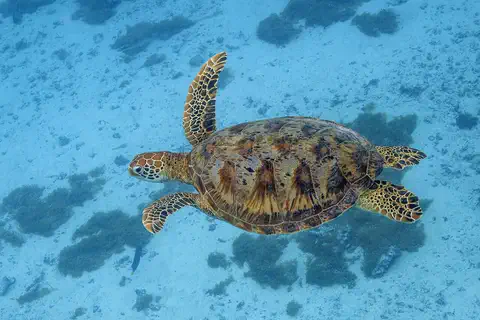
Green sea turtles and hawksbill turtles swim in the warm seas off Oman. The country also has a great many kinds of birds. Britannica calls Oman's birdlife extraordinarily varied.
Vegetation is sparse outside irrigated land, and acacias make up most of it. Plant species are protected in nature preserves, the government also protects rare animal species, and Britannica calls Oman's birdlife extraordinarily diverse.
UNESCO records that the Arabian oryx became extinct in the wild in 1972 and was reintroduced in Oman in 1982, forming the first free-ranging herd since then; the IUCN Red List lists Oman among the countries where captive-bred oryx have been returned. The Arabian Oryx Sanctuary, inscribed as a World Heritage Site in 1994, became in 2007 the first site ever deleted from the List, after Oman reduced the protected area by 90 percent. Offshore, the IUCN ranges of the green and hawksbill sea turtles include Oman's waters.

People, languages and food
About 5.4 million people live in Oman.
Most people speak Arabic. A favorite meal is rice with lamb or fish, and dates. After the meal, some families burn sweet-smelling frankincense.
About 5.4 million people lived in Oman in 2026. Arabic is the official language, and many people also speak English, Persian, Urdu or Swahili. Many people from South Asia and other countries live and work in Oman, especially in Muscat.
A typical meal is rice with spiced lamb or fish, dates, and coffee or tea. Frankincense, which comes from trees that grow in Oman, is often burned at the end of a meal. Popular sports include football and traditional races of camels and of wooden sailing boats called dhows.
More than half of Oman's population is Arab; Baloch families live near the Al-Batinah coast, and Muscat-Matrah has long had Persian and South Asian communities, among them the Liwatiyyah, originally from Sindh. The jibalis of the Dhofar mountains speak older South Arabian dialects, quite different from the North Arabian–derived dialects elsewhere. Arabic is official, and English, Persian, Urdu and Swahili are also spoken. The great majority of Omanis are Muslims, most of them Ibadi, a branch close to Sunni Islam in belief and ritual; there are also Sunni and Shia Muslims and a few Hindus. Since the 1980s, a policy called Omanization has aimed to reduce reliance on foreign workers.
Meals center on rice, spiced lamb or fish, dates and coffee or tea, with frankincense, native to Oman, burned afterward. Many men wear the dishdashah, a woven cotton robe, with a light turban. Artisans are known for woodcarving, weaving and silver- and goldsmithing. Dhow racing, camel racing and Arabian horse racing are popular, and Oman first competed at the Olympics in 1984.
Sailors, forts and sultans
People have lived in Oman for a very long time.
Long ago, they dug channels to bring water to their farms. Omani sailors sailed across the ocean to trade. Sultans have ruled Oman for a long time.
Signs of early towns in Oman go back more than 4,000 years. More than 2,000 years ago, water channels called aflaj began to carry water to farms, and many still work today. In the south, frankincense from Oman's trees was traded far and wide.
Omani sailors traveled across the Indian Ocean, reaching as far as China by the 1400s. Portugal controlled the coast from 1507 until 1650. In 1749 a new ruling family, the Al Bu Said, came to power, and it still rules today. From 1970 Sultan Qaboos bin Said opened up the country and modernized it quickly, and Sultan Haitham bin Tariq has ruled since 2020.
Archaeological evidence of civilization in Oman goes back to about the 3rd millennium BCE, and Persian colonization before the 1st century CE established the falaj system. Islam arrived in the 7th century, and the Ibadi imamate, under an elected imam, unified Oman from the 8th century. Omani sailors ranged as far as China by the 15th century. The Portuguese sacked Muscat in 1507 and held the coast until the Ya'rubid dynasty recaptured Muscat in 1650.
Ahmad ibn Said expelled a Persian occupation and was elected imam in 1749, founding the Al Bu Said dynasty. Under Said ibn Sultan (1806/07–56) Oman also ruled Zanzibar. In the 20th century the country was slow to modernize; after a rebellion in Dhofar, Sultan Said was overthrown by his son Qaboos bin Said in a palace coup on July 23, 1970, and the Dhofar rebellion ended in December 1975. Qaboos ended his father's isolation and rapidly developed the country. He died on January 10, 2020, and Haitham bin Tariq succeeded him.
Oman on the map
Find Oman on the globe.
It is on the edge of Arabia, by the sea. One small piece of Oman is far to the north. It sits beside a narrow strait.
Oman is on the southeastern edge of the Arabian Peninsula. Yemen lies to the southwest, Saudi Arabia to the west and the United Arab Emirates to the northwest. The Gulf of Oman is to the north and the Arabian Sea to the east and south.
A small piece of Oman, the tip of the Musandam Peninsula, lies apart from the rest, on the narrow Strait of Hormuz. Oman also has islands, such as Masirah off the east coast.
Britannica gives Oman's boundaries as Yemen to the southwest, the Arabian Sea to the south and east, the Gulf of Oman to the north, the United Arab Emirates to the northwest and Saudi Arabia to the west. The exclave of Ru'us al-Jibal, at the northern tip of the Musandam Peninsula, faces the Strait of Hormuz and gives Oman its only Persian Gulf frontage; Khasab is its only significant town.
Offshore territories include Masirah Island to the east and Al-Hallaniyah, the largest of the five Khuriya Muriya Islands, 40 km off the south coast. Dhofar, in the southwest, is separated from northern Oman by several hundred kilometers of open desert.
- Average rainfall
- about 100 mm a year
- Muscat in summer
- often 43 °C
- Working aflaj
- more than 3,000
- People (end of June 2026)
- 5,398,645
Amazing facts
-
Oman has old water channels that still work.
More than 3,000 aflaj, channels that carry water to villages and farms, still work in Oman.
UNESCO's Aflaj Irrigation Systems site represents more than 3,000 still functioning aflaj, which deliver groundwater, spring water or surface water through underground or surface channels.
-
Frankincense trees grow in Oman.
Frankincense comes from trees that grow in Oman, and many families burn it at the end of a meal.
Frankincense is native to Oman, and burning it at the end of a meal is a common custom.
-
Omani sailors sailed all the way to China long ago.
By the 1400s, Omani sailors were traveling across the Indian Ocean as far as China.
Largely cut off from the rest of Arabia by deserts, Omani sailors ranged as far as China by the 15th century.
-
Oman had the first World Heritage Site ever taken off the list.
In 2007, Oman's Arabian Oryx Sanctuary became the first place ever removed from UNESCO's World Heritage List.
Inscribed in 1994, the Arabian Oryx Sanctuary was delisted in 2007, the first World Heritage property ever removed from the List.
Words to know
- falaj
- a channel, often underground, that carries water to villages and farms in Oman; more than one are called aflaj
- frankincense
- a sweet-smelling dried tree sap that is burned as incense
- sultanate
- a country ruled by a sultan, a Muslim king
- monsoon
- a wind that changes direction with the seasons and can bring rain
- exclave
- a part of a country that is separated from the rest of it
- dhow
- a traditional wooden sailing boat of the Arabian Sea and Indian Ocean
Discovery challenge
-
What is the capital city of Oman?
Which city is the capital of Oman?
Which ancient port, now merged with Matrah, is Oman's capital?
- Doha
- Muscat
- Riyadh
Show the answer
Muscat
Muscat is the capital of Oman.
Muscat is the capital. Doha is in Qatar and Riyadh is in Saudi Arabia.
Muscat and Matrah, both ancient ports, have merged into one metropolitan area.
-
Which sweet-smelling tree sap comes from Oman?
Which sweet-smelling tree resin, traded for centuries, comes from Oman?
Which resin from Boswellia sacra gave its name to a UNESCO site in Dhofar?
- Maple syrup
- Rubber
- Frankincense
Show the answer
Frankincense
Frankincense comes from trees in Oman.
Frankincense from Oman's trees was traded for many centuries through ports like Khor Rori and Al Baleed.
The Land of Frankincense (2000) includes the Boswellia sacra trees of Wadi Dawka and the trading ports and outpost that shipped the resin.
-
What do Oman's aflaj carry?
What do the aflaj of Oman carry to villages and farms?
What do aflaj, Oman's ancient channel systems, deliver?
- Water
- Oil
- Sand
Show the answer
Water
Aflaj carry water to the farms.
Aflaj carry water from springs and underground to villages and farms; more than 3,000 still work.
They collect groundwater, spring water or surface runoff and deliver it for domestic and agricultural use.
-
What is the name of the big desert in Oman?
Which huge sand desert covers much of Oman's interior?
Which desert, shared with Saudi Arabia and Yemen, covers much of Oman's interior?
- The Gobi
- The Empty Quarter
- The Sahara
Show the answer
The Empty Quarter
The big desert is called the Empty Quarter.
The Rub' al-Khali, or Empty Quarter, covers much of inland Oman.
The Rub' al-Khali, shared with Saudi Arabia and Yemen, is sandy, treeless and largely waterless.
-
Which white antelope was brought back to Oman's desert?
Which desert antelope, bred in captivity, was returned to the wild in Oman in 1982?
Which antelope, Oryx leucoryx, lives in Oman today because captive-bred animals were reintroduced?
- Arabian oryx
- Giant panda
- Polar bear
Show the answer
Arabian oryx
The Arabian oryx came back to Oman's desert.
The oryx died out in the wild in 1972; captive-bred oryx were returned to Oman in 1982.
The IUCN records Oman among the countries where captive-bred Arabian oryx were reintroduced.
Animals of Oman
-
Watch
Animal
Arabian oryx
The Arabian oryx is a white desert antelope with long, straight horns and a black-and-white face. Hunting wiped it out in the wild, but animals kept in zoos were bred and returned to the deserts of Arabia. Today it lives wild again in five countries.
-
 Watch
Animal
Green sea turtle
The green sea turtle is the largest sea turtle with a hard shell. It lives in warm seas around the world and, unlike other sea turtles, grown-ups eat mostly seagrass and algae. Females swim hundreds or even thousands of kilometers to lay their eggs on the beaches where they hatched long ago.
-
 Watch
Animal
Loggerhead sea turtle
The loggerhead sea turtle is named for its huge head and powerful jaws, which crush crabs, conchs and other hard-shelled animals. Babies hatch on sandy beaches, ride the open ocean for years and may cross an entire ocean before coming home to nest.
Explore next
-
 Watch
 Country
United Arab Emirates
The United Arab Emirates, or UAE, is a country of seven emirates on the Arabian Peninsula, on the Persian Gulf and the Gulf of Oman. Most of it is desert, and its cities, Abu Dhabi, Dubai and Sharjah, line the coast. Dubai has the Burj Khalifa, the world's tallest building.
-
 Watch
 Country
Saudi Arabia
Saudi Arabia covers about four-fifths of the Arabian Peninsula. Most of it is dry desert, including the Empty Quarter, the largest sand area in the world. About 35.3 million people lived there in 2024, most of them in cities such as Riyadh, the capital.
-
 Watch
 Country
Yemen
Yemen sits at the southwestern corner of the Arabian Peninsula, between the Red Sea and the Arabian Sea. Its green, terraced highlands are unlike anywhere else in Arabia, its old towns have tall houses of stone and mud brick, and it was the first place where coffee was grown as a crop to sell.
-
Watch
Animal
Arabian oryx
The Arabian oryx is a white desert antelope with long, straight horns and a black-and-white face. Hunting wiped it out in the wild, but animals kept in zoos were bred and returned to the deserts of Arabia. Today it lives wild again in five countries.
-
Watch
Animal
Green sea turtle
The green sea turtle is the largest sea turtle with a hard shell. It lives in warm seas around the world and, unlike other sea turtles, grown-ups eat mostly seagrass and algae. Females swim hundreds or even thousands of kilometers to lay their eggs on the beaches where they hatched long ago.
- Watch Geography What makes a desert? A desert is any place that gets very little rain or snow, usually less than about 250 millimeters a year. Deserts can be hot, like the Sahara, or freezing cold, like Antarctica, the driest continent. They form where winds, mountains or cold ocean currents keep rain away.
- Watch Geography Monsoons A monsoon is a seasonal change in the direction of a region's strongest winds. In South Asia, the summer monsoon blows warm, wet air in from the Indian Ocean and brings months of heavy rain, while the winter monsoon blows dry air from the land. About three-quarters of India's yearly rain falls in the monsoon season, so farms, wells, rivers and power stations all depend on it.
-
Watch
Animal
Loggerhead sea turtle
The loggerhead sea turtle is named for its huge head and powerful jaws, which crush crabs, conchs and other hard-shelled animals. Babies hatch on sandy beaches, ride the open ocean for years and may cross an entire ocean before coming home to nest.
For parents & teachers
What children will learn
- Locate Oman, its neighbors, the Musandam exclave and the Strait of Hormuz.
- Explain how people farm in a land with about 100 mm of rain a year, using aflaj.
- Describe Oman's frankincense trade and seafaring past, and its World Heritage Sites.
- Outline Oman's history from ancient irrigation to the Al Bu Said sultans of today.
Recommended ages: 3 to 17 · About 15 minutes
Talk about it
- If almost no rain fell where you live, how would you get water for a garden?
- Why might a country with long coasts and a big desert become famous for its sailors?
- Why do you think UNESCO removed a site from its list, and what does that teach about protecting places?
Try at home or in class
- Make a model falaj: lay a plastic straw or tube through a tray of sand from a high end to a low end, pour water in at the top and watch it reach the 'farm'.
- Measure 100 millimeters on a ruler to see how much rain Oman gets in a whole year, then compare it with your area's rainfall.
Key vocabulary: falaj, frankincense, sultanate, monsoon, exclave, dhow
Where these facts come from
- Wikidata , Wikimedia Foundation (CC0 1.0)
- Natural Earth vector data , Natural Earth (NACIS) (Public domain)
- UNESCO World Heritage List , UNESCO World Heritage Centre (Linked as a reference; site facts come from Wikidata)
- The IUCN Red List of Threatened Species , International Union for Conservation of Nature (IUCN terms of use (no redistribution of Red List data or range maps))
- Oman (introduction, quick facts, land, relief, drainage, climate) , Encyclopaedia Britannica
- Oman: Plant and animal life (people, languages, religion, settlement, demographic trends) , Encyclopaedia Britannica
- Oman: Cultural life (daily life, food, arts, forts, sports) , Encyclopaedia Britannica
- Oman: The early period , Encyclopaedia Britannica
- Oman: Restoration of Omani rule (Al Bu Said dynasty to the present) , Encyclopaedia Britannica
- Bahla Fort , UNESCO World Heritage Centre
- Land of Frankincense , UNESCO World Heritage Centre
- Aflaj Irrigation Systems of Oman , UNESCO World Heritage Centre
- Ancient City of Qalhat , UNESCO World Heritage Centre
- Arabian Oryx Sanctuary (delisted 2007) , UNESCO World Heritage Centre
- Total population of Oman exceeds 5.3 million (NCSI figure for the end of June 2026: 5,398,645) , Times of Oman
- PlayOwl region table, version 1 , PlayOwl (PlayOwl original data)
- flag-icons 7.5.0 , Panayiotis Lipiridis and contributors (MIT)
- Wikimedia Commons , Wikimedia Foundation (Per file (public domain, CC0, CC BY or CC BY-SA); see each media record)
Checked, not yet human-reviewed. Last updated October 28, 2026. Spotted a mistake? Tell us.