Animal
Green sea turtle
The green sea turtle is a big turtle that swims in warm seas. It eats sea grass and comes to the beach to lay its eggs.
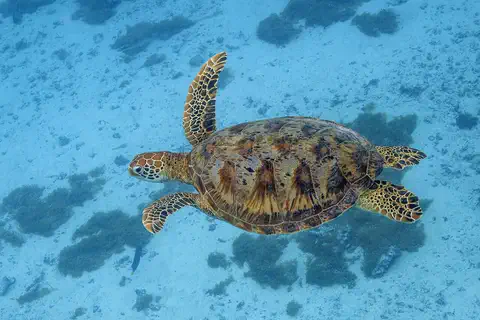
The green sea turtle is the largest sea turtle with a hard shell. It lives in warm seas around the world and, unlike other sea turtles, grown-ups eat mostly seagrass and algae. Females swim hundreds or even thousands of kilometers to lay their eggs on the beaches where they hatched long ago.
Chelonia mydas is the largest hard-shelled sea turtle and the only herbivorous one. Hunted for centuries for meat, fat and eggs, it declined catastrophically, but decades of protection have increased the global population by about 28 percent since the 1970s, and in 2025 the IUCN moved it from Endangered to Least Concern.
Photo: Charles J. Sharp, CC BY-SA 4.0, via Wikimedia Commons
Meet the green sea turtle
The green sea turtle is a very big turtle.
It lives in the sea and swims with flippers. Its shell is brown and olive, and its tummy is pale yellow.
The green sea turtle is the largest of the hard-shelled sea turtles. A typical adult is about 0.9 to 1.2 meters long and weighs about 136 to 159 kilograms, as much as two grown-ups.
Despite its name, its shell is not green. It is dark brown, gray or olive on top and yellow to white underneath. The name comes from the greenish color of the fat inside its body. Like all sea turtles, it is a reptile that breathes air, so it must come to the surface to breathe.
Chelonia mydas (family Cheloniidae) is the largest hard-shelled sea turtle. NOAA Fisheries gives a typical adult length of 3 to 4 feet (about 0.9 to 1.2 meters) and weight of 300 to 350 pounds (about 136 to 159 kilograms), with a comparatively small head.
The carapace is dark brown, gray or olive, with five scutes down the middle and four on each side; the plastron is yellow to white. The common name refers to the greenish color of the body fat, once attributed to its plant diet, although NOAA notes that other sea turtles have greenish fat too.
Quick facts
- Group
- Reptile
- Length
- 0.9 to 1.2 m
- Weight
- 136 to 159 kg
- Lifespan in the wild
- 70 years
Where it lives
Green sea turtles live in warm seas all around the world.
They swim near coasts, coral reefs and meadows of sea grass. Mothers come onto sandy beaches to lay eggs.
Green sea turtles live in warm seas all over the world, mostly in tropical and subtropical parts of the Atlantic, Pacific and Indian Oceans and in the Mediterranean Sea. They live along the coasts of more than 140 countries and lay their eggs on beaches in more than 80.
Baby turtles spend their first years drifting in the open ocean. Older turtles move to shallow coastal waters such as seagrass meadows and coral reefs, where they feed for the rest of their lives.
The species occurs worldwide, primarily in subtropical and temperate waters of the Atlantic, Pacific and Indian Oceans and the Mediterranean (NOAA Fisheries); IUCN lists about 150 countries and territories where it lives. It nests in more than 80 countries and lives in the coastal waters of more than 140.
The two biggest nesting populations are at Tortuguero on Costa Rica's Caribbean coast, where about 30,000 females nest per season on average, and Raine Island on the Great Barrier Reef, where up to 60,000 females nest in a peak season. In the eastern Pacific green turtles have been sighted as far north as southern Alaska.
Its habitat

Where can you find this animal?
- Lives here naturally · Countries and seas named by a scientific source
- Sightings recorded · Records of wild sightings (GBIF)
Lives here naturally · Countries and seas named by a scientific source
Tropical and subtropical seas of the Atlantic, Pacific and Indian Oceans and the Mediterranean. Adults feed in shallow coastal waters such as seagrass meadows and reefs, and females nest on sandy beaches in more than 80 countries. Countries shown have green turtles somewhere along their coasts; many small islands are too small to show.
Places: Atlantic Ocean, Pacific Ocean, Indian Ocean, Albania, Angola, Australia, Bahamas, Bangladesh and 90 more places.
Source: iucn-red-list · checked October 2026
Sightings recorded · Records of wild sightings (GBIF)
Counts of GBIF records of wild observations (human and machine) and preserved specimens. Records include introduced populations, vagrants, escaped or released animals and misidentifications, so a country with records is not necessarily part of the native range.
Wild sightings have been recorded in Australia, United States, Brazil, UAE, Ecuador, Mexico, Taiwan, Suriname and 108 more places.
Source: gbif · checked October 2026
Range maps show where scientists say an animal lives, often country by country. An animal may live in only part of a country shown, and sightings records can include animals that wandered far from home.
A sea turtle that eats its greens
Grown-up green turtles eat sea grass and seaweed.
They munch underwater like cows eating grass. Babies eat little plants and animals that float in the sea.
Green sea turtles are the only sea turtles whose adults eat mostly plants. They graze on seagrasses and algae in shallow coastal waters. Sometimes they also eat sponges and other small animals, or fish thrown away by people.
Young turtles living out in the open ocean eat a mix of tiny plants and animals that drift together near the surface, such as in floating mats of Sargassum seaweed.
NOAA Fisheries describes green turtles as the only herbivorous sea turtle: adults feed mainly on seagrasses and algae but may take sponges, other invertebrates and discarded fish or bait when available. The East Pacific population tends to eat more animal prey than others.
Pelagic juveniles, before they recruit to coastal foraging grounds, eat plant and animal life from oceanic drift communities such as Sargassum mats. The IUCN describes green turtles as keystone species in tropical marine ecosystems such as seagrass meadows and coral reefs.

Built for the ocean
The green turtle has long, flat flippers.
It swims with them all through its life. Its head is small, and its beak has a jagged edge.
A green turtle has long front flippers. Animal Diversity Web reports that young green turtles are said to swim faster than loggerheads and olive ridleys because of the way they stroke these flippers. Its shell has five big plates, called scutes, down the middle and four on each side.
Its head is small for its body. Look for two large scales between its eyes and a beak with a jagged, saw-like edge. Young green turtles have shells with patterns like sunbursts, and hatchlings are dark on top with white edges on their shells and flippers.
Distinguishing features listed by NOAA Fisheries include a comparatively small head, serrated edges to the beak and two large scales between the eyes, together with five central and four lateral scutes on each side of the carapace.
The shell pattern changes as turtles grow: immature green turtles have dappled or sunburst-patterned shells and are often confused with hawksbills, and hatchlings have a dark gray to black carapace, a white plastron and prominent white margins on shell and flippers. As reptiles, green turtles must surface to breathe.
A long journey home
Mother turtles crawl onto a beach at night.
They dig a hole and lay about 110 eggs. The babies hatch and crawl to the sea all by themselves.
Green sea turtles grow up slowly. Females are ready to lay eggs at 25 to 35 years old, and they may live 70 years or more. Every 2 to 5 years, adults swim back toward the beach where they hatched.
A female crawls up the sand at night and lays about 110 eggs in a nest. She returns to nest every two weeks or so for several months. The eggs warm in the sand for about two months. Then the hatchlings dig out and head for the brightest horizon, which on a natural beach is the open sea.
Females mature at 25 to 35 years and adults may live 70 years or more. Every 2 to 5 years, adults migrate from coastal foraging areas to the waters off the nesting beaches where they hatched; males mate with females on foraging grounds, along migratory routes and off nesting beaches. Females nest alone and at night, laying about 110 eggs per nest and nesting about every two weeks over several months.
Incubation takes about two months. Hatchlings orient seaward by moving away from the dark silhouette of dunes or vegetation toward the brightest horizon. They spend several years in the open ocean before settling in shallow coastal habitats to mature.
Great navigators
Green turtles swim very far.
They can find their way back to the beach where they hatched, even after many years!
Green sea turtles are remarkable navigators. Adults migrate hundreds or even thousands of kilometers between the places where they feed and the beaches where they nest. Females usually return to lay their eggs in the general area where they themselves hatched, decades earlier.
Nesting is a solo job: each female comes ashore alone, at night. Scientists follow their long journeys using satellite tracking, genetics and tags clipped to their flippers.
Green turtles undertake long reproductive migrations, hundreds to thousands of miles each way, between foraging grounds and nesting beaches, and females usually return to the general region of their own birth. NOAA Fisheries describes them as solitary, night-time nesters.
Because their migrations cross national boundaries, conservation needs international cooperation; NOAA uses satellite tracking, genetics and flipper tagging to follow individuals, learn their growth rates and ages at maturity and monitor population trends.
Did you know?
Up to 60,000 mother turtles may nest on one island!
In a peak season, up to 60,000 female green turtles nest on Raine Island and its surrounding reef in Australia.
Raine Island on the Great Barrier Reef hosts up to 60,000 nesting females in a peak season; the IUCN calls it the world's largest green turtle rookery.
A comeback story
Long ago, people hunted many green turtles.
Now many countries protect them, and there are more green turtles again. People still keep beaches dark and clean to help them.
For centuries people killed huge numbers of green turtles for their meat, fat and eggs, and their numbers crashed. Then countries began protecting nesting beaches, turtles and eggs. In 2025 the IUCN Red List announced that green turtles worldwide had increased by about 28 percent since the 1970s, and it moved them from Endangered to Least Concern.
They still face dangers: getting caught in fishing gear, losing beaches to building, boat strikes, plastic in the sea and warming sand. Some populations are still in trouble.
The IUCN's October 2025 Red List update moved Chelonia mydas from Endangered to Least Concern, citing an approximately 28 percent increase in the global population since the 1970s after decades of protecting nesting females and eggs, reducing harvest and trade, and using Turtle Excluder Devices. Ascension Island, Brazil, Mexico and Hawai'i stand out as successes.
The IUCN stresses that the species remains far below its abundance before European colonization. Bycatch, direct take, coastal development, vessel strikes, debris and the disease fibropapillomatosis persist, and declining hatchling production at Raine Island is a concern. Under the U.S. Endangered Species Act, three of 11 distinct population segments are listed as endangered and eight as threatened.
IUCN Red List
How is the green sea turtle doing in the wild?
- Least Concern (this animal)
- Near Threatened
- Vulnerable
- Endangered
- Critically Endangered
- Extinct in the Wild
- Extinct
Least Concern
Not at risk of disappearing from the wild right now.
See the IUCN Red List assessment · The IUCN Red List of Threatened Species 2025.2
Amazing facts
-
The green turtle is named after the color of its fat, not its shell.
Green sea turtles get their name from the greenish color of their body fat, not their shells.
The name refers to greenish fat once attributed to diet, though NOAA notes other sea turtles have greenish fat too.
-
Up to 60,000 mother turtles may nest on one island!
In a peak season, up to 60,000 female green turtles nest on Raine Island and its surrounding reef in Australia.
Raine Island on the Great Barrier Reef hosts up to 60,000 nesting females in a peak season; the IUCN calls it the world's largest green turtle rookery.
-
Baby turtles find the sea by heading to the brightest sky.
Hatchlings find the ocean by crawling away from dark dunes toward the brightest horizon, which is why beach lights can confuse them.
Seaward orientation relies on moving toward the brightest horizon, so artificial beach lighting can disorient hatchlings.
-
A green turtle may live for 70 years or more.
Green turtles are long-lived: they could live at least 70 years, and females start nesting at 25 to 35.
Longevity may exceed 70 years, with female maturity at 25 to 35 years.
Words to know
- herbivore
- an animal that eats only or mostly plants
- flipper
- a flat, paddle-like limb used for swimming
- scute
- one of the hard plates that cover a turtle's shell
- hatchling
- a baby animal that has just come out of its egg
- migrate
- to travel a long way to a different place, often at a certain time of year
- bycatch
- animals caught by accident in fishing gear
Discovery challenge
-
What do grown-up green turtles eat?
What do adult green sea turtles mostly eat?
What makes the green turtle's diet unusual among sea turtles?
- Sea grass and algae
- Jellyfish only
- Sharks
Show the answer
Sea grass and algae
They munch sea grass and seaweed.
Adults eat mostly seagrasses and algae.
It is the only herbivorous sea turtle, eating mainly seagrasses and algae as an adult.
-
Why is it called a green turtle?
Where does the green sea turtle get its name?
What does the 'green' in green turtle refer to?
- The color of its fat
- Its bright green shell
- Its green eyes
Show the answer
The color of its fat
Its fat is greenish, not its shell!
The name comes from the greenish color of its body fat.
Greenish body fat, once credited to its diet; the shell is brown, gray or olive.
-
Where do mother turtles lay eggs?
Where do green sea turtles lay their eggs?
Where do female green turtles usually nest?
- On sandy beaches
- On the sea floor
- In trees
Show the answer
On sandy beaches
They dig nests on sandy beaches.
Females crawl up sandy beaches at night to lay their eggs.
On sandy beaches, usually in the general area where they hatched.
-
What has happened to green turtle numbers in the last 50 years?
What has happened to the number of green turtles since the 1970s?
How did the IUCN change the green turtle's global status in 2025?
- Their numbers went up
- They all disappeared
- Nothing changed at all
Show the answer
Their numbers went up
People protected them, and their numbers went up.
The global population grew by about 28 percent since the 1970s.
Numbers went up about 28 percent, so it moved from Endangered to Least Concern.
Places where you might see it
-
 Watch
 Country
Costa Rica
Costa Rica is a small country in Central America between the Caribbean Sea and the Pacific Ocean. Volcanoes and mountains run down its middle, its forests are full of wildlife, and many national parks protect them. Since 1949 it has had no army. About 5.2 million people lived there in 2025.
-
 Watch
 Country
Australia
Australia is a country and the smallest continent, surrounded by ocean in the Southern Hemisphere. Much of its middle is dry and flat, most people live near the coast, and its animals include kangaroos, koalas and the platypus, a mammal that lays eggs.
-
 Watch
 Country
Guinea-Bissau
Guinea-Bissau is a small country on the Atlantic coast of West Africa. Its land is low and flat, and the tide pushes seawater far up its rivers. Off the coast lie the Bijagós Islands, where sea turtles nest and hippos swim in the sea. The 2026 national census counted about 2.2 million people.
-
Watch
 Country
Cyprus
Cyprus is the third-largest island in the Mediterranean Sea, after Sicily and Sardinia. It has two mountain ranges with a flat plain between them, hot dry summers and rainy winters, and its first known village was built about 9,000 years ago.
-
 Watch
Natural wonder
Great Barrier Reef
The Great Barrier Reef stretches about 2,300 kilometers along the coast of Queensland, Australia. It is made of about 2,500 separate reefs and more than 900 islands, built by tiny coral animals, and it is home to more than 1,500 kinds of fish.
-
 Watch
 Country
Oman
Oman is a country on the southeastern corner of the Arabian Peninsula, with long coasts on the sea and the huge Empty Quarter desert inland. People have watered their farms with ancient channels called aflaj for more than 2,000 years, and Oman was famous for frankincense. About 5.4 million people lived there in 2026.
Experiments to try
Explore next
-
 Watch
3D
Animal
Hawksbill sea turtle
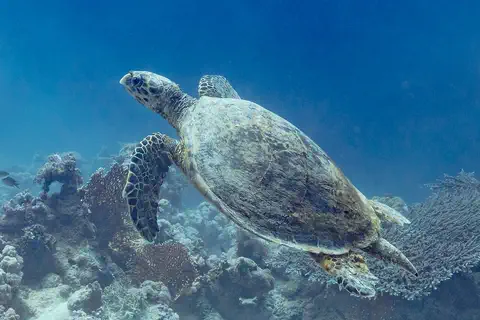
The hawksbill sea turtle lives in warm seas around the world, mostly near coral reefs. Its pointed, hawk-like beak reaches into cracks in the reef to find sponges, its favorite food. Its beautiful patterned shell once made it a target for hunters, and today it is critically endangered.
-
 Watch
Animal
Loggerhead sea turtle
The loggerhead sea turtle is named for its huge head and powerful jaws, which crush crabs, conchs and other hard-shelled animals. Babies hatch on sandy beaches, ride the open ocean for years and may cross an entire ocean before coming home to nest.
-
 Watch
Animal
Leatherback sea turtle
The leatherback sea turtle is the largest turtle on Earth. Instead of a hard shell it has tough, rubbery skin over a layer of tiny bones. It eats jellyfish, dives deeper than any other turtle and swims thousands of kilometers between feeding waters and the beaches where it lays its eggs.
-
Watch
Country
Costa Rica
Costa Rica is a small country in Central America between the Caribbean Sea and the Pacific Ocean. Volcanoes and mountains run down its middle, its forests are full of wildlife, and many national parks protect them. Since 1949 it has had no army. About 5.2 million people lived there in 2025.
-
Watch
Country
Australia
Australia is a country and the smallest continent, surrounded by ocean in the Southern Hemisphere. Much of its middle is dry and flat, most people live near the coast, and its animals include kangaroos, koalas and the platypus, a mammal that lays eggs.
-
 Watch
Animal
Yellow tang
The yellow tang is a lemon-yellow surgeonfish of Pacific coral reefs, most common around Hawaii. It grazes on algae all day, which helps keep reefs from being smothered by seaweed, and it has a sharp white spine on each side of its tail for defense. It is one of the most collected fish for home aquariums.
-
 Watch
3D
Animal
Spotted eagle ray
The spotted eagle ray is a ray that 'flies' through warm Atlantic waters by flapping its wide, wing-like fins. Its dark back is covered in white spots, its tail is long and whip-like, and its snout looks a bit like a duck's bill, which it uses to dig for clams and other shellfish.
-
 Watch
3D
Animal
Tiger shark
The tiger shark is one of the biggest sharks in the sea. Young tiger sharks have dark spots and stripes like a tiger, which fade as they grow. It eats an amazing range of food, and it travels long distances between warm and cooler seas.
For parents & teachers
What children will learn
- Describe the green sea turtle's body and how it differs from other sea turtles.
- Explain the green turtle's life cycle, from beach nest to ocean and back.
- Describe how green turtles migrate and return to nest near where they hatched.
- Explain how protection helped green turtles recover and what threats remain.
Recommended ages: 3 to 17 · About 15 minutes
Talk about it
- Why might it take so long for a turtle population to recover?
- Why are lights on beaches a problem for baby turtles?
- What could you do on a beach trip to help sea turtles?
Try at home or in class
- Lay out a tape measure to 1.2 meters and compare it with your height.
- Make a 'brightest horizon' test: in a dim room, see which way you turn toward a lit doorway, like a hatchling heading for the sea.
Key vocabulary: herbivore, flipper, scute, hatchling, migrate, bycatch
Where these facts come from
- The IUCN Red List of Threatened Species , International Union for Conservation of Nature (IUCN terms of use (no redistribution of Red List data or range maps))
- GBIF Backbone Taxonomy and GBIF Occurrence Search , Global Biodiversity Information Facility (CC0 1.0 (backbone); occurrence counts are facts derived from records under CC0, CC BY and CC BY-NC)
- Wikidata , Wikimedia Foundation (CC0 1.0)
- Chelonia mydas (Green Turtle), Red List assessment , IUCN Red List of Threatened Species
- Green Turtle , NOAA Fisheries
- Chelonia mydas (green sea turtle) , Animal Diversity Web, University of Michigan Museum of Zoology
- Arctic seals threatened by climate change, birds decline globally: IUCN Red List (press release, October 2025) , IUCN
- Wikimedia Commons , Wikimedia Foundation (Per file: Public domain, CC0, CC BY or CC BY-SA only (credited on each page))
Checked, not yet human-reviewed. Last updated October 28, 2026. Spotted a mistake? Tell us.