
 Country
Asia
Saudi Arabia
Saudi Arabia is a big, sunny country with lots of sandy desert. It has the Red Sea on one side and the Persian Gulf on the other.
Saudi Arabia covers about four-fifths of the Arabian Peninsula. Most of it is dry desert, including the Empty Quarter, the largest sand area in the world. About 35.3 million people lived there in 2024, most of them in cities such as Riyadh, the capital.
Saudi Arabia is an arid kingdom covering most of the northern and central Arabian Peninsula, between the Red Sea and the Persian Gulf. Its plateau rises steeply from the Red Sea and slopes gently east to the gulf; its population was 35,300,280 in 2024, more than four-fifths of it urban.
Photo: B.alotaby, CC BY-SA 4.0, via Wikimedia Commons
Discover Saudi Arabia
Saudi Arabia is a big country in Asia.
Most of the land is dry desert. Summers are very hot. Most people live in big cities. The capital city is called Riyadh.
Saudi Arabia is a country in the Middle East, in southwest Asia. It covers about four-fifths of the Arabian Peninsula, with the Red Sea to the west and the Persian Gulf to the east.
Most of the country is desert, with huge areas of sand, rocky plateaus and mountains in the west. There are almost no rivers that flow all year. About 35.3 million people lived in Saudi Arabia in 2024, and more than four out of five of them live in cities. The capital is Riyadh, in the middle of the country.
Saudi Arabia occupies about four-fifths of the Arabian Peninsula, some 2.25 million square kilometers. Britannica describes it as arid and sparsely populated, a kingdom that in the 20th century became one of the world's largest oil producers. The peninsula is dominated by a plateau that rises abruptly from the Red Sea and dips gently toward the Persian Gulf, and the country has virtually no permanent surface streams, only wadis (dry valleys) that fill after rain.
The General Authority for Statistics (GASTAT) gives a population of 35,300,280 in its 2024 estimates. Britannica notes that nearly two-fifths of residents were non-Saudi in 2018, that about half of the population is under 30, and that more than four-fifths live in cities. Riyadh, in the central Najd region, is the capital.
Cities and famous places
Riyadh is the capital city.
Its tall towers light up at night. Jeddah is a big city by the Red Sea. Mecca and Medina are very important cities for Muslims.
Riyadh, the capital, grew from a small walled desert village into a huge modern city of about 6.9 million people (2022). Its name comes from an Arabic word meaning gardens or meadows.
Jeddah, on the Red Sea, has been a major port since the 600s, and its old town, with tall houses built partly of coral stone, is a World Heritage Site. Mecca is the holiest city of Islam: Muslims around the world face toward it when they pray. Medina, to the north, is the second holiest city of Islam. At Hegra, people called the Nabataeans carved huge tombs into the rock about 2,000 years ago.
Riyadh, whose name derives from the plural of the Arabic rawdah (garden or meadow), lies where Wadi Hanifah meets Wadi al-Batha; it grew from a small fortified village in the 17th century into a metropolis of 6,924,566 people (2022). It holds the National Museum (1978) and the King Fahd National Library.
Historic Jeddah, inscribed by UNESCO in 2014, was from the 7th century a major port on Indian Ocean trade routes and the gateway for pilgrims arriving by sea; its late 19th-century tower houses combine Red Sea coral building with crafts from along the trade routes. Mecca, in the Sirat Mountains, is the holiest city of Islam, the birthplace of Muhammad and the direction (qiblah) Muslims face in prayer; able Muslims try to make the hajj pilgrimage there at least once. Medina, about 160 km inland, is the second holiest; Muhammad's tomb is in its chief mosque. Hegra (al-Hijr), Saudi Arabia's first World Heritage Site (2008), has 111 Nabataean tombs, 94 of them with decorated facades, from the 1st century BCE to the 1st century CE.

Deserts, mountains and heat
Saudi Arabia has seas of sand.
Some sand hills are as tall as a skyscraper. In the summer it is very, very hot. In the southwest, the mountains get more rain.
The Rub al-Khali, or Empty Quarter, covers the south of Saudi Arabia. It is the largest area of sand in the world, bigger than 647,500 square kilometers, and some of its sand mountains rise 250 meters high. A long, narrow arc of sand called Al-Dahna joins it to another sand sea, Al-Nafud, in the north.
In the southwest, the highlands of Asir get much more rain. Saudi Arabia's highest point, Jabal Sawda near Abha, rises more than 3,100 meters. Summer days are hotter than 38 °C in the shade almost everywhere, and the desert can reach 55 °C.
Western highlands rise above 1,500 m in the north and to more than 3,000 m in the southeast; Mount Sawda (Jabal Sawda) near Abha is generally considered the highest point, with estimates of 3,133 to 3,207 m. Inland, the Najd plateau of lava flows and volcanic debris slopes from about 1,370 m to 760 m, bounded by long ridges such as the Tuwayq Mountains. The Rub al-Khali covers more than 647,500 km², with sand mountains up to 250 m; Al-Nafud covers about 57,000 km², and Al-Dahna, nearly 1,450 km long but in places only 50 km wide, links them.
Britannica describes three climate zones: desert almost everywhere, steppe along the western highlands, and a small mild, humid area in the highlands north of Yemen. Mean annual rainfall is about 65 mm at Jeddah and a little more than 75 mm at Riyadh, while Asir may receive more than 480 mm, mostly from the summer monsoon; in the Rub al-Khali a decade may pass without rain. Summer shade temperatures exceed 38 °C almost everywhere, and frost and snow may occur in the southern highlands in winter.
Animals of Saudi Arabia
Foxes, hedgehogs and jerboas live in Saudi Arabia.
A jerboa is a small animal that hops. Falcons and eagles fly in the sky. People raise camels, sheep and goats.
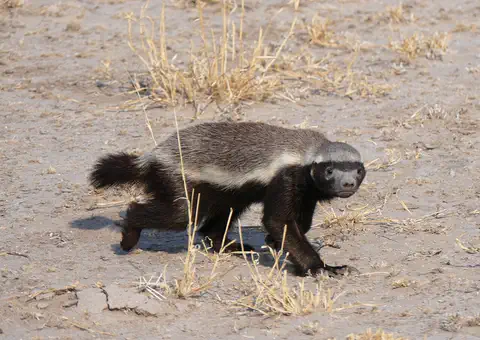
Wild animals in Saudi Arabia include wolves, hyenas, foxes, honey badgers, porcupines, hedgehogs, hares and jerboas, small hopping rodents. Baboons live there too. Birds include falcons, eagles, owls, flamingos and pelicans, and the gulf has a wide variety of sea life.
Larger animals such as gazelles, oryx and leopards were fairly common until about 1950. Then hunting from cars and trucks made them very rare. Camels, fat-tailed sheep and long-eared goats are among the farm animals people raise.
Most of the vegetation belongs to the North African-Indian desert region: xerophytic (drought-adapted) herbs and shrubs that serve as forage, with a few small areas of grass and trees in southern Asir. The date palm is widespread, and about one-third of the country's date palms grow in Al-Sharqiyyah (Eastern) province.
Britannica lists wolves, hyenas, foxes, honey badgers, mongooses, porcupines, baboons, hedgehogs, hares, sand rats and jerboas. Gazelles, oryx, leopards and mountain goats were relatively numerous until about 1950, when hunting from motor vehicles reduced them almost to extinction. Birds include falcons, which are caught and trained for hunting, eagles, hawks, vultures, owls, ravens, flamingos, egrets, pelicans, doves, quail, sand grouse and bulbuls; there are many lizards and several species of snakes, and the gulf supports a wide variety of marine life. Domesticated animals include camels, fat-tailed sheep, long-eared goats, salukis, donkeys and chickens.
People, languages and food
About 35 million people live in Saudi Arabia.
Most people speak Arabic. Flat bread is part of almost every meal. Sweet dates are found almost everywhere. Strong coffee is a traditional drink.
About 35.3 million people lived in Saudi Arabia in 2024. Arabic is the main language, with three main groups of local dialects, and English is widely understood. Many people living there come from other countries to work, from places such as Egypt, Yemen, Pakistan and the Philippines.
Flat bread is part of almost every meal, and dates, fresh or candied, are everywhere. Popular dishes include kebabs, shawarma and makhbus, rice with fish or shrimp. Football is very popular, and camel racing and falconry are traditional pastimes that continue today.
GASTAT's 2024 estimate is 35,300,280 people; Britannica reports a young population, with roughly half under 30, about one-fourth under 15, and a life expectancy of about 75 years. Arabic, a Semitic language, has three main dialect groups in the east, center and west; Modern Standard Arabic, derived from Classical Arabic, is the written language. Foreign workers, who have arrived in large numbers since the 1950s, speak languages such as Urdu, Tagalog and Korean, and English is widely understood.
Saudi Arabia is the birthplace of Islam, and most Saudis follow the Sunni branch; Shi'i communities live mostly in the eastern oases of Al-Hasa and Al-Qatif. The traditional national dish is khuzi, stuffed lamb; makhbus, rice with fish or shrimp, is extremely popular, flat bread comes with virtually every meal, dates are everywhere, and strong Turkish-style coffee is the traditional drink. Nabati poetry, composed in everyday Arabic, is very popular, and the King's Camel Race, begun in 1974, is one of the sport's major contests.
A long history
People have lived in Arabia for a very long time.
Long ago, people carved big tombs into rocks. Ships brought goods to the port of Jeddah. In 1932 the country got its name, Saudi Arabia.
About 2,000 years ago, the Nabataeans carved grand tombs into the cliffs at Hegra, beside water wells. In the 600s, Islam arose in western Arabia, the region where Mecca and Medina stand.
In the middle of the 1700s, in central Arabia, a family called the Saud formed a new state, with its first capital at Diriyah near Riyadh. On 23 September 1932, the regions of Hejaz and Najd were joined as the Kingdom of Saudi Arabia, with Riyadh as the capital. Oil was found near the Persian Gulf and pumped after 1941. In the 1950s, money from oil brought fast changes: new roads, schools, hospitals and airports.
Hegra's tombs date from the 1st century BCE to the 1st century CE, and Hegra also holds some 50 pre-Nabataean inscriptions. Islam arose in western Arabia in the 7th century; in 622 Muhammad and his followers moved from Mecca to Medina, the Hijrah, which marks the start of the Muslim calendar. The Ottoman Empire ordered much of the Arab Middle East from the 16th century, while central Arabia was often isolated by its remoteness.
In the mid-18th century an alliance of Wahhabi religious reformers and the Saud dynasty formed a state at ad-Diriyah, whose at-Turaif district UNESCO inscribed in 2010; Riyadh first became the dynasty's capital in 1824. By royal decree, the Kingdom of Saudi Arabia was proclaimed on 23 September 1932, uniting Hejaz and Najd. Oil discovered in Al-Hasa before World War II was exploited after 1941, and the kingdom became a founding member of the United Nations. It is a monarchy ruled by the Saud family, with no written constitution; the 1992 Basic Law of Government sets out how the state is run, and the king appoints the Council of Ministers and the Consultative Council.

Saudi Arabia on the map
Find Saudi Arabia on the globe.
It is in Asia, near Africa. The Red Sea is on its west side. The Persian Gulf is on its east side.
Saudi Arabia fills most of the Arabian Peninsula, a huge block of land between Africa and the rest of Asia. The Red Sea is to the west and the Persian Gulf to the east.
Jordan, Iraq and Kuwait lie to the north. Qatar, the United Arab Emirates and Oman are to the east and southeast, and Yemen is to the south. Riyadh, the capital, is in the middle of the country, and the port of Jeddah is on the Red Sea coast.
Saudi Arabia borders Jordan, Iraq and Kuwait to the north; the Persian Gulf, Qatar, the United Arab Emirates and Oman to the east and southeast; Yemen to the south and southwest; and the Red Sea and the Gulf of Aqaba to the west. Britannica notes that the border with the United Arab Emirates remains undefined.
It has four traditional regions: the Hejaz in the northwest, with Mecca, Medina and the port of Jeddah; Asir, the highlands to its south, whose capital Abha stands at about 2,400 m; Najd, the interior, with Riyadh; and Al-Hasa along the gulf, which holds the main oil fields. The kingdom is divided into 13 administrative regions. The Red Sea watershed lies only 40 km inland in the north and about 130 km near Yemen.
- Share of the Arabian Peninsula
- about four-fifths
- Rub al-Khali (Empty Quarter)
- more than 647,500 km²
- Highest point
- Jabal Sawda, estimated 3,133 to 3,207 m
- People (2024 estimate)
- 35,300,280
Amazing facts
-
Saudi Arabia has the biggest sand desert area in the world.
The Empty Quarter, in southern Saudi Arabia, is the largest area of sand in the world.
Britannica calls the Rub al-Khali the world's largest sand area, more than 647,500 km², with individual sand mountains up to 250 m high.
-
Saudi Arabia has almost no rivers that flow all year.
Saudi Arabia has almost no rivers that flow all year, but it has many wadis, valleys that fill with water after rain.
There are virtually no permanent surface streams in Saudi Arabia; wadis draining to the Red Sea are short and steep, while those draining east are longer and more developed.
-
The name Riyadh means gardens.
The name Riyadh comes from an Arabic word meaning gardens or meadows.
Riyadh's name derives from the plural of the Arabic rawdah, garden or meadow, for the fertile land where Wadi Hanifah and Wadi al-Batha meet.
-
Long ago, people carved big tombs into rocks at Hegra.
At Hegra, the Nabataeans carved 111 huge tombs into the rock about 2,000 years ago.
Hegra (al-Hijr) has 111 monumental Nabataean tombs, 94 with decorated facades, and was Saudi Arabia's first World Heritage Site, inscribed in 2008.
-
Old houses in Jeddah were built with coral stone.
Tall old houses in Jeddah were built partly with coral stone from the Red Sea coast.
Historic Jeddah's late 19th-century tower houses combine Red Sea coastal coral building traditions with influences from along the trade routes; UNESCO inscribed the old town in 2014.
Words to know
- peninsula
- land with water on three sides
- wadi
- a dry valley that fills with water after rain
- oasis
- a green place in a desert where there is water
- jerboa
- a small desert rodent that hops on long back legs
- pilgrimage
- a journey to a place that is important in a person's religion
- kingdom
- a country ruled by a king or queen
Discovery challenge
-
What is the capital city of Saudi Arabia?
Which city is the capital of Saudi Arabia?
Which city's name comes from an Arabic word for gardens or meadows?
- Riyadh
- Jeddah
- Dammam
Show the answer
Riyadh
Riyadh is the capital. It is in the middle of the country.
Riyadh is the capital. It has been the capital since the kingdom was formed in 1932.
Riyadh's name derives from the plural of rawdah, garden or meadow; it became the Saud dynasty's capital in 1824 and the kingdom's capital in 1932.
-
What is the Empty Quarter?
What is the Empty Quarter in southern Saudi Arabia?
What is the Rub al-Khali, which covers more than 647,500 km²?
- A huge sandy desert
- A big lake
- A snowy mountain range
Show the answer
A huge sandy desert
The Empty Quarter is a huge desert full of sand.
The Empty Quarter is the largest area of sand in the world, with sand mountains up to 250 meters tall.
The Rub al-Khali is the world's largest sand area; a decade may pass there with no rain.
-
Which sea is on the west side of Saudi Arabia?
Which sea lies along Saudi Arabia's west coast?
On which sea does the historic port of Jeddah stand?
- The Red Sea
- The Black Sea
- The Baltic Sea
Show the answer
The Red Sea
The Red Sea is on the west side.
The Red Sea is to the west, and the Persian Gulf is to the east.
Jeddah, on the Red Sea, was a major port from the 7th century and the gateway for pilgrims arriving by sea.
-
Which animal with a hump do people raise in Saudi Arabia?
Which farm animal, along with fat-tailed sheep and long-eared goats, do people raise in Saudi Arabia?
Which domesticated animal does Britannica list with fat-tailed sheep, long-eared goats and salukis?
- Camel
- Penguin
- Panda
Show the answer
Camel
Camels have humps. People raise camels in Saudi Arabia.
Camels are among the animals people raise, and camel racing is a popular old pastime.
Britannica lists camels, fat-tailed sheep, long-eared goats, salukis, donkeys and chickens as domesticated animals.
-
Which sweet fruit is found almost everywhere in Saudi Arabia?
Which fruit, fresh or candied, is found almost everywhere in Saudi Arabia?
Which fruit, from a palm grown widely and especially in the Eastern province, is a near-universal food?
- Dates
- Apples
- Cherries
Show the answer
Dates
Dates are a sweet fruit. They are found almost everywhere.
Dates, fresh or candied, are everywhere, and flat bread comes with almost every meal.
The date palm is widespread, with about one-third grown in Al-Sharqiyyah province, and Britannica calls dates ubiquitous.
Places to discover in Saudi Arabia
-
 Watch
City
Mecca
Mecca is a city in western Saudi Arabia, in a dry valley ringed by mountains, about 70 kilometers from the Red Sea. About 2.4 million people lived there at the 2022 census. Its Great Mosque surrounds the Kaaba, and in 2026 more than 1.7 million pilgrims came to the city for the hajj.
-
 Watch
Landmark
Al-Masjid al-Haram
Al-Masjid al-Haram, the Great Mosque of Mecca in Saudi Arabia, was built around the Kaaba, a cube-shaped building that Muslims face when they pray. It is the most important place of pilgrimage in Islam. In 2026, 1,707,301 pilgrims came to Mecca for the hajj, and the mosque can hold up to about one million worshippers.
-
Watch
Landmark
Prophet's Mosque
The Prophet's Mosque in Medina, Saudi Arabia, began as the simple home and courtyard of the Prophet Muhammad, who helped build it after he came to Medina in 622. Rebuilt and enlarged many times, it now has a famous green dome over Muhammad's tomb, ten minarets and room for up to a million worshippers at the busiest times.
Animals of Saudi Arabia
-
 Watch
Animal
Arabian oryx
The Arabian oryx is a white desert antelope with long, straight horns and a black-and-white face. Hunting wiped it out in the wild, but animals kept in zoos were bred and returned to the deserts of Arabia. Today it lives wild again in five countries.
-
 Watch
Animal
Honey badger
The honey badger, or ratel, is a stocky member of the weasel family that lives across Africa, the Middle East and India. Its gray or white back and black underside make it easy to spot. It digs with huge front claws, travels far to find food, and breaks into bees' nests for honey and bee grubs.
-
 Watch
3D
Animal
Veiled chameleon
The veiled chameleon lives in the dry mountains of Yemen and Saudi Arabia. It has a tall helmet-like casque on its head, eyes that can look two ways at once, feet that grip like hands and a super-fast sticky tongue. It changes color to show its mood, not to hide.
-
 Watch
Animal
Desert locust
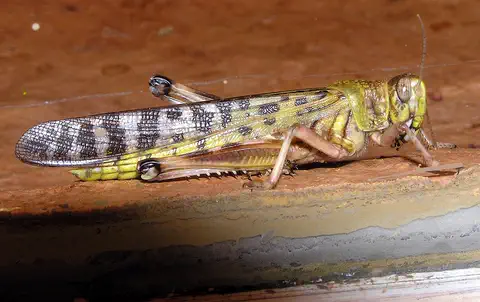
The desert locust is a large grasshopper of the deserts of Africa, the Middle East and Southwest Asia. Most of the time it lives alone. But after good rains, when locusts become crowded, they change their color and behavior and can gather into enormous swarms that fly long distances and eat farmers' crops.
-
 Watch
Animal
Sand cat
The sand cat is a small wild cat of the deserts of North Africa, Arabia and Central Asia. Its sandy coat hides it on the dunes, its big ears hear prey moving under the sand, and thick fur on the soles of its feet protects it from scorching days and freezing nights.
Explore next
-
Watch
City
Mecca
Mecca is a city in western Saudi Arabia, in a dry valley ringed by mountains, about 70 kilometers from the Red Sea. About 2.4 million people lived there at the 2022 census. Its Great Mosque surrounds the Kaaba, and in 2026 more than 1.7 million pilgrims came to the city for the hajj.
-
Watch
Animal
Arabian oryx
The Arabian oryx is a white desert antelope with long, straight horns and a black-and-white face. Hunting wiped it out in the wild, but animals kept in zoos were bred and returned to the deserts of Arabia. Today it lives wild again in five countries.
-
Watch
Animal
Honey badger
The honey badger, or ratel, is a stocky member of the weasel family that lives across Africa, the Middle East and India. Its gray or white back and black underside make it easy to spot. It digs with huge front claws, travels far to find food, and breaks into bees' nests for honey and bee grubs.
-
Watch
Landmark
Prophet's Mosque
The Prophet's Mosque in Medina, Saudi Arabia, began as the simple home and courtyard of the Prophet Muhammad, who helped build it after he came to Medina in 622. Rebuilt and enlarged many times, it now has a famous green dome over Muhammad's tomb, ten minarets and room for up to a million worshippers at the busiest times.
-
 Watch
 Country
Kuwait
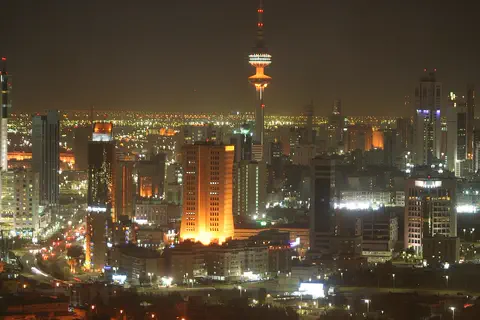
Kuwait is a small desert country at the top of the Persian Gulf, between Iraq and Saudi Arabia. It grew from a trading town on Kuwait Bay into a modern country after oil was found. About 4.9 million people live there, most of them in and around Kuwait City.
-
Watch
Landmark
Al-Masjid al-Haram
Al-Masjid al-Haram, the Great Mosque of Mecca in Saudi Arabia, was built around the Kaaba, a cube-shaped building that Muslims face when they pray. It is the most important place of pilgrimage in Islam. In 2026, 1,707,301 pilgrims came to Mecca for the hajj, and the mosque can hold up to about one million worshippers.
-
 Watch
 Country
Bahrain
Bahrain is a small island country in the Persian Gulf, linked to Saudi Arabia by a long causeway. Long ago it was the center of a trading land called Dilmun, and for centuries its people dived for pearls. About 1.6 million people live there today.
-
Watch
3D
Animal
Veiled chameleon
The veiled chameleon lives in the dry mountains of Yemen and Saudi Arabia. It has a tall helmet-like casque on its head, eyes that can look two ways at once, feet that grip like hands and a super-fast sticky tongue. It changes color to show its mood, not to hide.
For parents & teachers
What children will learn
- Locate Saudi Arabia on the Arabian Peninsula and name the seas on each side.
- Describe how deserts, wadis and highlands shape where people live and what grows.
- Describe ways of life, languages and foods in Saudi Arabia without treating everyone there as the same.
- Outline Saudi Arabia's history from Nabataean Hegra to the kingdom of 1932.
Recommended ages: 3 to 17 · About 15 minutes
Talk about it
- How might people and animals find water in a land with almost no rivers that flow all year?
- Riyadh was once an oasis town. Why might people in a dry land build towns near oases?
- What food is part of almost every meal for you, the way flat bread is in Saudi Arabia?
Try at home or in class
- Pour sand into a tray, blow gently across it with a straw and watch small dunes form.
- On a world map, find the Arabian Peninsula and trace the Red Sea and the Persian Gulf.
Key vocabulary: peninsula, wadi, oasis, jerboa, pilgrimage, kingdom
Where these facts come from
- Wikidata , Wikimedia Foundation (CC0 1.0)
- Natural Earth vector data , Natural Earth (NACIS) (Public domain)
- UNESCO World Heritage List , UNESCO World Heritage Centre (Linked as a reference; site facts come from Wikidata)
- General Authority for Statistics: Main indicators (Population Estimates Publication 2024) , General Authority for Statistics (GASTAT), Kingdom of Saudi Arabia
- Saudi Arabia , Encyclopaedia Britannica
- Saudi Arabia: Climate (plant and animal life, ethnic groups, languages) , Encyclopaedia Britannica
- Saudi Arabia: Religion (settlement patterns, demographic trends) , Encyclopaedia Britannica
- Saudi Arabia: Daily life and social customs (cultural life, history) , Encyclopaedia Britannica
- Saudi Arabia: Government and society , Encyclopaedia Britannica
- Saudi Arabia: The Kingdom of Saudi Arabia , Encyclopaedia Britannica
- Riyadh , Encyclopaedia Britannica
- Mecca , Encyclopaedia Britannica
- Medina , Encyclopaedia Britannica
- Hegra Archaeological Site (al-Hijr / Mada'in Salih) , UNESCO World Heritage Centre
- At-Turaif District in ad-Dir'iyah , UNESCO World Heritage Centre
- Historic Jeddah, the Gate to Makkah , UNESCO World Heritage Centre
- PlayOwl region table, version 1 , PlayOwl (PlayOwl original data)
- flag-icons 7.5.0 , Panayiotis Lipiridis and contributors (MIT)
- Wikimedia Commons , Wikimedia Foundation (Per file (public domain, CC0, CC BY or CC BY-SA); see each media record)
Checked, not yet human-reviewed. Last updated October 24, 2026. Spotted a mistake? Tell us.
Picture credits
- Photo: B.alotaby, CC BY-SA 4.0, via Wikimedia Commons · source · license
- Photo: Kolaiel, CC0 1.0, via Wikimedia Commons · source · license
- Photo: Bluemangoa2z at Malayalam Wikipedia, public domain, via Wikimedia Commons · source
- Photo: King Eliot, CC BY-SA 3.0, via Wikimedia Commons · source · license