
Animal
Loggerhead sea turtle
The loggerhead is a sea turtle with a big head. It crunches crabs and shellfish with its strong jaws, and it swims across whole oceans.
The loggerhead sea turtle is named for its huge head and powerful jaws, which crush crabs, conchs and other hard-shelled animals. Babies hatch on sandy beaches, ride the open ocean for years and may cross an entire ocean before coming home to nest.
Caretta caretta is a widespread marine turtle of subtropical and temperate seas, built to crush hard-shelled prey. Females take about 35 years to mature, and young turtles make ocean-crossing migrations guided partly by Earth's magnetic field. Fishing bycatch is its greatest continuing threat, and the IUCN lists it as Vulnerable.
Photo: ukanda, CC BY 2.0, via Wikimedia Commons
Meet the loggerhead
The loggerhead is a sea turtle.
It has a very big head and a reddish-brown shell. It lives in the sea. It comes up to the top of the water to breathe air.
The loggerhead sea turtle gets its name from its enormous head, which holds the strong jaw muscles it needs to crack open shellfish. Its top shell is reddish brown and a little heart-shaped, and its bottom shell is pale yellow.
Loggerheads are reptiles, like lizards and snakes, but they spend almost their whole lives at sea. They must swim up to the surface to breathe air. The loggerhead is the most common sea turtle in the United States.
Caretta caretta belongs to the family Cheloniidae, the hard-shelled sea turtles. NOAA Fisheries describes adults as about 0.76 to 1.07 meters (2.5 to 3.5 feet) long and 91 to 159 kilograms (200 to 350 pounds), with a large head carrying powerful jaw muscles, a reddish-brown, slightly heart-shaped carapace and a pale yellowish plastron.
Like all sea turtles, loggerheads breathe air and cannot pull their head or flippers into the shell, unlike freshwater turtles and tortoises. Smithsonian Ocean calls the loggerhead the most common sea turtle in the United States, and NOAA calls it the most abundant sea turtle species nesting there.
Quick facts
- Group
- Reptile
- Length
- 0.76 to 1.07 m
- Weight
- 91 to 159 kg
- Lifespan in the wild
- from 70 years
Where it lives
Loggerheads live in warm and cool seas all around the world.
Baby turtles float far out in the open ocean. Older turtles swim near the coast to find food.
Loggerheads live in the Atlantic, Pacific and Indian Oceans and in the Mediterranean Sea, mostly in warm and mild waters. In the Atlantic they have been seen from Canada all the way to Argentina.
Where a loggerhead lives changes as it grows. Hatchlings and young turtles drift and swim in the open ocean for 7 to 15 years. Then they move to shallower water near the coast, where food lies on the seafloor.
The species occurs in subtropical and temperate parts of the Atlantic, Pacific and Indian Oceans and the Mediterranean Sea; in the western Atlantic it ranges from Newfoundland to Argentina, and in the eastern Pacific it has been reported from Alaska to Chile. Under the United States Endangered Species Act it is managed as nine distinct population segments.
Nesting is concentrated in a few places. NOAA reports that only two nesting groups have more than 10,000 females nesting a year, peninsular Florida and Oman, and that the United States has more than 100,000 nests a year. Smaller nesting groups use beaches in the Caribbean, Cape Verde, Brazil, the eastern Mediterranean, Japan, Australia and New Caledonia.
Did you know?
Baby turtles crawl toward the brightest part of the sky.
Hatchlings find the sea by crawling toward the brightest horizon, so bright beach lights can lead them the wrong way.
Hatchlings move away from the dark landward silhouette of dunes and vegetation toward the brighter seaward horizon; artificial lighting disrupts this cue.
Where can you find this animal?
- Lives here naturally · Countries and seas named by a scientific source
- Sightings recorded · Records of wild sightings (GBIF)
Lives here naturally · Countries and seas named by a scientific source
Subtropical and temperate waters of the Atlantic, Pacific and Indian Oceans and the Mediterranean Sea, from the open ocean to coastal waters. The biggest nesting beaches are in Florida and Oman.
Places: Atlantic Ocean, Pacific Ocean and Indian Ocean.
Source: iucn-red-list · checked October 2026
Sightings recorded · Records of wild sightings (GBIF)
Counts of GBIF records of wild observations (human and machine) and preserved specimens. Records include introduced populations, vagrants, escaped or released animals and misidentifications, so a country with records is not necessarily part of the native range.
Wild sightings have been recorded in United States, Spain, Portugal, Australia, Japan, Colombia, Brazil, Greece and 128 more places.
Source: gbif · checked October 2026
Range maps show where scientists say an animal lives, often country by country. An animal may live in only part of a country shown, and sightings records can include animals that wandered far from home.
What it eats
Loggerheads eat animals with hard shells.
They eat crabs, clams and sea snails. Their strong jaws crunch the shells. Baby turtles eat things that float.
Loggerheads are carnivores, which means they eat other animals. Out in the open ocean, young turtles snack on many kinds of floating food.
Once they move near the coast, they hunt along the seafloor for crabs, horseshoe crabs, clams and big sea snails called whelks and conchs. Their wide heads hold strong jaw muscles that crush those hard shells. Sadly, floating bits of plastic can look like food, and turtles sometimes swallow them.
Loggerheads are carnivorous and only occasionally eat plants. During the oceanic phase they take a wide variety of floating prey, which also exposes them to marine debris: NOAA lists plastic fragments, fishing line, balloons, bags and tar among the items turtles mistake for food.
Juveniles and adults in coastal waters feed mostly on bottom-dwelling invertebrates such as molluscs, crustaceans and horseshoe crabs. The enlarged head houses the jaw muscles that generate the force needed to crush whelks, conchs and crabs.
Did you know?
Baby loggerheads can feel Earth's magnet, like a compass.
Hatchling loggerheads can sense Earth's magnetic field and use it to stay on course in the Atlantic Ocean.
In laboratory tests, hatchlings oriented in directions that would keep them in the North Atlantic gyre when exposed to magnetic fields from points along the route.
Built for the sea
A loggerhead has four flippers instead of feet.
It paddles with its big front flippers to swim. Its shell is a hard home it carries everywhere. It cannot hide its head inside.
A loggerhead's legs are flippers. The big, strong front flippers work like paddles that push it through the water, while the smaller back flippers work like rudders to steer.
Its shell has two parts: the reddish-brown carapace on top and the pale plastron underneath. Unlike a tortoise, a sea turtle cannot pull its head or flippers inside its shell. Tiny hitchhikers such as barnacles and algae often live on its shell: scientists have found more than 100 kinds on loggerheads.
The large front flippers act as paddles for propulsion and the smaller hind flippers as rudders; nesting females use the hind flippers to dig the egg chamber. The carapace is reddish brown and slightly heart-shaped in adults and sub-adults, and the plastron is pale yellow; the neck and flippers are brown to reddish brown above and yellowish on the sides and below.
Sea turtles cannot retract the head or limbs into the shell, a key difference from freshwater turtles and tortoises; the Smithsonian notes that this, with the streamlined shell, makes them more hydrodynamic. More than 100 kinds of epibionts, such as barnacles and algae, have been recorded living on loggerhead shells. The species is named for its very large head, which anchors the jaw muscles used to crush hard-shelled prey.
From egg to ocean traveler
A mother turtle crawls up a beach at night.
She digs a hole and lays about 100 eggs. The warm sand keeps the eggs cozy. After about two months, tiny turtles hatch and crawl to the sea.
A female loggerhead comes ashore at night, digs a nest in the sand and lays about 100 eggs. She may nest three to five times in one season, about two weeks apart.
The temperature of the sand decides whether each baby is a boy or a girl: warmer sand makes more females, cooler sand more males. After about two months the hatchlings dig out and head for the brightest horizon, which on a natural beach is the sea. They grow slowly, and females are not ready to nest until about 35 years old.
Females nest at night, usually on narrow, steeply sloped, coarse-grained beaches, laying three to five clutches (sometimes more) about two weeks apart, each of about 100 eggs. Sex is set by incubation temperature: cooler sand produces males and warmer sand females. Incubation lasts about two months.
Hatchlings orient away from the dark silhouette of the dunes toward the brighter horizon, normally the sea, so artificial lights can lead them inland. Juveniles spend 7 to 15 years in the open ocean, then a decade or more growing in coastal waters; females mature at about 35 years and return every 2 to 3 years to breed near the area where they hatched.

Ocean navigators
Loggerheads go on very long swims.
Some cross a whole ocean and come back. Grown-up mothers find their way back to the beach where they hatched.
Loggerheads are amazing navigators. Scientists who fitted turtles with satellite tags found that young loggerheads from Japan and Australia cross the Pacific to feed off Mexico, Peru and Chile, nearly 13,000 kilometers away, and later swim all the way back.
How do they find the way? Experiments with hatchlings from Florida showed they can sense Earth's magnetic field. When scientists recreated the magnetism of different places in the Atlantic, the babies swam in the direction that would keep them on their ocean route.
Satellite tracking has shown trans-Pacific migrations: hatchlings from Japanese and Australian beaches travel nearly 8,000 miles (about 12,900 km) to feed off Baja California, Peru and Chile, spend possibly up to 20 years maturing, then return to the western Pacific to breed.
Laboratory work by Kenneth Lohmann's group at the University of North Carolina found that hatchling loggerheads detect magnetic inclination angle and field intensity. Exposed to fields replicating three widely separated points in the North Atlantic gyre, hatchlings swam in directions that would keep them in the gyre and moving along the route, suggesting they use regional magnetic fields as open-ocean markers from the start.
Did you know?
Warm sand makes girl turtles. Cooler sand makes boy turtles.
The temperature of the sand decides whether a baby loggerhead is male or female: warmer nests make more females.
Loggerheads have temperature-dependent sex determination, so rising sand temperatures can skew hatchling sex ratios toward females or kill eggs outright.
Helping loggerheads
Loggerheads need our help.
Some get caught in fishing nets by mistake. Beach lights can confuse the babies. People keep beaches dark at night and change their nets to keep turtles safe.
Loggerhead sea turtles are listed as Vulnerable, which means they are at risk. The biggest danger is bycatch, when turtles get caught by accident in fishing nets and on hooks. Boat strikes, plastic, lost nesting beaches and bright beach lights also harm them.
People are helping. Many shrimp nets now have turtle excluder devices, escape hatches that let turtles swim free. People turn off or shield beach lights at night, and nesting beaches are protected and watched.
The IUCN Red List assessed the loggerhead globally as Vulnerable in 2015; under the United States Endangered Species Act five population segments are endangered and four threatened. NOAA identifies bycatch in trawls, longlines and gillnets as the greatest continuing threat, alongside vessel strikes, egg and turtle harvest in some countries, coastal development, artificial lighting, marine debris and rising sand temperatures that can kill eggs or skew sex ratios.
Trends differ by region. Turtle excluder devices, circle hooks and gillnet bans have reduced bycatch in some fisheries, yet the South Pacific population has fallen from an estimated 3,500 nesting females a year in 1977 to about 500, and Oman's large nesting group is declining.
IUCN Red List
How is the loggerhead sea turtle doing in the wild?
- Least Concern
- Near Threatened
- Vulnerable (this animal)
- Endangered
- Critically Endangered
- Extinct in the Wild
- Extinct
Vulnerable
At high risk of disappearing from the wild.
See the IUCN Red List assessment · The IUCN Red List of Threatened Species 2022.2
Amazing facts
-
Warm sand makes girl turtles. Cooler sand makes boy turtles.
The temperature of the sand decides whether a baby loggerhead is male or female: warmer nests make more females.
Loggerheads have temperature-dependent sex determination, so rising sand temperatures can skew hatchling sex ratios toward females or kill eggs outright.
-
Baby loggerheads can feel Earth's magnet, like a compass.
Hatchling loggerheads can sense Earth's magnetic field and use it to stay on course in the Atlantic Ocean.
In laboratory tests, hatchlings oriented in directions that would keep them in the North Atlantic gyre when exposed to magnetic fields from points along the route.
-
Some loggerheads swim all the way across the Pacific Ocean.
Young loggerheads from Japan and Australia cross the Pacific to feed off Mexico, Peru and Chile, nearly 13,000 kilometers away.
Satellite tracking shows trans-Pacific migrations of nearly 8,000 miles, followed by a return to western Pacific beaches to breed after possibly up to 20 years.
-
Baby turtles crawl toward the brightest part of the sky.
Hatchlings find the sea by crawling toward the brightest horizon, so bright beach lights can lead them the wrong way.
Hatchlings move away from the dark landward silhouette of dunes and vegetation toward the brighter seaward horizon; artificial lighting disrupts this cue.
Words to know
- carapace
- the top part of a turtle's shell
- plastron
- the bottom part of a turtle's shell
- hatchling
- a baby animal that has just come out of its egg
- carnivore
- an animal that eats other animals
- bycatch
- animals caught by accident by people fishing for something else
- migration
- a long journey animals make between places, often at certain times of year
Discovery challenge
-
How did the loggerhead get its name?
Why is this turtle called a loggerhead?
Which feature gives Caretta caretta its common name?
- Its very big head
- It sleeps on logs
- Its long tail
Show the answer
Its very big head
It has a very big head!
It is named for its huge head, which holds strong jaw muscles.
The name refers to its very large head, which anchors the jaw muscles used to crush hard-shelled prey.
-
What do grown-up loggerheads like to eat?
What do adult loggerheads mostly eat near the coast?
What do coastal juvenile and adult loggerheads mainly feed on?
- Grass on the beach
- Crabs and shellfish
- Seaweed only
Show the answer
Crabs and shellfish
They crunch crabs and sea snails with strong jaws.
They eat crabs, clams, horseshoe crabs and sea snails, crushing the shells with their jaws.
Bottom-dwelling invertebrates such as molluscs, crustaceans and horseshoe crabs; loggerheads are carnivores that eat plants only occasionally.
-
What decides if a baby turtle is a boy or a girl?
What decides whether a loggerhead hatchling is male or female?
What determines the sex of a loggerhead embryo?
- The size of the mother
- The color of the sand
- The temperature of the sand
Show the answer
The temperature of the sand
Warm sand makes girls, and cooler sand makes boys.
Warmer sand produces more females and cooler sand more males.
Incubation temperature determines sex: warmer nests produce females and cooler nests males.
-
What can help baby turtles find the sea at night?
Which of these helps hatchlings reach the sea?
Which beach rule helps hatchlings orient correctly toward the ocean?
- Turning off beach lights
- Shining flashlights on the sand
- Building big sandcastles
Show the answer
Turning off beach lights
In the dark, babies crawl toward the bright sea.
Hatchlings crawl toward the brightest horizon. Bright lights on land can lead them the wrong way.
Turning off or shielding lights visible from the beach keeps the seaward horizon the brightest cue, so hatchlings are not drawn inland.
Places where you might see it
-
 Watch
 Country
Oman
Oman is a country on the southeastern corner of the Arabian Peninsula, with long coasts on the sea and the huge Empty Quarter desert inland. People have watered their farms with ancient channels called aflaj for more than 2,000 years, and Oman was famous for frankincense. About 5.4 million people lived there in 2026.
-
 Watch
 Country
Japan
Japan is an island country in East Asia. Most of its land is steep mountains and forest, Mount Fuji is its tallest peak, and about 124 million people live there, many of them in big cities such as Tokyo.
-
Watch
 Country
Cyprus
Cyprus is the third-largest island in the Mediterranean Sea, after Sicily and Sardinia. It has two mountain ranges with a flat plain between them, hot dry summers and rainy winters, and its first known village was built about 9,000 years ago.
Experiments to try
- Watch What If? Lab What if Earth had no magnetic field? Deep inside Earth, swirling melted iron makes a magnetic field all around our planet. It turns compass needles, helps sea turtles find their way and shields our air from the solar wind. Imagine it gone, compare Earth with Mars, and find out why scientists are calm about Earth's changing field.
- Watch What If? Lab What if sea turtles lost their way? Sea turtles cross oceans and return to the coast where they hatched, using Earth's magnetic field like a map. Baby turtles find the sea by heading for the brightest horizon. Imagine them losing their way: follow magnetic maps, bright beach lights, and how people help hatchlings.
- Watch What If? Lab What if there were no ocean currents? Ocean currents are like rivers in the sea. They carry warm water away from the equator and cold water away from the poles, and some lift food-rich water up from the deep. Imagine them stopping: follow the Gulf Stream, warm and cold coasts, and the rich fishing waters fed by upwelling.
Explore next
-
 Watch
Animal
Green sea turtle
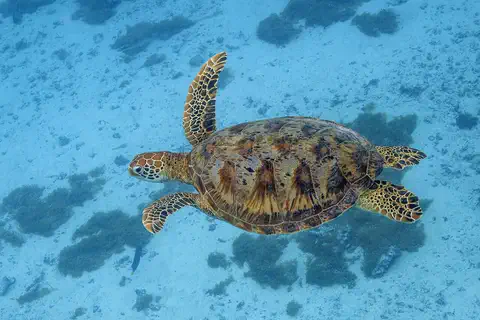
The green sea turtle is the largest sea turtle with a hard shell. It lives in warm seas around the world and, unlike other sea turtles, grown-ups eat mostly seagrass and algae. Females swim hundreds or even thousands of kilometers to lay their eggs on the beaches where they hatched long ago.
-
 Watch
Animal
Leatherback sea turtle
The leatherback sea turtle is the largest turtle on Earth. Instead of a hard shell it has tough, rubbery skin over a layer of tiny bones. It eats jellyfish, dives deeper than any other turtle and swims thousands of kilometers between feeding waters and the beaches where it lays its eggs.
-
 Watch
3D
Animal
Hawksbill sea turtle
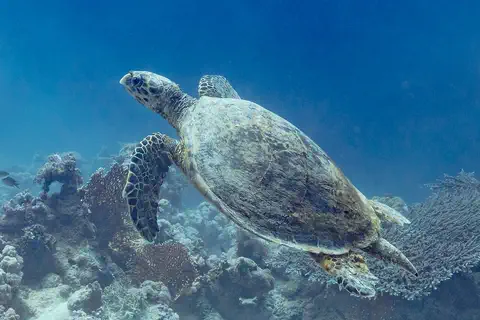
The hawksbill sea turtle lives in warm seas around the world, mostly near coral reefs. Its pointed, hawk-like beak reaches into cracks in the reef to find sponges, its favorite food. Its beautiful patterned shell once made it a target for hunters, and today it is critically endangered.
-
Watch
Country
Oman
Oman is a country on the southeastern corner of the Arabian Peninsula, with long coasts on the sea and the huge Empty Quarter desert inland. People have watered their farms with ancient channels called aflaj for more than 2,000 years, and Oman was famous for frankincense. About 5.4 million people lived there in 2026.
-
Watch
Country
Japan
Japan is an island country in East Asia. Most of its land is steep mountains and forest, Mount Fuji is its tallest peak, and about 124 million people live there, many of them in big cities such as Tokyo.
- Watch What If? Lab What if Earth had no magnetic field? Deep inside Earth, swirling melted iron makes a magnetic field all around our planet. It turns compass needles, helps sea turtles find their way and shields our air from the solar wind. Imagine it gone, compare Earth with Mars, and find out why scientists are calm about Earth's changing field.
-
 Watch
3D
Animal
Atlantic horseshoe crab
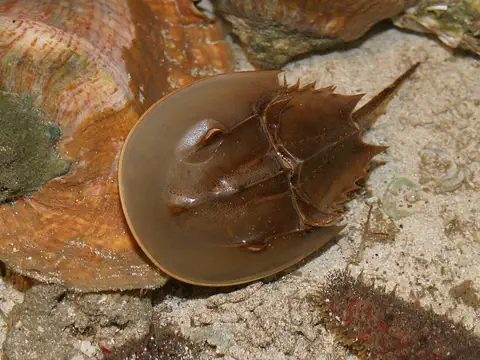
The Atlantic horseshoe crab is a living fossil: its relatives have looked much the same for hundreds of millions of years. Despite its name, it is more closely related to spiders and scorpions than to crabs. Each spring, thousands crawl onto beaches to lay eggs, feeding hungry shorebirds, and its blue blood helps keep medicines safe.
-
Watch
Country
Cyprus
Cyprus is the third-largest island in the Mediterranean Sea, after Sicily and Sardinia. It has two mountain ranges with a flat plain between them, hot dry summers and rainy winters, and its first known village was built about 9,000 years ago.
For parents & teachers
What children will learn
- Describe how the loggerhead's head, jaws, flippers and shell suit life in the sea.
- Explain the loggerhead life cycle, including temperature-dependent sex and the long time to maturity.
- Describe how hatchlings find the sea and how young turtles navigate using Earth's magnetic field.
- Name the main threats to loggerheads and ways people reduce them.
Recommended ages: 3 to 17 · About 15 minutes
Talk about it
- Why might an animal that takes 35 years to grow up be harder to protect than one that grows up in a year?
- If you lived in a beach town, what could your family do during nesting season to help turtles?
- How do you think a baby turtle could sense something invisible like a magnetic field?
Try at home or in class
- Measure about 1 meter with tape on the floor to see how long an adult loggerhead is, then lie down beside it.
- Use a magnet and a compass (or a needle stroked with a magnet and floated on a leaf in water) to see Earth's magnetism pointing the way, as turtles can sense it.
Key vocabulary: carapace, plastron, hatchling, carnivore, bycatch, migration
Where these facts come from
- The IUCN Red List of Threatened Species , International Union for Conservation of Nature (IUCN terms of use (no redistribution of Red List data or range maps))
- GBIF Backbone Taxonomy and GBIF Occurrence Search , Global Biodiversity Information Facility (CC0 1.0 (backbone); occurrence counts are facts derived from records under CC0, CC BY and CC BY-NC)
- Wikidata , Wikimedia Foundation (CC0 1.0)
- Caretta caretta (Loggerhead Turtle), Red List assessment 2015 , IUCN Red List of Threatened Species
- Loggerhead Turtle , NOAA Fisheries
- Sea turtles , Smithsonian Ocean, Smithsonian Institution
- Regional magnetic fields as navigational markers for sea turtles , Lohmann Laboratory, University of North Carolina at Chapel Hill
- Wikimedia Commons , Wikimedia Foundation (Per file: Public domain, CC0, CC BY or CC BY-SA only (credited on each page))
Checked, not yet human-reviewed. Last updated October 28, 2026. Spotted a mistake? Tell us.