Geography
What is a World Heritage Site?
A World Heritage Site is a very special place that the whole world helps to look after. Some are amazing buildings. Some are wild places full of animals.
World Heritage Sites are places so important that they belong, in a way, to everyone. Under a 1972 agreement, countries nominate their most outstanding places, experts check them, and a UNESCO committee decides. By 2026 the list held 1,273 sites: cultural places like the Taj Mahal, natural places like the Galápagos, and mixed ones like Machu Picchu.
The 1972 World Heritage Convention lets its States Parties nominate cultural and natural sites of Outstanding Universal Value. After evaluation by ICOMOS or IUCN, the World Heritage Committee decides on inscription against ten criteria. In 2026 the list held 1,273 properties (991 cultural, 240 natural, 42 mixed), 58 of them on the List in Danger.
Places that belong to everyone
Some places are so special that the whole world wants to keep them safe.
They are called World Heritage Sites. They can be old buildings, ancient cities, forests, reefs or islands.
Heritage is what we receive from the past, live with today and pass on to people in the future. Some heritage is cultural, made by people, like a palace or an ancient city. Some is natural, like a coral reef or a mountain range.
In 1972, countries meeting at UNESCO, the United Nations organization for education, science and culture, agreed to work together to protect the world's most important places. Places chosen under this agreement are called World Heritage Sites. Each one stays in its own country, which looks after it, but all the countries that signed promise to help protect them.
UNESCO describes heritage as our legacy from the past, what we live with today and what we pass on to future generations, and calls cultural and natural heritage irreplaceable sources of life and inspiration. The Convention concerning the Protection of the World Cultural and Natural Heritage was adopted by UNESCO's General Conference in Paris on November 16, 1972.
Its key idea is Outstanding Universal Value: some places matter so much that their protection concerns all humanity. Only countries that have signed the Convention, called States Parties, can nominate sites on their territory, and they pledge to protect their heritage. In 2026, 196 States Parties had signed, and 173 of them had at least one property on the list.
How a site is chosen
Choosing a World Heritage Site takes a long time.
First, a country makes a list of its special places. Then experts visit and check. Then a big committee decides.
Becoming a World Heritage Site takes years. First, a country puts the place on its Tentative List, a list of the places it might nominate in the next five to ten years. Next, it prepares a big report, called a nomination file, explaining why the place is special.
Then experts check it. ICOMOS, a group of experts on monuments and sites, checks cultural places, and IUCN, the International Union for Conservation of Nature, checks natural ones. They visit the site over about 14 months. Finally, the World Heritage Committee, which meets once a year, decides whether to add the place to the list.
UNESCO sets out four steps. (1) Tentative List: a State Party's inventory of significant heritage it may nominate within five to ten years; a site must be on it before the Committee can examine a nomination. (2) Nomination file: a mandatory desk-based Preliminary Assessment, in which the Advisory Bodies advise whether the site could justify Outstanding Universal Value, then a full dossier due by February 1 for a completeness check.
(3) Evaluation: over 14 months, ICOMOS (the International Council on Monuments and Sites) evaluates cultural nominations and IUCN natural ones, including a mission to the site, an interim report and requests for information. (4) Decision: the intergovernmental World Heritage Committee, meeting once a year, may inscribe, defer, refer or decline. To be inscribed, a site must show Outstanding Universal Value and meet at least one of ten criteria.
Ten ways to be outstanding
A World Heritage Site must be special in at least one way.
It might be a wonderful building. It might show how people lived long ago. Or it might be a beautiful wild place with rare animals.
UNESCO has ten criteria, or tests, and a place must pass at least one. Six are about culture: for example, being a masterpiece of human creative genius, or being an outstanding example of a type of building or of a traditional way of living on the land or sea.
Four are about nature: having superlative natural features or exceptional natural beauty, showing major stages of Earth's history, showing important ecological processes, or holding the most important habitats for protecting wildlife, including threatened species.
Until the end of 2004 sites were judged against six cultural and four natural criteria; the revised Operational Guidelines merged them into one set of ten. Criteria (i) to (vi) cover masterpieces of human creative genius, interchanges of human values, testimony to a cultural tradition or civilization, outstanding types of building or landscape, traditional settlement or land- and sea-use, and association with events, traditions, ideas or beliefs of outstanding universal significance.
Criteria (vii) to (x) cover superlative natural phenomena or exceptional natural beauty; major stages of Earth's history, including the record of life and geological processes; significant ongoing ecological and biological processes; and the most important natural habitats for in-situ conservation of biological diversity. The Committee revises the criteria regularly to reflect how the World Heritage idea itself evolves.
Cultural, natural and mixed
Some World Heritage Sites were made by people, like the Taj Mahal.
Some are natural, like the Galápagos Islands. Machu Picchu is both: old stone buildings on a green mountain.
There are three kinds of World Heritage Sites. Cultural sites were made by people: the Taj Mahal in India, a huge white marble tomb built between 1631 and 1648, was listed in 1983. Natural sites show nature at its most amazing: the Galápagos Islands, in the Pacific Ocean, were listed in 1978 and carry the number 1 on UNESCO's list.
Mixed sites are both. Machu Picchu in Peru, listed in 1983, is an Inca city of giant walls, terraces and ramps standing 2,430 meters above sea level in a tropical mountain forest. In 2026 the list held 991 cultural, 240 natural and 42 mixed sites.
In 2026 the 1,273 properties on the list comprised 991 cultural, 240 natural and 42 mixed sites, and 51 of them crossed national borders (transboundary). The Taj Mahal, a white marble mausoleum built in Agra between 1631 and 1648 by order of the Mughal emperor Shah Jahan, was inscribed in 1983 under criterion (i). The Galápagos Islands were inscribed in 1978 under all four natural criteria, (vii) to (x).
Machu Picchu, inscribed in 1983 under criteria (i), (iii), (vii) and (ix), shows why mixed sites exist: UNESCO values both the Inca urban creation, with walls, terraces and ramps that seem cut from the rock, and its natural setting on the eastern slopes of the Andes, 2,430 m above sea level, reaching into the upper Amazon basin. The Great Wall of China, inscribed in 1987 under five cultural criteria, is another cultural example.
- World Heritage properties (2026)
- 1,273
- Cultural / natural / mixed (2026)
- 991 / 240 / 42

Sites in danger
Some special places are in trouble.
They might be harmed by too many buildings, pollution or storms. A special list helps the world notice and help.
Being on the list does not make a place safe by itself. UNESCO warns that sites can be harmed by uncontrolled building, too much tourism, neglect, natural disasters, pollution, political instability and conflict.
When a site's special qualities are threatened, it can be put on the List of World Heritage in Danger. This tells the whole world that the site needs help and encourages action to fix the problems. In 2026, 58 sites were on this list. By 2026, 3 sites had even been removed from the World Heritage List.
UNESCO lists the pressures on sites as uncontrolled urban development, unsustainable tourism, neglect, natural calamities, pollution, political instability and conflict. The List of World Heritage in Danger is designed to inform the international community of conditions threatening the very characteristics for which a property was inscribed and to encourage corrective action; UNESCO now encourages telling its story in terms of positive conservation efforts rather than negativity.
In 2026, 58 properties were on the List in Danger, and 3 had been delisted. The Convention itself frames protection as shared: while fully respecting the sovereignty of the country where a site lies, States Parties recognize it as a world heritage that the international community as a whole has a duty to cooperate in protecting, and each undertakes not to take deliberate measures that might damage heritage in other States Parties.
Amazing facts
-
The Galápagos Islands are number 1 on the World Heritage List.
The Galápagos Islands have the number 1 on UNESCO's list and were listed in 1978.
The Galápagos Islands, UNESCO property number 1, were inscribed in 1978 under natural criteria (vii) to (x).
-
Some World Heritage Sites are in more than one country.
In 2026, 51 World Heritage Sites crossed the borders between countries.
Of the 1,273 properties listed in 2026, 51 were transboundary or transnational.
-
Experts visit a place before it can be chosen.
Experts take about 14 months to study a place before the committee decides.
ICOMOS and IUCN evaluate each nomination over 14 months, including a mission to the site.
-
Machu Picchu is very high up in the mountains.
Machu Picchu stands 2,430 meters above sea level in a tropical mountain forest.
Machu Picchu stands 2,430 m above sea level on the eastern slopes of the Andes, a setting that reaches into the upper Amazon basin.
Words to know
- heritage
- things from the past that we live with today and pass on to the future
- UNESCO
- the United Nations organization for education, science and culture
- nominate
- to put something forward to be chosen
- criteria
- the tests or rules used to decide something
- inscribe
- here, to add a place to the World Heritage List
- mixed site
- a World Heritage Site chosen for both its culture and its nature
Discovery challenge
-
Who decides which places become World Heritage Sites?
Who makes the final decision to add a site to the World Heritage List?
Which body makes the final decision on inscription?
- The World Heritage Committee
- The people who visit
- The site's neighbors
Show the answer
The World Heritage Committee
A big committee decides, after experts check.
The World Heritage Committee, which meets once a year, decides after experts have studied the place.
The intergovernmental World Heritage Committee decides, based on ICOMOS or IUCN evaluations.
-
What kind of site is Machu Picchu?
Machu Picchu is listed for both its culture and its nature. What kind of site is that?
Machu Picchu meets both cultural and natural criteria. Which category is it?
- Cultural only
- Natural only
- Mixed
Show the answer
Mixed
Mixed! It has old buildings and wild nature.
A mixed site. Machu Picchu is special for its Inca buildings and its mountain forest.
Mixed: it was inscribed in 1983 under criteria (i), (iii), (vii) and (ix).
-
When did countries promise to protect World Heritage?
In which year was the World Heritage agreement adopted?
When did UNESCO's General Conference adopt the World Heritage Convention?
- 1872
- 1972
- 2022
Show the answer
1972
In 1972, more than 50 years ago.
The World Heritage Convention was adopted in 1972.
On November 16, 1972, in Paris.
-
How many tests must a site pass?
A site must meet at least how many of UNESCO's ten criteria?
Besides Outstanding Universal Value, how many of the ten criteria must a site meet?
- At least one
- All ten
- Exactly five
Show the answer
At least one
At least one. It must be special in at least one way.
At least one of the ten criteria, six about culture and four about nature.
At least one of criteria (i) to (x), together with Outstanding Universal Value.
Explore next
- Watch Geography National parks and protected areas Countries set aside land and sea as national parks and other protected areas, so that wildlife, forests, reefs and wonderful landscapes are looked after. Yellowstone became the first national park in 1872. Today about 18 percent of the world's land is protected, and countries have agreed to aim for 30 percent by 2030.
-
 Watch
Natural wonder
Galápagos Islands
The Galápagos Islands are a group of volcanic islands in the Pacific Ocean, about 1,000 kilometers off the coast of Ecuador. Many of their animals live nowhere else on Earth, and they helped inspire Charles Darwin's theory of evolution by natural selection.
-
 Watch
Landmark
Taj Mahal
The Taj Mahal is a white marble tomb in Agra, India, beside the Yamuna River. The Mughal emperor Shah Jahan had it built in memory of his wife, Mumtaz Mahal. More than 20,000 workers spent about 22 years on the tomb, its gardens, a mosque and a great gateway.
-
Watch
Landmark
Machu Picchu
Machu Picchu is a 15th-century Inca town on a ridge high in the Andes Mountains of Peru. Its stone buildings fit together without mortar, and farm terraces step down the slopes. It was left empty in the 1500s and became known to the outside world in 1911.
-
 Watch
Landmark
Great Wall of China
The Great Wall is not one wall but many walls, built over about 2,000 years across northern China. The best-kept part, built under the Ming emperors, runs about 8,850 kilometers, with watchtowers, gates and signal towers along the way.
-
 Watch
Journey
The Silk Road
The Silk Road was not one road but a web of trade routes, about 6,400 kilometers long, linking China with Central Asia and the Mediterranean. For more than 1,500 years, caravans carried silk, tea, spices and glass, and travelers shared ideas, beliefs and inventions.
-
 Watch
Landmark
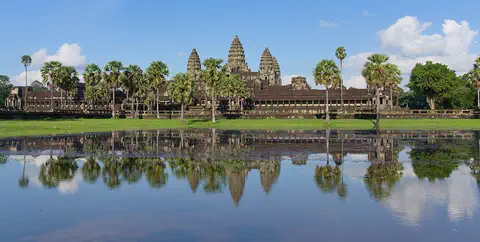
Angkor Wat
Angkor Wat, near the town of Siem Reap in Cambodia, was built in the 12th century by the Khmer king Suryavarman II. Britannica (2026) calls it the world's largest religious structure. It was built as a Hindu temple and later became a Buddhist place of worship.
-
 Watch
City
Tallinn
Tallinn, the capital of Estonia, lies on a bay of the Gulf of Finland. Its walled Old Town, with towers, church spires and a town hall finished in 1404, is, says UNESCO, an exceptionally complete and well-preserved medieval trading town, and today the city is also known for its technology companies.
For parents & teachers
What children will learn
- Explain what a World Heritage Site is and the idea of Outstanding Universal Value.
- Describe the steps from Tentative List to Committee decision.
- Tell cultural, natural and mixed sites apart, with an example of each.
- Explain the purpose of the List of World Heritage in Danger.
Recommended ages: 7 to 14 · About 12 minutes
Talk about it
- Which place in your country do you think should be a World Heritage Site, and which criterion would it meet?
- Why might lots of visitors be both good and bad for a site?
- Why do you think a site stays in its own country but the whole world promises to help?
Try at home or in class
- Write a mini nomination file for a special place near you: what it is, why it is outstanding and how it should be protected.
- Look up the World Heritage Sites in your country on UNESCO's website and sort them into cultural, natural and mixed.
Key vocabulary: heritage, UNESCO, nominate, criteria, inscribe, mixed site
Where these facts come from
- UNESCO World Heritage List , UNESCO World Heritage Centre (Linked as a reference; site facts come from Wikidata)
- World Heritage Convention (About) , UNESCO World Heritage Centre
- Convention concerning the Protection of the World Cultural and Natural Heritage (text) , UNESCO World Heritage Centre
- World Heritage List , UNESCO World Heritage Centre
- The Criteria for Selection , UNESCO World Heritage Centre
- World Heritage List Nominations , UNESCO World Heritage Centre
- List of World Heritage in Danger , UNESCO World Heritage Centre
- Galápagos Islands , UNESCO World Heritage Centre
- Taj Mahal , UNESCO World Heritage Centre
- Historic Sanctuary of Machu Picchu , UNESCO World Heritage Centre
- The Great Wall , UNESCO World Heritage Centre
Checked, not yet human-reviewed. Last updated October 27, 2026. Spotted a mistake? Tell us.