Landmark Asia
Angkor Wat
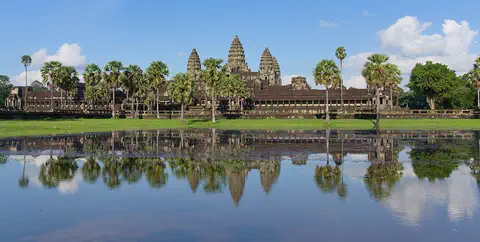
Angkor Wat is a giant stone temple in Cambodia. It has tall, pointed stone towers. Water and palm trees are all around it.
Angkor Wat, near the town of Siem Reap in Cambodia, was built in the 12th century by the Khmer king Suryavarman II. Britannica (2026) calls it the world's largest religious structure. It was built as a Hindu temple and later became a Buddhist place of worship.
Built over some three decades for Suryavarman II (reigned 1113 to c. 1150) as a funerary temple, Angkor Wat covers about 160 hectares and marks the high point of Khmer architecture. It is part of the Angkor World Heritage Site (1992) and appears on Cambodia's flag.
Photo: Satdeep Gill, CC BY-SA 4.0, via Wikimedia Commons
Discover Angkor Wat
Angkor Wat is in Cambodia, a country in Southeast Asia.
It is a huge temple made of stone. A temple is a building for worship. Its tall towers point up to the sky. A wide moat of water goes all the way around it.
Angkor Wat stands at Angkor, near the town of Siem Reap in northwestern Cambodia. Angkor was the center of the Khmer kingdom for several centuries, and it is full of ancient temples, reservoirs and canals.
Angkor Wat is the most famous of them. In 2026, Britannica calls it the world's largest religious structure: it covers about 160 hectares and has more than a thousand buildings. Five towers stand at its center, visitors pass through three galleries to reach them, and a huge moat surrounds the whole temple. It even appears on Cambodia's flag.
Angkor, in Siem Reap province, extends over about 400 km² and, UNESCO says, holds scores of temples, hydraulic structures (basins, dykes, reservoirs and canals) and routes; for several centuries it was the center of the Khmer kingdom. UNESCO lists Angkor Wat, with the Bayon and Banteay Srei, among the masterpieces of Khmer art from the 9th to the 14th centuries.
Britannica describes Angkor Wat as a complex of more than a thousand buildings covering some 400 acres (160 hectares), the world's largest religious structure (Britannica, 2026) and the high point of Khmer architecture. The park is still inhabited: UNESCO counts more than 100,000 people in 112 historic settlements, many of them rice farmers, some with ancestors dating back to the Angkor period.
- Where
- Angkor, near Siem Reap, Cambodia
- Built
- 12th century, over about three decades
- Area
- about 400 acres (160 hectares)
- World Heritage
- part of Angkor (1992)
A king's temple
Long ago, a Khmer king named Suryavarman II ruled here.
He had this temple built. It took about 30 years. Later, Buddhist monks looked after it for hundreds of years.
King Suryavarman II ruled the Khmer Empire from 1113 to about 1150. He had Angkor Wat built as a great temple where his remains would be placed after his death. Building took about 30 years. It was built as a Hindu temple, and all its first religious designs came from Hinduism.
In 1177, the Cham people attacked Angkor. Afterward, King Jayavarman VII built a new capital nearby and dedicated it to Buddhism, and Angkor Wat became a Buddhist place of worship. Angkor was left as a capital in the early 1400s, but Buddhist monks kept caring for Angkor Wat.
Britannica dates Angkor Wat to the reign of Suryavarman II (1113 to c. 1150), who built it as a vast funerary temple in which his remains were to be deposited; construction is believed to have spanned about three decades, during a period, from the late 9th to the early 13th century, of major building at Angkor. All its original religious motifs derived from Hinduism.
After the Cham, from present-day Vietnam, sacked Angkor in 1177, Jayavarman VII (reigned 1181 to c. 1220) built Angkor Thom nearby and dedicated it to Buddhism; Angkor Wat became a Buddhist shrine and many Hindu images were replaced by Buddhist art. Angkor was abandoned in the early 15th century, but Theravada Buddhist monks maintained Angkor Wat as a pilgrimage site, and it continued to attract European visitors. Britannica puts "rediscovered" in quotation marks when it says the explorer Henri Mouhot made that rediscovery, after the French colonial regime was established in 1863.
Who built it, and how
Khmer builders made Angkor Wat from big blocks of stone.
Skilled carvers covered its walls with pictures cut into the stone. They worked on it for about 30 years.
Angkor Wat was built for King Suryavarman II by the builders, stone carvers and artists of the Khmer Empire. UNESCO says Khmer architecture grew from the styles of the Indian subcontinent but soon developed its own special look.
Five towers rise in the middle. To reach them, visitors pass through three long galleries, with a paved walkway between one gallery and the next. Outside lies the great moat, crossed by a bridge 188 meters long. Carvings of very high quality cover the temple walls.
The temple was built by the Khmer state under Suryavarman II. UNESCO notes that Khmer architecture evolved largely from that of the Indian subcontinent, from which it soon became distinct, with features developed independently or acquired from neighboring traditions, and that Khmer art from Angkor deeply influenced much of Southeast Asia.
Britannica describes five central towers, reached by passing through three galleries, each separated by a paved walkway; the complex is ringed by an enormous moat crossed by a 617 ft (188 m) bridge. It describes the bas-reliefs on the temple walls as of very high quality, with ancient Khmer scenes among their subjects. UNESCO stresses that the Angkor temples are closely linked to their geographic setting and to the great hydraulic works around them.
Towers, galleries and the moat
Angkor Wat has five tall towers in the middle.
To reach them, you walk through long halls. The walls are covered with carvings. To get in, you cross a long bridge over the moat.
Five towers stand at the heart of Angkor Wat. In the photo of the temple across the water, you can see three of them. To reach them, visitors pass through three galleries, long covered halls.
The temple walls are covered with bas-reliefs, pictures carved into the stone so they stand out a little. Some show scenes from the Khmer past. Visitors reach the temple on a bridge 188 meters long, across the wide moat.
Britannica counts five central towers, three galleries separated by paved walkways and more than a thousand buildings across the complex. The bas-reliefs covering the temple walls, of very high quality, include ancient Khmer scenes; after 1177 many of the Hindu carvings and statues were replaced by Buddhist art.
The complex is surrounded by a moat crossed by a 188 m bridge. UNESCO emphasizes that Angkor's monuments belong to a wider system of barays (reservoirs), dykes and canals, most of which still exist, testifying to the hydraulic engineering of the Khmer period.
- Central towers
- 5
- Galleries
- 3, separated by paved walkways
- Bridge over the moat
- 617 ft (188 m)
- Buildings in the complex
- more than 1,000
Angkor Wat today
Today, many visitors come to Angkor Wat.
The nearby town of Siem Reap is busy with tourists. People in villages around the temples grow rice. Experts keep repairing the old stones.
Angkor Wat is one of the most important places of pilgrimage in Southeast Asia, and it is a popular place for tourists. The nearby town of Siem Reap is a busy center for tourism.
In the 1900s, teams began repairing the temples, but work stopped during years of unrest in the 1970s. It started again in the 1980s. In 1992, UNESCO made Angkor a World Heritage Site and at once put it on its list of sites in danger. After years of care, it was taken off the danger list in 2004.
Restoration programs of the 20th century were suspended amid the political unrest of the 1970s; when work resumed in the mid-1980s, sections had to be dismantled and rebuilt. UNESCO names earlier conservation by the École française d'Extrême-Orient, the Archaeological Survey of India, the Polish conservation body PKZ and the World Monuments Fund. Angkor was inscribed in 1992 and placed at once on the List of World Heritage in Danger; it was removed in 2004 as restoration increased.
UNESCO describes two pressures on the site today: more than 100,000 inhabitants of historic settlements seeking room to expand, and the nearby town of Siem Reap, the provincial seat and a tourism hub. Britannica calls Angkor Wat one of the most important pilgrimage shrines in Southeast Asia.

Amazing facts
-
Angkor Wat is on Cambodia's flag.
A picture of Angkor Wat appears on the flag of Cambodia.
The temple complex appears on the national flag of Cambodia.
-
People still live and farm near the temples.
More than 100,000 people live in villages inside the Angkor park, and many of them grow rice.
UNESCO counts more than 100,000 inhabitants in 112 historic settlements, some with ancestors dating back to the Angkor period.
-
The temple was built as a resting place for a king.
King Suryavarman II built Angkor Wat as a temple where his remains would be placed after his death.
Britannica describes Angkor Wat as a vast funerary temple within which Suryavarman II's remains were to be deposited.
-
Monks never stopped caring for it.
Even after Angkor stopped being a capital in the 1400s, Buddhist monks kept looking after Angkor Wat.
Theravada Buddhist monks maintained Angkor Wat after Angkor's abandonment in the early 15th century, keeping it a pilgrimage site.
Words to know
- temple
- a building used for worship
- moat
- a wide ditch filled with water around a building
- gallery
- a long covered hall, often with columns on one side
- bas-relief
- a carving that stands out only a little from a flat surface
- reservoir
- a large lake made by people to store water
- pilgrimage
- a journey to a special place for religious reasons
Discovery challenge
-
Which country is Angkor Wat in?
In which country is Angkor Wat?
Which country's flag shows Angkor Wat?
- Cambodia
- Brazil
- Italy
Show the answer
Cambodia
Cambodia, in Southeast Asia!
Angkor Wat is near Siem Reap, in northwestern Cambodia.
Cambodia: the temple appears on the national flag.
-
What goes all the way around Angkor Wat?
What surrounds Angkor Wat, crossed by a 188-meter bridge?
Which feature encloses the temple and is crossed by a 617 ft (188 m) bridge?
- A wide moat of water
- A tall fence of wood
- A railway
Show the answer
A wide moat of water
A moat, a wide ditch full of water.
A huge moat surrounds the temple, and visitors cross it on a stone bridge 188 meters long.
An enormous moat, crossed by a 188 m bridge; beyond it, Angkor's barays and canals managed water.
-
How many tall towers are in the middle?
How many central towers does Angkor Wat have?
How many central towers does Britannica count at Angkor Wat?
- One
- Five
- Twenty
Show the answer
Five
Five tall towers stand in the middle.
There are five central towers, reached through three galleries.
Five central towers, reached through three galleries separated by paved walkways.
-
Who looked after Angkor Wat for hundreds of years?
Who kept caring for Angkor Wat after Angkor stopped being a capital?
Which community maintained Angkor Wat after the early 15th-century abandonment of Angkor?
- Buddhist monks
- Pirates
- Nobody
Show the answer
Buddhist monks
Buddhist monks looked after it.
Buddhist monks kept caring for Angkor Wat, and it stayed an important place of pilgrimage.
Theravada Buddhist monks, who kept it a pilgrimage site.
Nearby places
-
Watch
Landmark
Angkor
Angkor, in northwestern Cambodia, was the capital of the Khmer Empire from the 9th to the 15th century. Its kings built city after city here, with scores of temples, such as Angkor Wat and the Bayon, and giant reservoirs and canals to water the rice fields. Today it covers about 400 square kilometers, and more than 100,000 people live in villages inside it.
-
 Watch
City
Bangkok
Bangkok, the capital of Thailand, lies on the delta of the Chao Phraya River, about 40 kilometers from the sea. It became the capital in 1782, when the new royal palace and temples were built. Once called the 'Venice of the East' for its canals, it is now a huge, busy city with skyscrapers and an elevated railway.
-
 Watch
City
Ho Chi Minh City
Ho Chi Minh City, once called Saigon, is Vietnam's largest city and the economic heart of the country. It lies on the Saigon River, north of the Mekong Delta. Since merging with two neighboring provinces in 2025, it has more than 14 million people, and in 2024 it opened its first metro line.
-
 Watch
Natural wonder
Son Doong Cave
Son Doong is a cave in the mountains of central Vietnam, inside Phong Nha–Ke Bang National Park. A river carved it, and its main passage is so wide and tall that a whole city block of skyscrapers could fit inside. Explorers first went in only in 2009. UNESCO says it holds the world's largest documented cave passage.
-
 Watch
Natural wonder
Phong Nha–Ke Bang National Park
Phong Nha–Ke Bang National Park, in central Vietnam near the border with Laos, protects one of the world's great limestone landscapes. UNESCO says its rocks began forming about 400 million years ago, and more than 220 kilometers of caves and underground rivers have been mapped. One of them, Son Doong, holds the world's largest known cave passage.
-
 Watch
Natural wonder
Ha Long Bay
Ha Long Bay is a bay in northeast Vietnam where more than a thousand limestone islands rise straight out of the sea. Over millions of years, water dissolved the limestone into towers and caves, and then the sea flooded in around them. Together with the nearby Cat Ba Archipelago it is a World Heritage site.
-
 Watch
Landmark
Petronas Towers
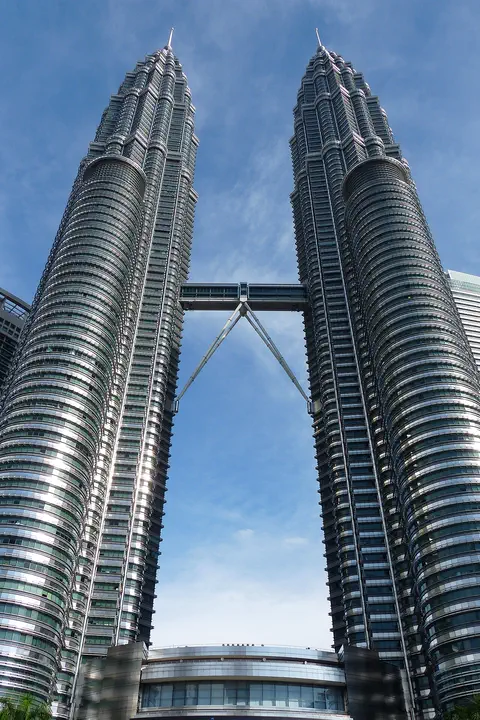
The Petronas Twin Towers in Kuala Lumpur, Malaysia, are two matching skyscrapers 452 meters tall, finished in 1998. Seen from above, each floor is shaped like an eight-pointed star, a pattern from Islamic art. A two-story skybridge joins them 170 meters above the ground, and from 1996 to 2003 they were counted as the tallest buildings in the world.
-
 Watch
City
Hong Kong
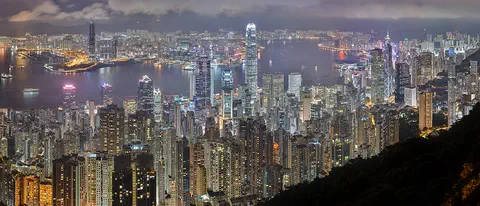
Hong Kong, on the south coast of China, grew around one of the world's great natural harbors. It was a British colony for 156 years and has been a special administrative region of China since 1997. About 7.5 million people lived there in mid-2026.
Explore next
-
 Watch
 Country
Cambodia
Cambodia is a country in mainland Southeast Asia, a land of wide plains and great rivers. Its Tonle Sap lake more than doubles in size every rainy season, and Angkor, with the remains of capitals built from the 800s to the 1400s, is one of the most important archaeological sites in Southeast Asia.
-
Watch
Landmark
Angkor
Angkor, in northwestern Cambodia, was the capital of the Khmer Empire from the 9th to the 15th century. Its kings built city after city here, with scores of temples, such as Angkor Wat and the Bayon, and giant reservoirs and canals to water the rice fields. Today it covers about 400 square kilometers, and more than 100,000 people live in villages inside it.
-
 Watch
Landmark
Borobudur
Borobudur is a huge Buddhist monument in central Java, Indonesia, built about 1,200 years ago. It is shaped like a stepped pyramid around a small hill, with carved walls and 72 bell-shaped stupas on its round top terraces. For centuries it lay hidden under volcanic ash and plants, and today it is a UNESCO World Heritage Site.
- Watch Geography What is a World Heritage Site? World Heritage Sites are places so important that they belong, in a way, to everyone. Under a 1972 agreement, countries nominate their most outstanding places, experts check them, and a UNESCO committee decides. By 2026 the list held 1,273 sites: cultural places like the Taj Mahal, natural places like the Galápagos, and mixed ones like Machu Picchu.
-
Watch
City
Bangkok
Bangkok, the capital of Thailand, lies on the delta of the Chao Phraya River, about 40 kilometers from the sea. It became the capital in 1782, when the new royal palace and temples were built. Once called the 'Venice of the East' for its canals, it is now a huge, busy city with skyscrapers and an elevated railway.
-
 Watch
Landmark
Anuradhapura
Anuradhapura, in north-central Sri Lanka, was the island's capital for more than 1,000 years. Its ruins include huge bell-shaped brick monuments called dagobas, monasteries, palaces and ancient reservoirs. It is an important place for Buddhists, and a World Heritage Site since 1982.
-
 Watch
Landmark
Agra Fort
Agra Fort is a huge red sandstone fortress beside the Yamuna River in Agra, India. The Mughal emperor Akbar began it in 1565. Its walls, about 2.5 kilometers around, protect palaces, halls and mosques added by later emperors. It was both an army base and a royal home.
-
 Watch
Landmark
Al-Aqsa Mosque
Al-Aqsa Mosque stands at the southern end of a huge raised plaza in the Old City of Jerusalem. Built in the early 700s, it has a silver-gray dome, and the golden Dome of the Rock stands nearby. The plaza is important to Muslims and to Jews.
For parents & teachers
What children will learn
- Locate Angkor in Cambodia and explain that Angkor Wat is a temple built for King Suryavarman II.
- Describe Angkor Wat's main parts: towers, galleries, carvings and moat.
- Explain that Angkor Wat was built as a Hindu temple and later became a Buddhist place of worship.
- Discuss how people live, worship and visit at a World Heritage Site today.
Recommended ages: 3 to 17 · About 15 minutes
Talk about it
- Why do you think the Khmer built such big reservoirs and canals around their city?
- Angkor Wat changed from one religion to another but was kept and cared for. Why do people look after old places of worship?
- More than 100,000 people live inside the Angkor park. How can people live near a famous site and protect it at the same time?
Try at home or in class
- Build a model temple from blocks on a tray, then pour water around it to make a moat, and add a 'causeway' bridge.
- Make a bas-relief: press shapes into a slab of clay or play dough so a picture stands out slightly from the surface.
Key vocabulary: temple, moat, gallery, bas-relief, reservoir, pilgrimage
Where these facts come from
- Wikidata , Wikimedia Foundation (CC0 1.0)
- UNESCO World Heritage List , UNESCO World Heritage Centre (Linked as a reference; site facts come from Wikidata)
- Angkor , UNESCO World Heritage Centre
- Angkor Wat , Encyclopaedia Britannica
- Wikimedia Commons , Wikimedia Foundation (Per file (public domain, CC0, CC BY or CC BY-SA); see each media record)
Checked, not yet human-reviewed. Last updated October 24, 2026. Spotted a mistake? Tell us.