
City Europe
Tallinn
Tallinn is the capital city of Estonia. It is by the sea. Its old town has stone walls, towers and red roofs.
Tallinn, the capital of Estonia, lies on a bay of the Gulf of Finland. Its walled Old Town, with towers, church spires and a town hall finished in 1404, is, says UNESCO, an exceptionally complete and well-preserved medieval trading town, and today the city is also known for its technology companies.
Tallinn, Estonia's capital on the Gulf of Finland, grew around a Danish fortress of 1219 on Toompea hill and a Hanseatic merchant town below it. Ruled by Danes, the Teutonic Order, Sweden and Russia, it became capital of independent Estonia in 1918 and again in 1991. Its Old Town has been a UNESCO World Heritage Site since 1997.
Photo: Hiiumaamudeliklubi, CC BY-SA 4.0, via Wikimedia Commons
Discover Tallinn
Tallinn is the capital city of Estonia.
It is right by the sea. On a hill stands an old castle. Below it is an old town with stone walls, tall towers and red roofs.
Tallinn is the capital of Estonia, a small country in northern Europe. It lies on Tallinn Bay, part of the Gulf of Finland, an arm of the Baltic Sea. About 458,000 people lived in the city in 2024.
Tallinn has two old parts: Toompea, a hill where a castle has stood since the 1200s, and the walled Lower Town below it, where merchants once lived and traded. UNESCO calls the Old Town an exceptionally complete and well-preserved medieval trading city.
Tallinn, capital of Estonia, stands on Tallinn Bay of the Gulf of Finland. Statistics Estonia's count for 2024, cited by Wikidata, was 457,572 residents; Britannica gives 437,817 for 2021.
The historic center has two parts: Toompea hill, where the Danes built a fortress in 1219, and the walled Lower Town of merchants below. UNESCO, which inscribed the Historic Centre (Old Town) in 1997, describes it as an exceptionally complete and well-preserved example of a medieval northern European trading city, a significant center of the Hanseatic League in the 13th to 16th centuries, whose pattern of building plots survives virtually intact from the 13th and 14th centuries.
- Country
- Estonia (capital)
- People in the city (2024)
- about 458,000
- Sea
- Tallinn Bay, Gulf of Finland
- UNESCO World Heritage Site
- Historic Centre (Old Town), 1997
Famous places
Tallinn's old town looks like a storybook town.
It has a town hall more than 600 years old. Tall church spires point up to the sky. Thick walls with towers wrap around the old streets.
Many old buildings survive in Tallinn, or have been carefully restored. The Town Hall was completed in 1404, and the Great Guildhall, where merchants met, in 1410. The tall Gothic churches of St. Olaf and St. Nicholas rise above the rooftops.
Up on Toompea hill stand the 13th-century Toom Church and much of the old castle. Around the Lower Town run its old walls. Walking its lanes, you can still see how the town was laid out in the 1200s and 1300s.
Britannica lists the relics of Tallinn's long history that survive or have been restored, especially on Toompea and in the walled Lower Town: the 13th-century Toom Church, the Gothic Oleviste (St. Olaf's) and Niguliste (St. Nicholas's) churches, the Great Guildhall of 1410, the Town Hall completed in 1404, and much of the old castle.
UNESCO stresses how complete the ensemble is: the distribution of building plots survives virtually intact from the 13th and 14th centuries, and the town retains the salient features of a medieval northern European trading community. It also notes the exchange of ideas among Cistercians, Dominicans, the Teutonic Order and the Hanseatic towns that shaped a shared culture across northern Europe.
- Town Hall (Raekoda)
- completed 1404
- Great Guildhall
- 1410
- Toom Church
- 13th century
- Gothic churches
- St. Olaf's (Oleviste) and St. Nicholas's (Niguliste)
Danes, knights and merchants
People have lived in Tallinn for a very long time.
Long ago, soldiers built a castle on the hill. Merchants came by ship to buy and sell. Over the years, many different kings and rulers were in charge.
A fortified settlement stood here more than 2,000 years ago, and a town by the 1100s. In 1219 the Danes captured it and built a fortress on Toompea hill. Trade grew, especially after Tallinn joined the Hanseatic League, a group of trading towns, in 1285. For centuries it was often called by its German name, Reval.
Later, Tallinn was ruled by the Teutonic Knights, then Sweden, then the Russian Empire. In 1918 it became the capital of independent Estonia. After decades under Soviet rule, it became the capital again in 1991.
A fortified settlement existed on the site from the late 1st millennium BCE until the 10th–11th century CE, and a town by the 12th century. The Danes took it in 1219 and built a new fortress on Toompea; trade flourished after Tallinn joined the Hanseatic League in 1285, and in 1346 it was sold to the Teutonic Knights. Known mostly by its German name, Reval, it was a multiethnic trading town dominated by German merchants. It passed to Sweden in 1561 and to the Russian Empire when Peter I captured it in 1710.
Industry in the late 19th century drew Estonian workers from the countryside. Tallinn became capital of independent Estonia in 1918. Estonia was annexed to the Soviet Union in 1940; German forces occupied the city in 1941–44, and it was severely damaged. Many residents were deported by Soviet forces in 1940 and 1944–49, and the city's Jewish community was destroyed in World War II. Under Soviet rule the population grew from 137,792 (1934 census) to about 500,000 by the late 1980s. Tallinn became capital of the refounded Estonian republic in 1991.
Getting around Tallinn
In Tallinn you can ride a tram, a trolleybus or a bus.
In the old town, people walk along narrow stone streets. Big ships come and go from the harbor.
Tallinn's city transport includes trams, trolleybuses, which are buses powered by overhead electric wires, and city buses, and the same tickets work on all of them.
Tallinn is also a port. Ships load and unload cargo there, and fishing boats work from it too. Tallinn Airport has flights within Estonia and to other countries.
Visit Tallinn notes that the same tickets serve the city's trams, trolleybuses and city buses. Tallinn is a major commercial and fishing port, and Tallinn Airport handles both domestic and international flights.
In the Soviet period the city expanded greatly with new industries, reaching about 500,000 people by the late 1980s, while the Old Town kept its medieval plots.
- City transport
- trams, trolleybuses and city buses
- Port
- a major commercial and fishing port
- Airport
- Tallinn Airport: domestic and international flights
Weather and seasons
Tallinn has cold winters and cool summers.
In winter, it is often below freezing, even in the daytime. In summer, days are mild and pleasant. Rain falls in every month.
Tallinn is cold in winter and mild in summer. At the World Meteorological Organization's Tallinn station, January days averaged about −1 °C and nights about −7 °C between 1971 and 2000, so it is often below freezing all day.
In July, days averaged about 21 °C and nights about 12 °C. Rain or snow falls in every month, adding up to about 690 millimeters a year, and late summer and autumn are the wettest times.
WMO normals for the Tallinn station (1971–2000) give average daily highs and lows of about −1 °C and −7 °C in January, with February slightly colder by night (about −8 °C), and about 21 °C and 12 °C in July. Average daily highs stay below freezing in January and February.
Precipitation is lowest in late winter and spring (about 34–37 mm a month from February to May) and highest from July to October (about 75–83 mm a month); the monthly averages add up to about 690 mm a year.
- January, average daily high and low (WMO Tallinn station, 1971–2000)
- about −1 °C and −7 °C
- July, average daily high and low (same station and period)
- about 21 °C and 12 °C
- Rain and snow in a year (sum of the monthly averages)
- about 690 mm
Living in Tallinn
Tallinn is known for computer technology.
Many new companies start up there. Lots of visitors come each year. The city has theaters, museums and a music school.
Tallinn is Estonia's cultural center and a busy place to work. Ships are built here, and machines and many everyday goods are made. In recent years Tallinn has become known for information technology: many new start-up companies begin here, and big foreign companies have set up offices.
Tourism matters too: millions of visitors come each year. For culture, the city has an academy of sciences, a music conservatory, and several theaters and museums.
Britannica describes Tallinn as a major port and industrial center, where shipbuilding and machine building lead a range of engineering industries alongside consumer goods. One of its most important recent developments is growth as an information technology center, with a high rate of local start-ups and IT development facilities of major foreign corporations. Estonia's membership in the European Union and the Schengen area has boosted tourism, which brings millions of visitors a year.
As the cultural center of Estonia, Tallinn has an academy of sciences; polytechnic, fine-arts and teacher-training institutes; a music conservatory; and several theaters and museums.
- Growing industry
- information technology and start-ups
- Older industries
- shipbuilding and machine building
- Visitors
- millions each year
Tallinn on the map
Find Tallinn on the globe.
It is in Estonia, in northern Europe. Look for the long Gulf of Finland. Tallinn is on its south shore.
Tallinn is on the north coast of Estonia, on the southern shore of the Gulf of Finland. Straight across the gulf, to the north, is Helsinki, the capital of Finland. To the south is Riga, the capital of Latvia.
The old center includes Toompea hill, where the Danes built a fortress in 1219.
Tallinn lies at about 59.4° N and 24.7° E on Tallinn Bay, on the south shore of the Gulf of Finland. Helsinki faces it across the gulf to the north; Riga, capital of Latvia, lies to the south.
The historic center has two levels: Toompea hill, site of the Danish fortress of 1219, and the walled Lower Town of the merchants below it.
- Latitude
- about 59.4° north
- Longitude
- about 24.7° east
- Across the gulf
- Helsinki, Finland, to the north
Amazing facts
-
Tallinn's town hall is more than 600 years old.
Tallinn's Town Hall was completed in 1404, more than 600 years ago.
Tallinn's Town Hall (Raekoda) was completed in 1404, six years before the Great Guildhall of 1410.
-
Tallinn used to have another name: Reval.
For centuries Tallinn was best known by its German name, Reval, when German merchants ran much of its trade.
In the medieval and early modern era Tallinn was more commonly known as Reval, a multiethnic trading town economically dominated by German merchants.
-
Some of Tallinn's old streets are laid out just as they were 700 years ago.
UNESCO says the way building plots are divided in Tallinn's Old Town has survived almost unchanged since the 1200s and 1300s.
UNESCO notes that the distribution of building plots in Tallinn's historic center survives virtually intact from the 13th–14th centuries.
-
Tallinn grew much bigger in the 1900s.
Tallinn had 137,792 people in 1934 and about 500,000 by the late 1980s.
From 137,792 at the 1934 Estonian census, Tallinn grew to about 500,000 by the late 1980s as new Soviet-era industries drew workers.
Words to know
- capital
- the city where a country's government meets
- medieval
- from the Middle Ages, about 1,500 to 500 years ago
- Hanseatic League
- a group of trading towns in northern Europe in the Middle Ages that worked together
- guildhall
- a building where members of a merchants' or craftsmen's group met
- trolleybus
- a bus powered by electricity from overhead wires
- start-up
- a new, young company, often working on a new idea
Discovery challenge
-
Tallinn is the capital of which country?
Tallinn is the capital city of which country?
Tallinn became the capital of which country in 1918 and again in 1991?
- Finland
- Estonia
- Latvia
Show the answer
Estonia
Estonia! Tallinn is its capital.
Estonia. Helsinki, the capital of Finland, is just across the Gulf of Finland.
Estonia: capital of the independent state from 1918 and of the refounded republic from 1991.
-
When was Tallinn's town hall finished?
In which year was Tallinn's Town Hall completed?
In which year was the Town Hall (Raekoda) of Tallinn's Lower Town completed?
- 1404
- 1804
- 2004
Show the answer
1404
1404! That is more than 600 years ago.
It was completed in 1404, and the Great Guildhall in 1410.
1404; the Great Guildhall followed in 1410.
-
Who built a fortress on Tallinn's hill in 1219?
Who captured Tallinn in 1219 and built a fortress on Toompea hill?
Which people captured Tallinn in 1219 and built a new fortress on Toompea?
- The Danes
- The Romans
- The Spanish
Show the answer
The Danes
The Danes! They came from Denmark.
The Danes, who built a new fortress on Toompea hill.
The Danes; the town later joined the Hanseatic League (1285) and was sold to the Teutonic Knights (1346).
-
Which month is colder in Tallinn?
In which month is Tallinn colder, on average?
In which month do days at the WMO Tallinn station average about −1 °C?
- January
- July
Show the answer
January
January! It is often freezing.
January days average about −1 °C, and July days about 21 °C.
WMO normals (1971–2000) give about −1 °C for January days and about 21 °C for July days.
-
What new kind of work is Tallinn known for?
Tallinn has grown in recent years as a center for which industry?
Which industry does Britannica single out as one of Tallinn's most important recent developments?
- Information technology
- Gold mining
- Banana farming
Show the answer
Information technology
Computers and technology! Many new companies start there.
Information technology, with many start-up companies and offices of big foreign firms.
Information technology, with a high rate of local start-ups and IT development facilities of major foreign corporations.
Nearby places
-
 Watch
City
Helsinki
Helsinki is the capital of Finland, on a peninsula in the Gulf of Finland. Founded in 1550 and made the capital in 1812, it has white stone buildings, a sea fortress on islands, and the world's most northern metro. About 694,000 people lived there at the end of 2025.
-
 Watch
Landmark
Hermitage Museum
The Hermitage in Saint Petersburg is one of the world's great art museums. Empress Catherine the Great started it in 1764 as her private collection, and it opened to the public in 1852. Today it fills five connected buildings, including the green and white Winter Palace, and holds nearly three million objects, from the Stone Age to today.
-
 Watch
City
Saint Petersburg
Saint Petersburg, in northwestern Russia, was founded by Tsar Peter the Great in 1703 on the islands of the Neva River delta. It was Russia's capital from 1712 to 1918 and is famous for the Winter Palace and Hermitage museum, its canals and bridges and its 'White Nights'. About 5.65 million people lived there in 2025.
-
 Watch
City
Stockholm
Stockholm, the capital of Sweden, is built on islands and the mainland where Lake Mälaren meets an arm of the Baltic Sea. First mentioned as a town in 1252, it has a medieval Old Town, a royal palace, a 17th-century warship you can visit and subway stations full of art. About 985,000 people lived there in 2022.
-
 Watch
City
Vilnius
Vilnius, the capital of Lithuania, grew where the Vilnia River flows into the Neris, below a castle on a hill. It was first written about in 1323, when it was already the capital of a huge state, and its old town of Gothic, Renaissance and Baroque buildings is a UNESCO World Heritage Site. About 618,000 people lived there in 2026.
-
 Watch
City
Minsk
Minsk, the capital of Belarus, lies on the Svislach River near the middle of the country. First written about in 1067, it was almost completely destroyed in World War II and rebuilt with wide avenues, parks and apartment blocks. About 2 million people lived there in 2026.
-
 Watch
City
Oslo
Oslo, the capital of Norway, lies at the head of the Oslo Fjord. It was founded about 1050, burned down in 1624 and was rebuilt under a new name, Christiania, before taking back the name Oslo in 1925. About 729,000 people lived there in 2026.
-
 Watch
City
Warsaw
Warsaw is the capital of Poland, on the Vistula River. Much of the city was destroyed in World War II, and afterward its people rebuilt the Old Town so carefully that UNESCO made it a World Heritage Site. About 1.86 million people lived there in 2024.
Explore next
-
 Watch
 Country
Estonia
Estonia is the northernmost of the three Baltic states in northeastern Europe. Its low land of forests, bogs and lakes was shaped by ice, it has about 1,500 islands and islets, and about 1.36 million people lived there at the start of 2026.
-
Watch
City
Helsinki
Helsinki is the capital of Finland, on a peninsula in the Gulf of Finland. Founded in 1550 and made the capital in 1812, it has white stone buildings, a sea fortress on islands, and the world's most northern metro. About 694,000 people lived there at the end of 2025.
-
Watch
City
Vilnius
Vilnius, the capital of Lithuania, grew where the Vilnia River flows into the Neris, below a castle on a hill. It was first written about in 1323, when it was already the capital of a huge state, and its old town of Gothic, Renaissance and Baroque buildings is a UNESCO World Heritage Site. About 618,000 people lived there in 2026.
- Watch Geography What is a World Heritage Site? World Heritage Sites are places so important that they belong, in a way, to everyone. Under a 1972 agreement, countries nominate their most outstanding places, experts check them, and a UNESCO committee decides. By 2026 the list held 1,273 sites: cultural places like the Taj Mahal, natural places like the Galápagos, and mixed ones like Machu Picchu.
- Watch Geography Capital cities A capital is the city where a country's government is based. Many capitals grew up over hundreds of years beside rivers and trade routes. A few, like Brasília and Canberra, were built from scratch, and some countries share out their capital's jobs among two or three cities.
-
 Watch
City
Amsterdam
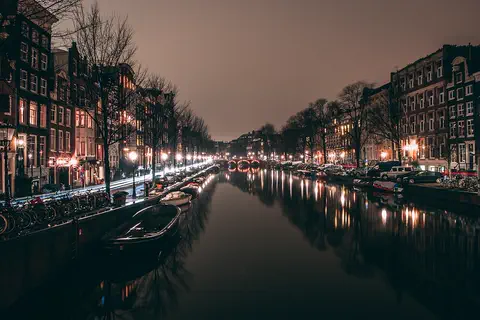
Amsterdam is the capital of the Netherlands. It began as a fishing village beside a dam on the Amstel River, which gave the city its name. Today about 942,000 people live among its rings of canals, hundreds of bridges, houseboats and bicycles.
-
 Watch
City
Athens
Athens is the capital of Greece and one of the oldest cities in the world. Above it rises the Acropolis, a rocky hill crowned by the marble Parthenon, built about 2,500 years ago. Ancient Athens was home to early democracy, great thinkers and theater.
-
 Watch
City
Barcelona
Barcelona, the capital of Catalonia in northeastern Spain, lies on the Mediterranean between mountains and the sea. It is famous for the buildings of the architect Antoni Gaudí, including the Sagrada Família, a giant church begun in 1882. About 1.7 million people live in the city (2025).
For parents & teachers
What children will learn
- Locate Tallinn on the Gulf of Finland and name its neighbors across the water.
- Describe a medieval trading town: walls, a town hall, a guildhall and churches.
- Explain how Tallinn was ruled by different powers before becoming Estonia's capital.
- Read temperature averages to describe a climate with cold winters and mild summers.
Recommended ages: 3 to 17 · About 15 minutes
Talk about it
- Why might people build a castle on a hill and a town for traders below it?
- Tallinn has very old buildings and very new technology companies. How can a city keep its old buildings while it changes?
- Merchants from many places traded in Tallinn. What goods might they have carried by ship?
Try at home or in class
- Draw a medieval town: a castle on a hill, a wall with towers around the town below, a town hall on the main square and a harbor.
- Make a timeline strip from 1219 to today and add the rulers of Tallinn in different colors.
Key vocabulary: capital, medieval, Hanseatic League, guildhall, trolleybus, start-up
Where these facts come from
- Wikidata , Wikimedia Foundation (CC0 1.0)
- Natural Earth vector data , Natural Earth (NACIS) (Public domain)
- UNESCO World Heritage List , UNESCO World Heritage Centre (Linked as a reference; site facts come from Wikidata)
- Tallinn , Encyclopaedia Britannica
- Historic Centre (Old Town) of Tallinn , UNESCO World Heritage Centre
- Public transport , Visit Tallinn (Tallinn City Tourist Office)
- Tallinn: climatological information , World Meteorological Organization, World Weather Information Service
- Wikimedia Commons , Wikimedia Foundation (Per file (public domain, CC0, CC BY or CC BY-SA); see each media record)
Checked, not yet human-reviewed. Last updated October 27, 2026. Spotted a mistake? Tell us.