
Landmark Asia
Taj Mahal
The Taj Mahal is a big white building in India. It has a huge round dome and four tall towers. An emperor built it to remember his wife.
The Taj Mahal is a white marble tomb in Agra, India, beside the Yamuna River. The Mughal emperor Shah Jahan had it built in memory of his wife, Mumtaz Mahal. More than 20,000 workers spent about 22 years on the tomb, its gardens, a mosque and a great gateway.
Commissioned by the Mughal emperor Shah Jahan after Mumtaz Mahal died in 1631, the Taj Mahal complex rose from about 1632 on the Yamuna's right bank. UNESCO, which listed it in 1983, calls it the jewel of Muslim art in India; its central dome reaches 73 m.
Photo: © Yann Forget, CC BY-SA 4.0, via Wikimedia Commons
Discover the Taj Mahal
The Taj Mahal is in the city of Agra, in India.
It is made of shiny white stone called marble. It has a big round dome on top. Four tall, thin towers stand at its corners. A long pool of water runs through its garden.
The Taj Mahal stands on the bank of the Yamuna River in Agra, in northern India. It is a mausoleum, a grand building that holds a tomb. The Mughal emperor Shah Jahan built it in memory of his wife, Mumtaz Mahal, who died in 1631.
The tomb is covered in white marble, which changes color with the light of the sun and moon. It sits at one end of a huge walled garden, with a mosque on one side and a matching building on the other. In 1983 UNESCO made it a World Heritage Site.
The Taj Mahal stands on the right (southern) bank of the Yamuna in Agra, in a Mughal garden of nearly 17 hectares. Shah Jahan (reigned 1628 to 1658) built it in memory of Mumtaz Mahal, his companion since their marriage in 1612, who died in childbirth in 1631. UNESCO calls it the jewel of Muslim art in India and the greatest architectural achievement of Indo-Islamic architecture; Britannica calls it the finest example of Mughal architecture, a blend of Indian, Persian and Islamic styles.
The complex has five principal elements, designed together as one: the main gateway, the garden, the mosque, the jawab (a building that mirrors the mosque) and the mausoleum with its four minarets. UNESCO inscribed it in 1983 under criterion (i), as a masterpiece of human creative genius.
- Where
- Agra, Uttar Pradesh, India, on the Yamuna River
- Built
- from about 1632; tomb finished 1648
- Height of the dome
- 240 ft (73 m) to the tip
- World Heritage Site
- since 1983
An emperor's memorial
Long ago, an emperor named Shah Jahan ruled a big empire.
His wife, Mumtaz Mahal, died. He was very sad. He had the Taj Mahal built to remember her. Later, he was buried there too.
Shah Jahan was the Mughal emperor from 1628 to 1658. When his wife Mumtaz Mahal died in 1631, he ordered a magnificent tomb for her in Agra.
Work began in about 1632. The tomb was finished in 1648, and the gateway, mosque, guest house and courtyards around it by 1653. In 1658, Shah Jahan's son Aurangzeb took the throne from him and kept him in Agra Fort for the rest of his life. Shah Jahan's own tomb was later placed beside his wife's.
UNESCO dates the construction from 1632 to 1648 for the tomb, with the mosque, guest house, main southern gateway and outer courtyard with its cloisters completed in 1653; Arabic inscriptions, both historical and Quranic, help fix this chronology. Britannica gives a slightly different sequence: the mausoleum by about 1638 to 1639, the adjunct buildings by 1643 and decoration until at least 1647, about 22 years in all.
In 1658 Shah Jahan was deposed by his son Aurangzeb and held in Agra Fort, about 1.6 km to the west, until his death. His cenotaph, larger than Mumtaz Mahal's, was installed beside hers more than thirty years after hers. Over the following centuries, Britannica notes, the complex suffered neglect and decay.
Who built it, and how
Thousands and thousands of workers built the Taj Mahal.
Stone cutters, carvers and painters came from many lands. Elephants helped carry heavy loads. Artists set colorful stones into the white marble.
Britannica says more than 20,000 workers built the Taj Mahal over about 22 years. Masons, stone cutters, carvers, painters, dome builders and artists who wrote beautiful lettering came from all over the Mughal Empire, and from Iran and Central Asia. The main architect was Ustad Ahmad Lahori.
The walls are brick, held with lime mortar and covered with red sandstone and white marble. The marble came from Makrana, in Rajasthan. Colored stones such as jade and turquoise came from as far away as China, Sri Lanka and Afghanistan, carried by hundreds of elephants.
UNESCO records that masons, stone-cutters, inlayers, carvers, painters, calligraphers, dome builders and other artisans were requisitioned from the whole empire and from Central Asia and Iran, and names Ustad Ahmad Lahori as main architect; Britannica counts more than 20,000 workers and names the calligrapher Amanat Khan al-Shirazi. The official site of Uttar Pradesh's tourism department says the design came from a team of architects, adding that credit at the time usually went to the patron.
The structure is brick in lime mortar, faced with red sandstone and marble. The white marble came from Makrana in Rajasthan; lapis lazuli, jade, turquoise and jasper were brought from regions including China, Sri Lanka and Afghanistan. According to the court historian Abdul Hamid Lahori, quoted on the state site, the foundation stands on a network of wells sunk along the river and filled with stone and other solid material.
Dome, minarets and gardens
The tomb sits on a high platform.
It has one big dome and four small domes. Four tall towers, called minarets, stand at the corners. Long pools of water cut the garden into four parts. Flowers made of colored stones decorate the walls.
The tomb stands on a platform 7 meters high, with a slim minaret at each corner. Its central dome rises 73 meters to the tip of its spike, called a finial, with four smaller domes around it. Each side has a giant arch 33 meters tall.
Inside, an eight-sided room holds the memorial tombs of Mumtaz Mahal and Shah Jahan, behind a carved marble screen. The real graves are in a room below. Outside, water channels divide the garden into four parts. Two matching red sandstone buildings stand on either side of the tomb: a mosque, where Muslims pray, and its mirror image.
The mausoleum stands on a 7 m plinth; each of its four nearly identical faces has a central arch 33 m high, and the central dome reaches 73 m at the tip of its finial, ringed by four lesser domes. UNESCO notes the innovation of placing the tomb at one end of the four-part garden rather than its center, adding depth to the view, and of four free-standing minarets, which give the building a three-dimensional effect.
The octagonal tomb chamber holds the cenotaphs of Mumtaz Mahal (at the exact center) and Shah Jahan within an inlaid marble lattice screen; as in other imperial Mughal tombs, the real graves lie in the crypt below. Decoration combines pietra dura, the inlay of semiprecious stones in floral and geometric designs, with Quranic calligraphy under Amanat Khan, its letters enlarged higher up so they look uniform from the terrace. The red sandstone mosque and its identical jawab flank the tomb.
- Plinth (platform)
- 23 ft (7 m) high
- Central arch of each face
- 108 ft (33 m) high
- Minarets
- 137 ft (about 42 m) tall
- Garden
- nearly 17 hectares

Caring for the Taj today
Millions of people visit the Taj Mahal every year.
It is closed on Fridays. People work hard to keep its white marble clean and safe from dirty air.
Millions of visitors come to the Taj Mahal every year. It opens 30 minutes before sunrise and closes on Fridays. On nights around the full moon, small groups can visit after dark.
Dirty air from factories and traffic has harmed the white marble. To protect it, India's Supreme Court ordered factories in a large area around Agra in 1996 to stop burning coal. Cars are kept away from the monument, and the Archaeological Survey of India looks after the buildings.
The Archaeological Survey of India manages the complex under the Ancient Monuments and Archaeological Sites and Remains Act of 1958. Air pollution from foundries, factories and traffic has damaged the marble; in December 1996 the Supreme Court banned coal and coke in industries of the Taj Trapezium Zone, a 10,400 km² area that holds 40 protected monuments, among them three World Heritage Sites (the Taj Mahal, Agra Fort and Fatehpur Sikri). Britannica adds that nearby vehicle traffic was banned and a parkland buffer created, though progress has been slow.
A major restoration took place at the start of the 20th century under the viceroy Lord Curzon, and an air-monitoring station now tracks pollutants. UNESCO stresses that the heavy pressure of visitors calls for an integrated management plan. Night viewing, banned from 1984 to 2004, is now open on full-moon nights to 400 people in eight groups of 50.
Amazing facts
-
The real graves are in a room under the floor.
The tombs you see inside are memorials. The real graves of Mumtaz Mahal and Shah Jahan are in a room below.
The upper cenotaphs are only illusory: as in other imperial Mughal tombs, the real graves lie in the lower chamber.
-
The letters get bigger higher up.
The writing around the arches gets bigger the higher it goes, so from the ground it all looks the same size.
The Quranic lettering increases in size with height and distance from the viewer, so it appears uniform from the terrace.
-
The tomb is not in the middle of the garden.
Most garden tombs stood in the middle of the garden. The Taj was built at the far end, so you see it across the whole garden.
Placing the tomb at one end of the quadripartite garden, rather than its center, was one of the innovations UNESCO highlights.
-
Only small groups can visit at night.
On nights around the full moon, the Taj opens for night visits, for up to 400 people in groups of 50.
Night viewing runs on the full-moon day and two days either side, for a maximum of 400 people in eight batches of 50.
Words to know
- mausoleum
- a large, grand building that holds a tomb
- minaret
- a tall, slim tower next to a mosque or tomb
- marble
- a hard stone that can be polished until it shines
- dome
- a round roof shaped like half a ball
- inlay
- pieces of colored stone set into a surface to make a pattern
- calligraphy
- beautiful, carefully made handwriting
- cenotaph
- a memorial tomb that does not hold the body
Discovery challenge
-
Which country is the Taj Mahal in?
In which country is the Taj Mahal?
In which country did the Mughal emperor Shah Jahan build the Taj Mahal?
- India
- Japan
- Egypt
Show the answer
India
India! It is in the city of Agra.
The Taj Mahal is in Agra, in northern India, beside the Yamuna River.
It stands on the right bank of the Yamuna in Agra, Uttar Pradesh, India.
-
Who did Shah Jahan build the Taj Mahal for?
In memory of whom was the Taj Mahal built?
Whose death in 1631 led Shah Jahan to commission the Taj Mahal?
- His horse
- His wife, Mumtaz Mahal
- His teacher
Show the answer
His wife, Mumtaz Mahal
He built it for his wife, Mumtaz Mahal.
Shah Jahan built it in memory of his wife, Mumtaz Mahal, who died in 1631.
Mumtaz Mahal, his companion since 1612, died in childbirth in 1631; building began about 1632.
-
What are the four tall towers called?
What are the four tall towers at the corners of the platform called?
What are the four free-standing towers at the corners of the plinth called?
- Minarets
- Chimneys
- Lighthouses
Show the answer
Minarets
They are called minarets.
Minarets are tall, slim towers. The Taj has one at each corner of its platform.
UNESCO says the four free-standing minarets added a new, three-dimensional effect to Mughal architecture.
-
What white stone covers the Taj Mahal?
What shiny white stone covers the tomb?
Which stone, quarried at Makrana in Rajasthan, faces the mausoleum?
- Marble
- Chalk
- Ice
Show the answer
Marble
Marble! It is shiny and white.
The tomb is covered in white marble from Makrana, in Rajasthan.
Makrana marble faces a core of brick in lime mortar; the flanking buildings use red sandstone.
-
How many people built the Taj Mahal?
About how many workers built the Taj Mahal?
How many workers does Britannica say built the Taj Mahal complex?
- One person
- About 20 people
- More than 20,000 people
Show the answer
More than 20,000 people
More than 20,000 people helped build it!
More than 20,000 workers, from many parts of the empire and beyond, built it over about 22 years.
Britannica gives more than 20,000 workers; UNESCO lists the trades, from masons to calligraphers and dome builders.
Nearby places
-
 Watch
Landmark
Agra Fort
Agra Fort is a huge red sandstone fortress beside the Yamuna River in Agra, India. The Mughal emperor Akbar began it in 1565. Its walls, about 2.5 kilometers around, protect palaces, halls and mosques added by later emperors. It was both an army base and a royal home.
-
 Watch
Landmark
Fatehpur Sikri
Fatehpur Sikri, the "City of Victory," was built on a ridge near Agra, India, by the Mughal emperor Akbar from 1571. It was his capital until 1585. Its red sandstone palaces, halls and great mosque still stand, and its gateway, the Buland Darwaza, is 40 meters tall.
-
 Watch
Natural wonder
Ganges
The Ganges, called the Ganga in India, flows about 2,510 kilometers from a glacier in the Himalayas across the plains of northern India to the Bay of Bengal, through India and Bangladesh. Its basin is home to hundreds of millions of people who farm, fish and travel on it. For many Hindus it is the holiest of rivers. Near the sea it builds a giant delta with the Brahmaputra.
-
 Watch
Landmark
Harmandir Sahib (Golden Temple)
Harmandir Sahib, often called the Golden Temple, is the most important gurdwara, or place of worship, for Sikhs. It stands on a small island in a pool in Amritsar, India, and a marble causeway leads out to it. Its upper stories are covered in gilded copper, and its free kitchen serves meals to about 100,000 people a day.
-
 Watch
Natural wonder
Himalayas
The Himalayas are a giant wall of mountains in Asia, between the high Plateau of Tibet and the plains of India. They hold the highest mountains in the world, including Mount Everest. They rose when the land carrying India crashed into Asia, and their snow and ice feed great rivers such as the Ganges and the Indus.
-
 Watch
Natural wonder
Chitwan National Park
Chitwan National Park, in the lowlands of southern Nepal, was Nepal's first national park. Its sal forests, tall grasslands and rivers are home to the second-largest population of greater one-horned rhinoceroses in the world, 694 in 2021, and to Bengal tigers, 145 counted in and around the park in 2026.
-
 Watch
Natural wonder
Ajanta Caves
The Ajanta Caves are about 30 halls and rooms carved by hand into a curving cliff above the Waghora River in western India. Buddhist communities made them in two big phases, starting more than 2,000 years ago. Their wall paintings and stone carvings are some of the most famous ancient art in India, and they have been a UNESCO World Heritage Site since 1983.
-
 Watch
Natural wonder
Mount Everest
Mount Everest, in the Himalayas on the border of Nepal and China, is what Britannica calls the highest mountain in the world. In 2020 China and Nepal announced its height as 8,848.86 meters. It grew as two giant plates of Earth's crust pushed together, and it is still rising a tiny bit each year.
Experiments to try
Explore next
-
Watch
 Country
India
India is a huge country in South Asia, shaped like a big triangle pointing into the Indian Ocean. The Himalayas rise along its north, heavy monsoon rains arrive every summer, and about 1.46 billion people (2025) live there, speaking hundreds of languages.
-
Watch
Landmark
Agra Fort
Agra Fort is a huge red sandstone fortress beside the Yamuna River in Agra, India. The Mughal emperor Akbar began it in 1565. Its walls, about 2.5 kilometers around, protect palaces, halls and mosques added by later emperors. It was both an army base and a royal home.
-
 Watch
Landmark
Hagia Sophia
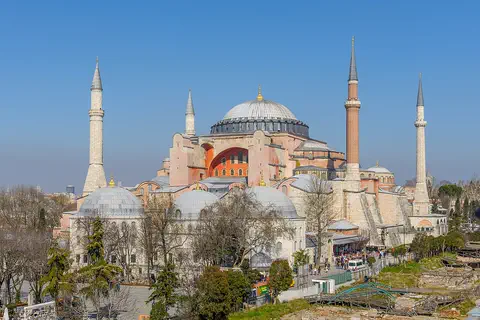
Hagia Sophia in Istanbul was built in under six years, from 532 to 537, for the emperor Justinian. Its enormous dome seems to float on a ring of 40 windows. Over almost 1,500 years it has been a church, a mosque and a museum, and since 2020 it has been a mosque.
- Watch Geography What is a World Heritage Site? World Heritage Sites are places so important that they belong, in a way, to everyone. Under a 1972 agreement, countries nominate their most outstanding places, experts check them, and a UNESCO committee decides. By 2026 the list held 1,273 sites: cultural places like the Taj Mahal, natural places like the Galápagos, and mixed ones like Machu Picchu.
- Watch Try it What If? Lab What if buildings had different foundations? A building's whole weight presses down through its foundation onto the ground. A wide foundation spreads that weight out, like snowshoes on snow. In our model, a 200-tonne building on sand is safe on a 40-square-meter footing. Shrink the footing to 8 square meters and it presses five times harder, more than the sand can take, so the building would sink and could crack or tilt.
-
 Watch
Landmark
Mausoleum at Halicarnassus
The Mausoleum at Halicarnassus was the tomb of Mausolus, ruler of Caria, in what is now southwestern Turkey. Built around 353 to 351 BCE, it was covered in sculptures by four famous Greek artists and became one of the Seven Wonders of the World. An earthquake probably brought it down, and its stones went into other buildings, but its name lives on in the word 'mausoleum'.
-
 Watch
Landmark
Alhambra
The Alhambra is a palace and fortress above the city of Granada, in Spain. The Nasrid rulers built most of it between 1238 and 1358. It is famous for its courtyards, fountains, carved plaster and tiles, and the gardens of the Generalife next door.
-
Watch
Landmark
Fatehpur Sikri
Fatehpur Sikri, the "City of Victory," was built on a ridge near Agra, India, by the Mughal emperor Akbar from 1571. It was his capital until 1585. Its red sandstone palaces, halls and great mosque still stand, and its gateway, the Buland Darwaza, is 40 meters tall.
For parents & teachers
What children will learn
- Locate Agra and explain why Shah Jahan built the Taj Mahal.
- Describe who built the Taj Mahal and where its materials came from.
- Name the parts of the complex (tomb, dome, minarets, garden, mosque, gateway) and explain its symmetry.
- Discuss how pollution and crowds affect a monument and what is done to protect it.
Recommended ages: 3 to 17 · About 15 minutes
Talk about it
- The Taj Mahal is perfectly balanced: each side matches the other. Can you find something symmetrical in your home or school?
- Why might builders bring stone from far away instead of using what was nearby?
- How can visitors help protect a famous building like the Taj Mahal?
Try at home or in class
- Fold a sheet of paper in half, draw half a building with a dome along the fold, cut it out and open it to see a symmetrical shape.
- Make an 'inlay' picture by gluing small pieces of colored paper into a flower pattern on white card.
Key vocabulary: mausoleum, minaret, marble, dome, inlay, calligraphy, cenotaph
Where these facts come from
- Wikidata , Wikimedia Foundation (CC0 1.0)
- UNESCO World Heritage List , UNESCO World Heritage Centre (Linked as a reference; site facts come from Wikidata)
- Taj Mahal , UNESCO World Heritage Centre
- Taj Mahal , Encyclopaedia Britannica
- Creation of the Taj Mahal , Official Taj Mahal website, Department of Tourism, Government of Uttar Pradesh
- History of the Taj Mahal , Official Taj Mahal website, Department of Tourism, Government of Uttar Pradesh
- Outlying buildings , Official Taj Mahal website, Department of Tourism, Government of Uttar Pradesh
- FAQs , Official Taj Mahal website, Department of Tourism, Government of Uttar Pradesh
- Wikimedia Commons , Wikimedia Foundation (Per file (public domain, CC0, CC BY or CC BY-SA); see each media record)
Checked, not yet human-reviewed. Last updated October 24, 2026. Spotted a mistake? Tell us.