How do clamps hold pieces tightly together?
A clamp's screw turns easy twists of your hand into a strong squeeze, and friction keeps it tight after you let go.
The big idea: The screw in a clamp is a ramp wrapped around a rod. Many easy turns move it a tiny way with a big push. Friction in the thread stops it from turning back, so the squeeze stays.
It's like screwing a lid onto a jar: easy twists press the lid down hard, and it stays tight after you let go because the threads grip.
The interactive parts didn't load. The explanations below still work; try reloading the page.
How a clamp holds on
- Kai is gluing two boards. Glue needs a firm squeeze for a long time while it dries. His hands get tired, and when he lets go the boards slip apart.
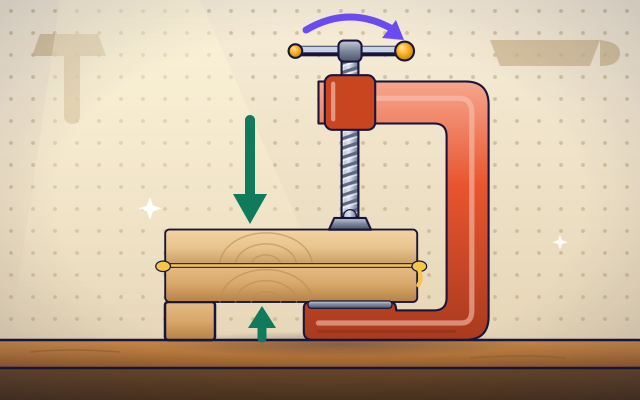
- A clamp has a strong frame shaped like the letter C and a long screw. Turning the handle winds the screw down through the frame until its pad touches the wood.
- The ridge on a screw is really a ramp wrapped around a rod. One whole turn of the handle moves the screw down by just one ridge. Your hand travels far, so the screw pushes hard.
- Keep turning and the pad presses down while the jaw below presses up. The boards are squeezed between them, and the frame holds the two jaws together.
- Kai lets go of the handle, and nothing moves. The ridges of the screw press against the ridges in the frame, and that rubbing, called friction, stops the screw from turning back.
- When the glue is dry, Kai unscrews the clamp. The boards are joined for good. Other clamps squeeze in other ways: a clothespin uses a spring, and a bar clamp slides to fit big things.
Look closely at a C-clamp
Tap each part to see it move. Which part makes the push, and which part holds it?
- Handle. The handle is a bar through the top of the screw. Pushing on its end turns the screw. A longer handle makes turning easier.
- Screw. The screw is a steel rod with a ridge winding around it. Each full turn moves it down by one ridge, slowly but with great force.
- Threaded hole. The hole in the frame has matching ridges inside. The screw's ridges slide along them, so turning the screw makes it climb up or down.
- Swivel pad. The pad on the end of the screw sits on a ball, so it can tilt to lie flat on the wood. It also stays still while the screw turns, so it does not scratch.
- Fixed jaw. The fixed jaw is part of the frame. When the screw pushes the wood against it, it pushes back just as hard. That is the squeeze.
- Frame. The C-shaped frame joins the two jaws. The squeeze tries to pull the C open, so the frame is made thick and strong to resist.
Tighten, let go, test
Drag the handle to tighten the clamp, then hang the weight to test it. Try it loose, then tight. Then try the steep, slippery thread.
Experiment: You tighten the clamp and let go of the handle. What happens to the squeeze?
- With the clamp loose, tap the weight. What happens to the top board?
- Tighten the clamp until the needle is in the green. The weight tugs again by itself.
- Now choose the steep, slippery thread and tighten again.
What we found: A loose clamp cannot stop the boards from sliding. A tight one can, and it stays tight when you let go, because friction between the screw's ridges and the frame's ridges stops the screw from turning back. With a steep, slippery thread the squeezed wood just pushes the screw back out.
Turn on JavaScript to try it yourself.
Not too loose, not too tight
Glue needs just the right squeeze. Tighten until the needle is in the green band, then press Check. Too tight squeezes all the glue out!
How a clamp really works
A clamp is a helper that squeezes and never gets tired. Woodworkers use clamps to press glued boards together for an hour or more while the glue dries. They also use them to hold wood still for sawing or drilling. Your hands could never squeeze that hard for that long.
The secret is the screw. Look closely at one and you will see a ridge winding around it. That ridge is a ramp, wrapped around a rod. Walking up a gentle ramp is easier than climbing straight up, but you have to walk farther. A screw works the same way: your hand goes round and round, the screw moves down only a little, and in exchange it pushes very hard.
When the screw's pad touches the wood, the push begins. The pad pushes down and the fixed jaw pushes up, and the strong C-shaped frame holds them together. The frame even stretches a tiny bit, like a very stiff spring. That is useful, because it keeps squeezing even if the wood sinks a little.
Why does the clamp stay tight when you let go? Because of friction, the rubbing between the screw's ridge and the ridge inside the frame. The ramp is so gentle that the wood cannot push the screw back up it. A jar lid stays tight the same way. The jar lid idea only goes so far, though: a lid just closes a jar, while a clamp's frame has to carry the whole squeeze around the outside.
Key words
- Thread
- The ridge that winds around a screw, and the matching groove inside a nut or hole.
- Pitch
- How far a screw moves in one full turn.
- Friction
- The force that resists two surfaces sliding over each other.
- Mechanical advantage
- How many times a tool multiplies your push.
- Self-locking
- Staying tight without being held, because friction stops it from turning back.
- Torque
- The turning effect of a force: the force multiplied by its distance from the axis.
Check your thinking
-
A screw's ridge is really a ramp wrapped around a rod. What does that do for you?
Show the answer
Many easy turns become one slow, strong push. Your hand goes a long way round while the screw moves a little. Trading distance for force gives a strong push.
-
Why does a clamp stay tight after you let go?
Show the answer
Friction between the ridges stops the screw from turning back. The screw's ramp is very gentle, and the ridges rub. The wood cannot push the screw back up the ramp.
-
The screw pushes down on the wood. What pushes up?
Show the answer
The fixed jaw, just as hard. A squeeze needs two sides. The fixed jaw pushes back just as hard, and the frame holds the two jaws together.
-
You want more squeeze from the same push. Which change helps?
Show the answer
A longer handle. A longer handle is a longer lever, so the same push turns the screw harder.
-
Why can tightening a clamp as hard as possible make a glue joint weaker?
Show the answer
It can squeeze out too much glue and crush the wood fibers. A joint needs a thin, even film of glue. Too much pressure forces the glue out and can dent the wood.
You're a Tools & workshop expert!
You watched, looked inside, tried it, solved the challenge and went deeper. Pick another question below, or switch the age at the top to see this topic another way.
More about tools & workshop
 #170
Tools & workshop
How does a hammer drive a nail?
Change hammer mass and speed and compare the impact on a model nail.
#170
Tools & workshop
How does a hammer drive a nail?
Change hammer mass and speed and compare the impact on a model nail.
 #171
Tools & workshop
How does a rivet fasten sheets together?
Set a virtual rivet and watch its end deform to grip the sheets.
#171
Tools & workshop
How does a rivet fasten sheets together?
Set a virtual rivet and watch its end deform to grip the sheets.
 #172
Tools & workshop
How do wire strippers remove insulation?
Match virtual wire sizes to openings and separate insulation without cutting the conductor.
#172
Tools & workshop
How do wire strippers remove insulation?
Match virtual wire sizes to openings and separate insulation without cutting the conductor.
 #181
Tools & workshop
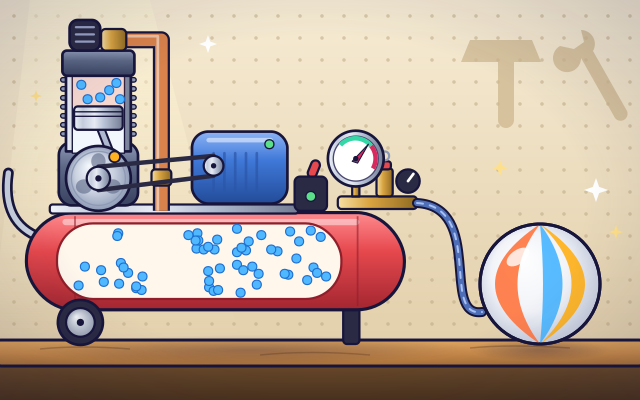
How does an air compressor store compressed air?
Watch a piston draw in air and push it into a storage tank.
#181
Tools & workshop
How does an air compressor store compressed air?
Watch a piston draw in air and push it into a storage tank.
Keep exploring
Games to play next
- Machine RepairFix levers, pulleys, gears and ramps so every contraption works.
- Bridge LabBuild a bridge from beams, brace it with triangles, and stay on budget.
Guide for grown-ups
- How to start homeschooling: a step-by-step guide for familiesA guide for parents · 7 min read
Science games by grade
Science worksheets by grade
- Preschool Science Worksheets
- Pre-K Science Worksheets
- Kindergarten Science Worksheets
- 1st Grade Science Worksheets
- 2nd Grade Science Worksheets
- 3rd Grade Science Worksheets
- 4th Grade Science Worksheets
- 5th Grade Science Worksheets
- 6th Grade Science Worksheets
- 7th Grade Science Worksheets
- 8th Grade Science Worksheets