How does a power sander smooth surfaces?
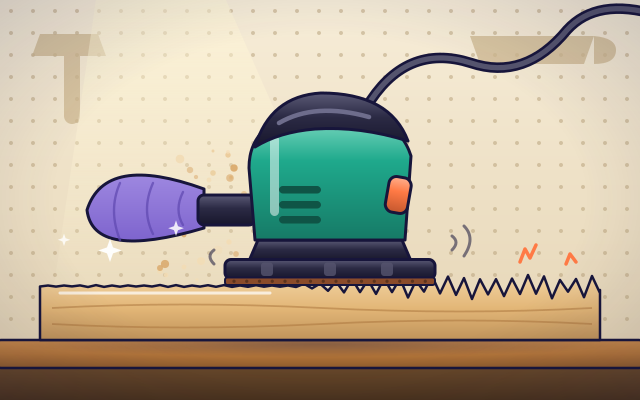
A motor rubs sandpaper in tiny, fast circles, and thousands of sharp grains scrape the bumps away.
The big idea: Every grain on sandpaper is a tiny sharp scraper. A sander's motor moves the paper very fast, so the grains scrape off the high spots. Finer and finer paper leaves smaller and smaller scratches.
It's like filing a fingernail: a nail file is covered in tiny hard grains, and rubbing it back and forth scrapes the rough edge away a little at a time.
The interactive parts didn't load. The explanations below still work; try reloading the page.
From rough to smooth
- Ava has built a shelf, but the wood is rough and full of splinters. Rubbing it with her hand does nothing. She needs a power sander.
- The secret is on the bottom: sandpaper. Look closely and you see thousands of hard, sharp grains glued onto strong paper.
- When the paper moves, each grain scrapes off a tiny shaving. The tall bumps go first, because they are the ones the grains touch.
- Inside the sander, a motor spins a weight that is off center. That makes the pad jiggle in tiny circles, thousands of times every minute.
- Big grains take the bumps off fast, but leave scratches. So next comes paper with smaller grains, then smaller still. Each one rubs out the scratches of the one before.
- All the wood that was scraped off is now fine dust. A fan inside sucks it up through holes in the pad and blows it into a bag. The shelf is silky smooth.
Look inside a power sander
Tap each part. See how the motor's spin becomes a tiny, fast jiggle at the pad.
- Switch. The switch lets electricity flow to the motor. A grown-up holds the sander by its rounded top and keeps it moving.
- Motor. The electric motor spins a shaft that points straight down at the pad.
- Fan. A fan on the motor shaft pulls air up through the holes in the pad. The air carries the dust with it.
- Off-center weight. This part sits off center on the shaft. As it spins, it pushes the pad round in tiny circles instead of just spinning it.
- Pad. The pad is a flat, slightly soft disc. It presses the sandpaper evenly onto the wood, and has holes for the dust.
- Sandpaper. The sandpaper disc is the only part that touches the wood. Its hard grains do all the scraping, so it wears out and gets replaced.
- Dust bag. The bag lets the air out but traps the dust. When it is full, a grown-up empties it.
Which paper, which motion?
Drag the sander across the board, or press Sand. Try the three papers and the three motions. What is the quickest way to a silky board?
Experiment: What is the quickest way to make a rough board silky smooth?
- Sand with fine paper only and count the passes until the board is silky.
- Press New rough board. Sand with coarse, then medium, then fine.
- Compare the number of passes.
What we found: Coarse paper takes the tall bumps off quickly, but it cannot make the board smooth, because its big grains leave scratches. Fine paper leaves tiny scratches, but it is slow on tall bumps. Using coarse, then medium, then fine is the quickest way to silky.
Turn on JavaScript to try it yourself.
Silky in ten passes
Make the tabletop silky smooth in 10 passes or fewer. Choose your papers wisely.
How sanding really works
Run a finger over sandpaper and it feels scratchy. That is because it is covered in thousands of tiny grains of very hard mineral, glued onto strong paper. Each grain has sharp corners, like a tiny scraper. A nail file works the same way, which is why filing a nail makes a little pile of dust.
When sandpaper rubs across wood, each grain scrapes off a tiny shaving. The tallest bumps get scraped first, because they stick up and meet the grains. Rub long enough and the bumps are worn down to the same level. But the grains leave little scratches of their own, as deep as the grains are big.
That is why sandpaper comes in different grits. Coarse paper has big grains. It removes wood fast and leaves deep scratches. Fine paper has tiny grains. It removes wood slowly and leaves scratches too small to feel. Woodworkers start coarse and finish fine, so each paper rubs out the scratches of the one before.
Rubbing by hand is slow, so a power sander uses a motor. The motor spins a part that is off center, which moves the pad in tiny circles thousands of times a minute. A nail file only goes back and forth, so this is where the comparison ends. A fan sucks the dust into a bag. The grown-up using it keeps it moving and does not press hard.
Key words
- Abrasive
- A hard, rough material that wears another material away by rubbing.
- Grit
- A number that tells how big the grains on sandpaper are. A bigger number means smaller grains.
- Orbit
- The tiny circle a sander's pad moves in.
- Off-center weight
- A part mounted away from the middle of a shaft, so that spinning it makes a circling, shaking motion.
- Micrometer
- One thousandth of a millimeter. A human hair is roughly 70 micrometers thick.
Check your thinking
-
How does sandpaper make wood smoother?
Show the answer
Its hard grains scrape the tops off the bumps. Each grain is a tiny scraper. Together they wear the bumps down and make dust.
-
You sand a rough board with coarse paper for a long time. Why does it never get silky?
Show the answer
The big grains keep leaving scratches of their own. A surface can only be as smooth as the scratches the paper leaves. Big grains leave big scratches.
-
Why do woodworkers use coarse paper first and fine paper last?
Show the answer
Coarse is quick on big bumps, and fine rubs out the scratches coarse leaves. Each paper does the job it is quick at. Fine paper on tall bumps would take a very long time.
-
What makes a sander's pad move in tiny circles?
Show the answer
A spinning part that is off center. The off-center part pushes the pad around in a tiny circle each time the motor turns.
-
Someone presses down hard on a sander to finish faster. What is the most likely result?
Show the answer
The pad slows and the scratches get deeper, so the finish is worse. Extra pressure loads the motor and digs the grains in deeper. Light, even pressure and steady movement give the best finish.
You're a Tools & workshop expert!
You watched, looked inside, tried it, solved the challenge and went deeper. Pick another question below, or switch the age at the top to see this topic another way.
More about tools & workshop
 #169
Tools & workshop
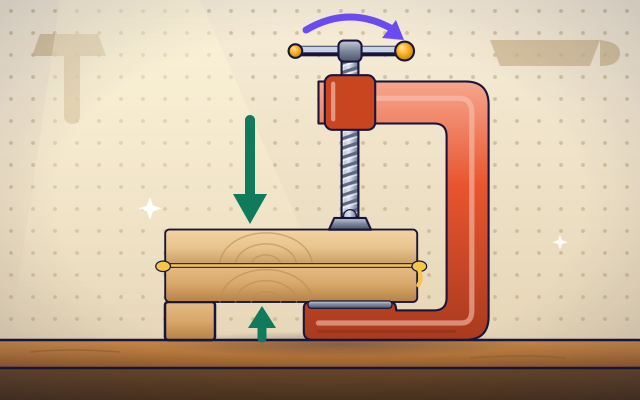
How do clamps hold pieces tightly together?
Tighten a clamp and trace how its mechanism maintains squeezing force.
#169
Tools & workshop
How do clamps hold pieces tightly together?
Tighten a clamp and trace how its mechanism maintains squeezing force.
 #170
Tools & workshop
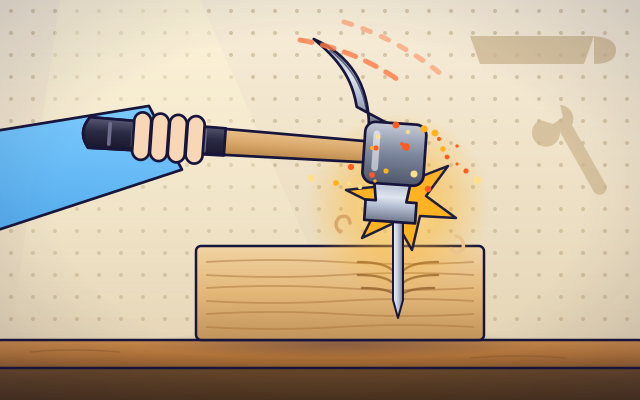
How does a hammer drive a nail?
Change hammer mass and speed and compare the impact on a model nail.
#170
Tools & workshop
How does a hammer drive a nail?
Change hammer mass and speed and compare the impact on a model nail.
 #171
Tools & workshop
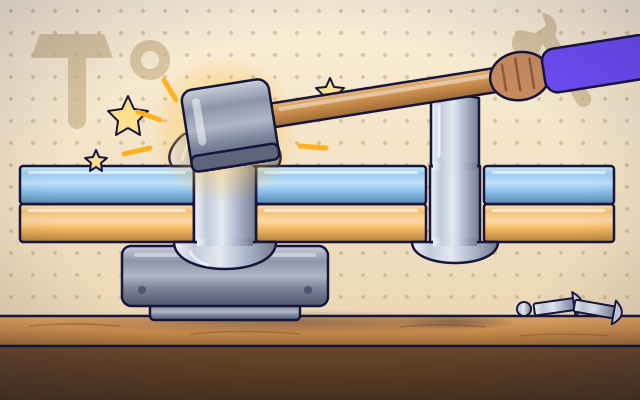
How does a rivet fasten sheets together?
Set a virtual rivet and watch its end deform to grip the sheets.
#171
Tools & workshop
How does a rivet fasten sheets together?
Set a virtual rivet and watch its end deform to grip the sheets.
 #172
Tools & workshop
How do wire strippers remove insulation?
Match virtual wire sizes to openings and separate insulation without cutting the conductor.
#172
Tools & workshop
How do wire strippers remove insulation?
Match virtual wire sizes to openings and separate insulation without cutting the conductor.
Keep exploring
Games to play next
- Machine RepairFix levers, pulleys, gears and ramps so every contraption works.
- Bridge LabBuild a bridge from beams, brace it with triangles, and stay on budget.
Guide for grown-ups
- How to start homeschooling: a step-by-step guide for familiesA guide for parents · 7 min read
Science games by grade
Science worksheets by grade
- Preschool Science Worksheets
- Pre-K Science Worksheets
- Kindergarten Science Worksheets
- 1st Grade Science Worksheets
- 2nd Grade Science Worksheets
- 3rd Grade Science Worksheets
- 4th Grade Science Worksheets
- 5th Grade Science Worksheets
- 6th Grade Science Worksheets
- 7th Grade Science Worksheets
- 8th Grade Science Worksheets