How does air traffic control organize flights?
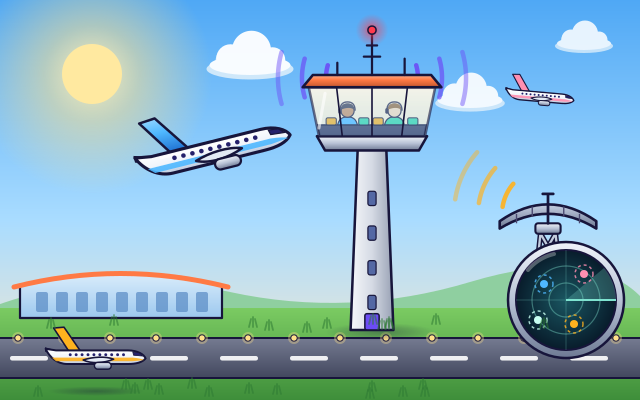
Controllers watch every plane on radar and talk to the pilots, so planes stay apart and take turns on the runway.
The big idea: Air traffic controllers can see where every plane is. They give each pilot instructions that keep the planes a safe distance apart and line them up for the runway.
It's like a crossing guard and a lunch line together: someone who can see everybody tells each person when to go, so nobody bumps and everyone gets a turn.
The interactive parts didn't load. The explanations below still work; try reloading the page.
Eyes on the sky
- A big airport has a takeoff or a landing every minute or two. Planes fly fast and cannot stop in the air. Somebody has to organize them all.
- A turning radar dish sends out pulses of radio waves. They bounce off each plane and return as echoes. The time each echo takes shows how far away the plane is, and it appears as a dot on the radar screen.
- The controller speaks to the pilots by radio and tells them which way to turn, how high to fly and how fast. Each pilot repeats the instruction back, so both know it was heard correctly.
- The rule is to keep a safe gap around every plane. Two planes may fly on the same path if one stays far behind the other. They may also cross, if one flies well above the other.
- Planes arrive from every direction, but there is only one runway. The controller slows some and turns others until they form one evenly spaced line. If the line is full, a plane circles in a holding loop and waits.
- The tower controller watches the runway. Only one plane may use it at a time. When a landing plane has turned off the runway, the next one is cleared to land or to take off.
Look inside the control tower
This is the top of an airport control tower. Tap each part to find out how controllers see and talk to the planes.
- Glass cab. The room at the top has windows all the way around. From here the tower controllers can see the runway, the taxiways and the planes close to the airport with their own eyes.
- Radio mast. Aerials on the roof send the controller's voice to the planes by radio and bring the pilots' answers back. Controllers wear headsets so they can listen and talk all the time.
- Radar dish. The radar dish turns all the time, sending out radio pulses and catching the echoes that bounce back from planes. Each turn gives a fresh picture of the sky.
- Radar screen. The radar screen shows a symbol for every plane, with a small label beside it. The label gives the flight's name and how high it is flying.
- Flight strips. Every flight has a strip, like a name card, showing where it is going. Controllers keep the strips in the order the planes will land or take off, and move a strip when a plane moves.
- Runway lights. Lights along the edges of the runway show pilots exactly where to land in the dark, in rain or in fog. The tower controllers switch them on and set how bright they are.
Two planes, one runway
This is a radar screen. Two planes are heading for one runway and will arrive together. Give the orange plane an instruction and watch the gap between them.
Experiment: Two planes would reach the runway together. What happens if the controller slows one of them down?
- Leave the instruction on Straight in and watch what the alert does.
- Choose Slow down and read the gap at the merge.
- Try Long way round and Circle once. Which gap is biggest?
What we found: Slowing a plane, sending it on a longer path or making it circle all open up a gap, so the two planes reach the runway one after the other. Circling makes the biggest gap. That is very safe, but the runway sits empty while it passes.
Turn on JavaScript to try it yourself.
Clear them to land
Four planes wait in holding loops. Clear them to land one after another, keeping 5 kilometers between them. One plane is slow, so choose your order with care.
How controllers organize the sky
A plane cannot pull over and stop. It has to keep moving fast to stay in the air, and from the cockpit a pilot can only see a small part of the sky. So every flight is watched by air traffic controllers, people whose whole job is to keep planes safely apart.
Controllers see the planes with radar. A turning dish sends out radio pulses, and the echoes show where each plane is. Each plane also sends back its name and its height. On the screen, every flight is a small symbol with a label.
Controllers talk to pilots by radio. They might say: turn left, fly lower, or slow down. The pilot repeats the instruction to show it was understood. With these instructions the controller keeps a gap around every plane, either side to side or up and down.
Near the airport, planes from every direction have to share one runway. The controller arranges them into one line, like children lining up at a door, with a safe space between each one. Unlike a line of children, though, planes cannot stand still, so a plane that has to wait flies round and round in a holding loop until it is called.
Key words
- Separation
- The safe gap that must always be kept around a plane.
- Radar
- A system that finds planes by sending out radio pulses and catching the echoes.
- Holding pattern
- A loop that a plane flies round and round while it waits for its turn.
- Readback
- The pilot repeating an instruction so the controller can check it was heard correctly.
- Wake
- Swirling air left behind a plane's wings, strongest behind big planes.
- Handoff
- Passing a flight from one controller to the next as it moves on.
Check your thinking
-
Why may only one plane use a runway at a time?
Show the answer
So a landing or departing plane always has a clear strip in front of it. Planes move very fast on the runway and cannot swerve, so the whole strip must be empty for each one.
-
A plane has to wait for its turn to land. What does it do?
Show the answer
It flies round a holding loop. A plane has to keep moving to stay up, so it circles in a holding pattern until the controller calls it in.
-
How does radar find out where a plane is?
Show the answer
It sends out radio pulses and catches the echoes. Radio pulses bounce off the plane. The echo shows which direction it is in and how far away.
-
Why does the pilot repeat the controller's instruction?
Show the answer
So both can be sure it was heard correctly. If the pilot repeats it wrongly, the controller hears the mistake and corrects it straight away.
-
A fast jet is cleared onto the approach just behind a much slower plane. What happens to the gap between them?
Show the answer
It shrinks, because the jet catches up. The plane behind is faster, so it closes on the one in front. Controllers put slower aircraft behind faster ones, or leave extra room.
-
Two planes need to cross the same point. Which of these keeps them safely separated?
Show the answer
One flies well above the other. Planes can be kept apart sideways or in height. A big enough height difference lets them cross safely.
You're a Buildings & city systems expert!
You watched, looked inside, tried it, solved the challenge and went deeper. Pick another question below, or switch the age at the top to see this topic another way.
More about buildings & city systems
 #368
Buildings & city systems
How do dry docks make ship repairs possible?
Float in a vessel, close the gate, and lower water around its hull.
#368
Buildings & city systems
How do dry docks make ship repairs possible?
Float in a vessel, close the gate, and lower water around its hull.
 #369
Buildings & city systems
How do utility maps show what is underground?
Switch between pipe and cable layers before planning a simulated excavation.
#369
Buildings & city systems
How do utility maps show what is underground?
Switch between pipe and cable layers before planning a simulated excavation.
 #370
Buildings & city systems
How does a stadium open and close its roof?
Coordinate movable roof sections as they travel along their tracks.
#370
Buildings & city systems
How does a stadium open and close its roof?
Coordinate movable roof sections as they travel along their tracks.
 #371
Buildings & city systems
How do buildings use emergency backup power?
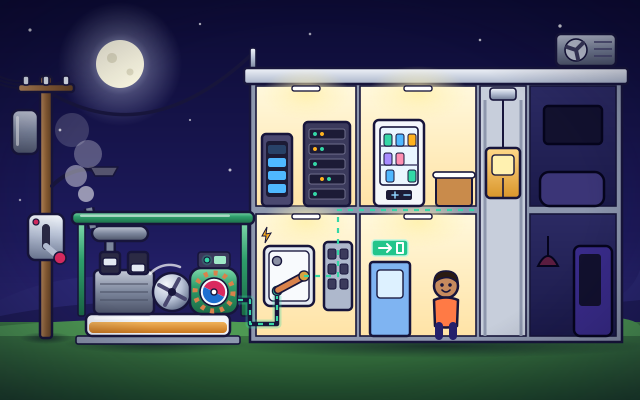
Simulate an interruption and watch essential equipment transfer to a backup supply.
#371
Buildings & city systems
How do buildings use emergency backup power?
Simulate an interruption and watch essential equipment transfer to a backup supply.
Keep exploring
Games to play next
- Plane Flight SimulatorTake off from the runway and thread numbered sky hoops in order. Every clean flight is a new personal best.
- Bridge LabBuild a bridge from beams, brace it with triangles, and stay on budget.
- Route PlannerFind the shortest way around town, dodge closed roads, and measure trips with a scale bar.
Guide for grown-ups
- How to start homeschooling: a step-by-step guide for familiesA guide for parents · 7 min read
Science games by grade
Science worksheets by grade
- Preschool Science Worksheets
- Pre-K Science Worksheets
- Kindergarten Science Worksheets
- 1st Grade Science Worksheets
- 2nd Grade Science Worksheets
- 3rd Grade Science Worksheets
- 4th Grade Science Worksheets
- 5th Grade Science Worksheets
- 6th Grade Science Worksheets
- 7th Grade Science Worksheets
- 8th Grade Science Worksheets