How does a stadium open and close its roof?
A stadium's sliding roof is made of huge panels that roll along rails on wheels, driven slowly by electric motors that must all move together.
The big idea: Each half of the roof sits on wheels that run along two long rails. Motors turn the wheels slowly, and a computer keeps both ends of each half moving together so it never twists.
It's like a sliding closet door on its track: push just one corner and it twists and sticks, so you have to move both ends together.
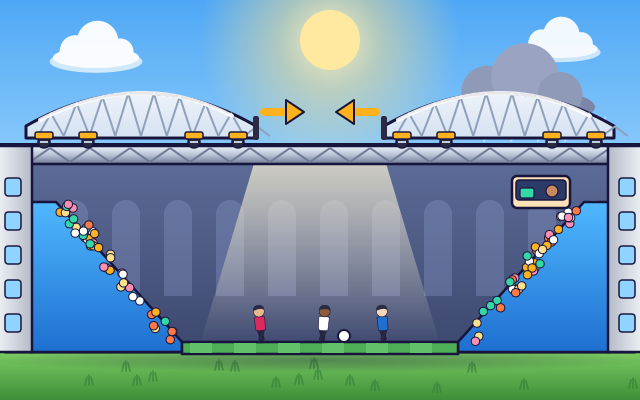
The interactive parts didn't load. The explanations below still work; try reloading the page.
Closing the roof
- It is a sunny day and the stadium roof is wide open. Then dark clouds blow in and rain begins to fall on the field. Time to close the roof!
- The roof is built in big pieces called panels. Here there are two halves. Each one rests on rails that run along the top of the stadium walls.
- Under each end of a panel are carriages with steel wheels, like the wheels of a train. Electric motors turn them through gears. The gears make the wheels turn slowly but with great force.
- Both ends of a panel must move at the same speed. If one end gets ahead, the panel twists across its rails and sticks. Sensors watch each end, and a computer slows whichever one is in front.
- The two halves roll toward each other and meet in the middle. Soft seals squeeze together along the join, so the rain runs off the roof instead of onto the field.
- When the weather clears, the motors run the other way and the halves roll back to the ends. Opening or closing takes about a quarter of an hour.
Look inside a sliding roof
The stadium has been cut through, and the round lens shows one wheel carriage close up. Tap each part to see what it does.
- Roof panel. Each roof panel is a frame of steel beams with a light covering on top. It has to be strong enough to span the whole stadium, but light enough to move.
- Rail. A steel rail runs along the top of each long wall, just like a railway track. The whole weight of the roof presses down on these two rails.
- Wheel carriage. A wheel carriage, called a bogie, has steel wheels that roll on the rail. Each panel stands on several of them, sharing the weight.
- Motor and gears. An electric motor on the carriage turns the wheels through a set of gears. A small gear turning a big gear makes the wheel go slowly but push very hard.
- Position sensor. A sensor on each end of the panel measures exactly how far it has travelled along the rail, and tells the control room.
- Control room. An operator starts the roof from the control room. A computer then drives all the motors, keeps every carriage in step, and stops everything if something looks wrong.
- Seal. Along the edges where the panels meet are soft rubber seals. When the roof closes, the seals squeeze together and keep out rain and wind.
Keep both ends together
You are looking down on the stadium. Press Close the roof and watch what happens when the south motors are slower. Drag the yellow handles to move each end yourself.
Experiment: The south motors run a bit slower than the north motors, and there is no computer link. What happens when the roof starts to close?
- Leave the south motors a bit slower and press Close the roof. Watch the twist.
- Wait while the crew lines the panel up. Then switch on the computer link.
- Press Close the roof again. Does it reach the middle this time?
What we found: When one end travels faster, the panel turns slightly and wedges across its rails, like a drawer pushed at one corner. With the computer link on, the faster end is held back so both ends arrive together. The roof closes safely, just a little more slowly.
Turn on JavaScript to try it yourself.
Close it by hand
The computer link is switched off for repair, and a storm is coming. Press Start closing, then keep the panels straight by boosting whichever end falls behind.
How a stadium roof opens and closes
Some stadiums can do something amazing: on a fine day the roof is open to the sky, and when it rains the roof slides shut. The moving part is built in giant pieces called panels. Each panel is a frame of steel beams with a light covering, wide enough to stretch right across the stadium.
The panels do not hang from above. They stand on steel wheels that roll along rails on top of the two long walls, much like a train on its track. Electric motors turn the wheels through gears. The gears make the wheels turn slowly but with enormous force, so the roof creeps along more slowly than you walk.
The clever part is keeping everything together. If one end of a panel moved faster than the other, the panel would twist and jam on its rails. So sensors measure how far each end has gone, and a computer speeds up or slows down the motors to keep them level.
It works like a sliding closet door on its track, but with one big difference. You can feel a door start to stick and stop pushing. A roof panel is far too big for anyone to feel, so sensors and a computer have to do the feeling. When the halves meet, rubber seals squeeze together to keep the rain out.
Key words
- Retractable roof
- A roof that can be opened and closed by moving parts of it out of the way.
- Bogie
- A carriage with wheels that carries part of the roof along the rail.
- Truss
- A strong, light frame made of beams joined in triangles.
- Gearbox
- A set of gears that makes a motor's fast, weak turning into slow, powerful turning.
- Skew
- The twist when one end of a panel gets ahead of the other.
- Synchronization
- Making separate motors move exactly together, by measuring each one and correcting it.
Check your thinking
-
What does a stadium's sliding roof travel on?
Show the answer
Steel wheels running on rails. The panels stand on wheeled carriages that roll along rails on top of the walls, like a train.
-
Why must both ends of a roof panel move at the same speed?
Show the answer
Otherwise the panel twists across its rails and jams. A panel is stiff. If one end gets ahead, the whole panel turns a little and wedges against the rails.
-
How does the computer know that one end of a panel is getting ahead?
Show the answer
Sensors measure how far each end has travelled. A sensor at each end reports its position, and the computer compares the two numbers.
-
Why do the motors turn the wheels through gears?
Show the answer
To make the wheels turn slowly but push very hard. A small gear driving a big gear swaps speed for strength, which is just what a heavy roof needs.
-
A linked panel has north motors that could do 6 meters per minute and south motors that can only manage 4. How fast does the panel move?
Show the answer
4 meters per minute. The controller holds the faster end back to stay level, so the panel travels at the speed of its slowest end.
-
Why is the roof not moved when the wind is very strong?
Show the answer
A moving panel catches the wind like a giant sail. A roof panel is enormous. Strong wind pushing on it while it is moving could shove it out of line.
You're a Buildings & city systems expert!
You watched, looked inside, tried it, solved the challenge and went deeper. Pick another question below, or switch the age at the top to see this topic another way.
More about buildings & city systems
 #371
Buildings & city systems
How do buildings use emergency backup power?
Simulate an interruption and watch essential equipment transfer to a backup supply.
#371
Buildings & city systems
How do buildings use emergency backup power?
Simulate an interruption and watch essential equipment transfer to a backup supply.
 #372
Buildings & city systems
How do roofs keep rain out?
Layer materials, add flashing and drainage, and trace raindrops around joints.
#372
Buildings & city systems
How do roofs keep rain out?
Layer materials, add flashing and drainage, and trace raindrops around joints.
 #373
Buildings & city systems
How can underground pipes be repaired without digging up a street?
Insert a virtual lining and watch a repaired passage form inside a damaged pipe.
#373
Buildings & city systems
How can underground pipes be repaired without digging up a street?
Insert a virtual lining and watch a repaired passage form inside a damaged pipe.
 #374
Buildings & city systems
How do utilities find hidden water leaks?
Compare flow readings across a network and narrow down where water escapes.
#374
Buildings & city systems
How do utilities find hidden water leaks?
Compare flow readings across a network and narrow down where water escapes.
Keep exploring
Games to play next
- Bridge LabBuild a bridge from beams, brace it with triangles, and stay on budget.
- Area ArchitectDesign rooms that hit the area and perimeter on the blueprint.
- Route PlannerFind the shortest way around town, dodge closed roads, and measure trips with a scale bar.
Draw it or make it
- Geodesic Paper DomePaper craft
Guide for grown-ups
- How to start homeschooling: a step-by-step guide for familiesA guide for parents · 7 min read
Science games by grade
Science worksheets by grade
- Preschool Science Worksheets
- Pre-K Science Worksheets
- Kindergarten Science Worksheets
- 1st Grade Science Worksheets
- 2nd Grade Science Worksheets
- 3rd Grade Science Worksheets
- 4th Grade Science Worksheets
- 5th Grade Science Worksheets
- 6th Grade Science Worksheets
- 7th Grade Science Worksheets
- 8th Grade Science Worksheets