How do ants follow scent trails?
No map, no leader: ants mark the way to food with scent, and the best path grows stronger by itself.
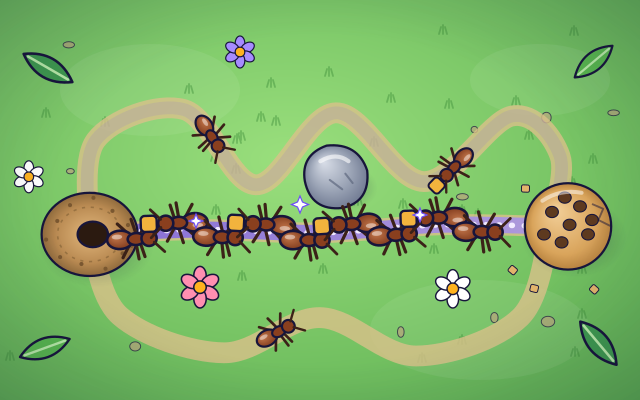
The big idea: An ant that finds food dabs scent on the ground as it walks home. Other ants follow the scent and add more. Short paths get more scent, so most ants end up using them.
It's like a path across a snowy field: the more people walk the same way, the clearer the path gets, and the more people follow it.
The interactive parts didn't load. The explanations below still work; try reloading the page.
How ants find the way
- A line of ants marches between a cookie and the nest. Nobody is leading, and ants do not see well. So how do they all know exactly where to go?
- It begins with a scout. She wanders around the garden, turning this way and that, until she bumps into something good to eat.
- She picks up a crumb and heads home. As she walks, she dabs the tip of her abdomen on the ground, leaving dots of scent. This scent is called a pheromone.
- At the nest, other ants smell the trail with their antennae and follow it to the food. Each ant that comes back with a crumb adds more scent, so the trail gets stronger.
- Now there are two ways around a rock. Ants on the short path finish their trips sooner, so that path gets fresh scent more often. Soon nearly all the ants use it.
- When the food runs out, ants come back empty and stop adding scent. The scent slowly dries up, the trail fades, and the ants go exploring again.
The parts of a worker ant
Tap each part of the ant. Find the part that lays the scent trail, and the part that smells it.
- Antennae. An ant smells with its two antennae. It taps them on the ground to follow a scent trail, and on other ants to tell friends from strangers.
- Eyes. Most ants have small eyes and do not see clearly. Smell and touch matter much more to them than sight.
- Jaws. An ant's jaws, called mandibles, work like hands. They carry food, dig tunnels and move the colony's young. An ant can carry many times its own weight.
- Legs. Six legs carry the ant quickly over the ground. Tiny hooks and sticky pads on its feet let it climb walls and walk upside down.
- Waist. An ant has a very thin waist. It lets the back part of the body bend down, so the tip can touch the ground.
- Abdomen. The big back part is the abdomen. Inside is a special stomach just for carrying liquid food home, to share with the other ants.
- Scent gland. At the tip of the abdomen is a gland that makes trail scent. The ant dabs it on the ground like a tiny marker pen.
Trails and rocks
Tap a path to lay scent on it. Drag the rock onto a path, or use the buttons. Watch how many ants use each path.
Experiment: Three paths lead to the cookie: short, medium and long. If you leave the ants alone, which will most of them end up using?
- Wash the scent away and just watch for a minute. Which path fills with ants?
- Now put the rock on that path. Watch what the ants do.
- Tap another path to lay scent on it and see how fast the ants switch.
What we found: Most of the time the short path wins. Ants on it get home sooner, so it gets fresh scent more often, and ants follow the strongest scent. Once in a while a longer path gets lucky early on and the colony sticks to it. When a path is blocked, its scent fades and the ants switch.
Turn on JavaScript to try it yourself.
The puddle problem
A puddle has flooded the ants' old trail, but they keep following its scent. Lay scent on an open path and get 30 crumbs home in 60 seconds. For 3 stars, do it in 46.
How a colony finds the best path
Ants live in big families called colonies. To feed everyone, worker ants go out to find food. At first they wander in all directions. These first explorers are called scouts. When a scout finds something good, she picks up a piece and heads home.
On the way she does something clever. She dabs the tip of her body on the ground and leaves tiny dots of a smelly chemical called a pheromone. The dots make a trail from the food to the nest. Other ants smell the trail with their antennae and follow it, like following a path of breadcrumbs.
Every ant that comes back with food adds more scent. So a trail to good food gets stronger and stronger. If there are two ways to the food, ants on the shorter way make more trips, so it gets more scent. That is why most ants end up on the shortest path, even though no ant measured anything.
The scent does not last. It slowly dries up. That is useful. When the food is gone, ants stop adding scent, the trail fades and the colony stops wasting time there. If ants ever march into your kitchen, wiping the trail with soapy water removes the scent they follow, and putting food away removes the reason to come.
Key words
- Pheromone
- A smelly chemical an animal makes to send a message to others of its kind.
- Scout
- A worker ant that explores to find new food.
- Positive feedback
- When more of something leads to even more of it, like a path getting clearer the more it is used.
- Evaporation
- When a liquid or a smell slowly disappears into the air.
- Self-organization
- A pattern that appears when many individuals follow simple rules, with nobody in charge.
Check your thinking
-
How do ants follow each other to food?
Show the answer
They follow a scent trail laid by ants that found food. An ant with food dabs scent on the ground, and nestmates follow the scent with their antennae.
-
Which body part does an ant use to smell a trail?
Show the answer
Its antennae. The antennae are covered in tiny smell detectors.
-
Two paths lead to food, one short and one long. Why do most ants end up on the short one?
Show the answer
Ants on it get home sooner, so it gets fresh scent more often. More trips means more scent, and more scent attracts more ants.
-
The food is all gone. What happens to the trail?
Show the answer
No ant adds scent any more, so it fades away. A trail needs fresh scent to stay strong. Without it, the scent dries up.
-
A rock falls onto the ants' trail. What do the ants do?
Show the answer
They explore, find another way, and a new trail builds up there. Blocked ants bring back no food and add no scent, so the old trail fades while a new one grows.
You're a Animals expert!
You watched, looked inside, tried it, solved the challenge and went deeper. Pick another question below, or switch the age at the top to see this topic another way.
More about animals
 #211
Animals
How do honeybees share the location of food?
Decode a simplified waggle dance and guide bees toward the matching flower patch.
#211
Animals
How do honeybees share the location of food?
Decode a simplified waggle dance and guide bees toward the matching flower patch.
 #212
Animals
How do paper wasps build nests?
Follow wood fibers through chewing and shaping into a nest's paper cells.
#212
Animals
How do paper wasps build nests?
Follow wood fibers through chewing and shaping into a nest's paper cells.
 #213
Animals
How do birds build nests?
Compare designs and arrange virtual materials that support model eggs.
#213
Animals
How do birds build nests?
Compare designs and arrange virtual materials that support model eggs.
 #214
Animals
How does a chick grow and hatch inside an egg?
Use a transparent egg and time slider to explore development and hatching.
#214
Animals
How does a chick grow and hatch inside an egg?
Use a transparent egg and time slider to explore development and hatching.
Keep exploring
Games to play next
- Classification ExplorerSort living things by what you can see, then follow and build yes-or-no keys.
- Habitat Builder 3DFind the right home for frogs, camels, polar bears and more.
- Forest Trails PhotosCreep up on the animals of a big forest valley and take the closest, best wildlife photos you can, without startling them.
Guide for grown-ups
- How to start homeschooling: a step-by-step guide for familiesA guide for parents · 7 min read
Science games by grade
Science worksheets by grade
- Preschool Science Worksheets
- Pre-K Science Worksheets
- Kindergarten Science Worksheets
- 1st Grade Science Worksheets
- 2nd Grade Science Worksheets
- 3rd Grade Science Worksheets
- 4th Grade Science Worksheets
- 5th Grade Science Worksheets
- 6th Grade Science Worksheets
- 7th Grade Science Worksheets
- 8th Grade Science Worksheets