How do honeybees share the location of food?
A honeybee cannot talk, so she dances a map: which way to fly and how far to go.
The big idea: The direction of the waggle shows which way to fly compared with the sun, and the length of the waggle shows how far the food is.
It's like giving a friend directions: "face the big tree, turn a little right, then walk for a long time." The bee says it with a dance.
The interactive parts didn't load. The explanations below still work; try reloading the page.
A map made of dancing
- A worker bee finds a patch of flowers full of sweet nectar. There is far too much for one bee. But how can she tell the others where it is?
- She flies straight home with nectar in her tummy and pollen packed on her back legs. On the way she remembers where the sun was.
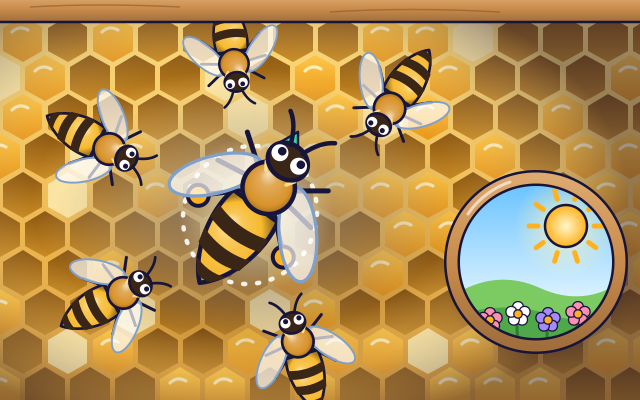
- Inside the dark hive she dances on the honeycomb. She walks in a straight line, waggling her body, then loops back and does it again. Her sisters follow closely.
- Straight up on the comb means fly toward the sun. If she waggles to the right of straight up, the flowers are to the right of the sun, by the very same angle.
- The length of the waggle shows the distance. A quick waggle means the flowers are close. A long waggle means a long flight.
- Her sisters read the dance, smell the flowers on her, and fly out the right way and the right distance. Soon the whole patch is buzzing.
Look closely at the dance
Tap each part of the dance floor inside the hive. Every part moves when you find it.
- The dancer. The dancer is a worker bee who has just come back from a good patch of flowers. Her dance is an invitation: come and help collect this food!
- The waggle run. In the middle of the dance she walks in a straight line, shaking her body from side to side. The direction of this line is the direction of the food.
- The loops back. After each waggle she circles back to where she started, first to one side and then to the other. That makes a shape like the number 8.
- The followers. It is dark in the hive, so the other bees cannot see the dance. They follow right behind the dancer, feeling her movements with their antennae and smelling the flowers on her.
- The upright comb. The wax honeycomb hangs straight down, like a wall. The bees can feel which way is up, and they agree that up means the direction of the sun.
- The sun compass. Outside, the bees use the sun like a signpost. They fly at the same angle from the sun that the dancer showed from straight up.
Move the flowers and watch the dance
Drag the flower patch around the meadow. The round window shows the dance inside the hive. What changes in the dance?
Experiment: What happens to the dance when you drag the flowers farther from the hive?
- Drag the flowers close to the hive and watch the waggle.
- Drag them far away, in the same direction. Watch again.
- Now drag them to the left and to the right of the sun. What changes this time?
What we found: Farther flowers make a longer waggle, and nearer flowers make a shorter one. Moving the flowers to the left or right of the sun turns the waggle to the left or right of straight up.
Turn on JavaScript to try it yourself.
Decode the dance
You are a follower bee. Watch the dance, then tap the flower patch it points to. Check the direction and the length of the waggle.
How bees talk by dancing
A honeybee colony has thousands of workers, and they all need food. When one bee finds a good patch of flowers, the best thing for the whole colony is to send many more bees there. But bees cannot talk or draw. So the bee who found the flowers dances.
She dances on the honeycomb, which hangs straight down like a wall. In the middle of the dance she walks in a line and waggles her body. The bees agree on a rule: straight up means toward the sun. If she waggles straight up, the food is toward the sun. If she waggles to the right of straight up, the food is to the right of the sun by the same angle.
The length of the waggle shows how far to fly. A short waggle means the flowers are near, and a long one means they are far away. If the nectar is extra sweet, she dances again and again, so more sisters notice.
It is dark in the hive, so the other bees feel the dance instead of watching it. They touch the dancer with their antennae, smell the flowers on her and taste a drop of nectar. Then they fly out and look for flowers with that smell in the place the dance described. Giving directions to a friend is a good comparison, but it is not perfect: bees are not using words. The dance is built into them, although young bees get better at it by following older dancers.
Key words
- Forager
- A worker bee whose job is to fly out and collect food.
- Waggle run
- The straight, wiggling part of the dance that shows the way.
- Nectar
- The sugary liquid that flowers make. Bees turn it into honey.
- Honeycomb
- Sheets of six-sided wax cells where bees store food, raise their young and dance.
- Azimuth
- The compass direction of something, such as the sun.
- Recruit
- A bee that follows a dance and then flies out to find the food.
Check your thinking
-
Why does a bee do the waggle dance?
Show the answer
To tell other bees where to find food. The dance is a message about where good flowers are, so more bees can collect the food.
-
A bee's waggle is very long. What does that tell the others?
Show the answer
The flowers are far away. The longer the waggle lasts, the farther the bees must fly.
-
A bee waggles straight up the comb. Which way should her sisters fly?
Show the answer
Straight toward the sun. On the comb, straight up stands for the direction of the sun.
-
It is dark inside the hive. How do the other bees follow the dance?
Show the answer
They feel it with their antennae and smell the flowers on the dancer. Followers stay close to the dancer and sense her movements by touch and smell.
-
The flowers stay in the same place all day, but a bee's dance for them slowly turns. Why?
Show the answer
The sun moves across the sky, so the angle between the sun and the flowers changes. The dance angle is measured from the sun's direction. As the sun moves, the same place needs a different angle.
-
What happens when the nectar is extra sweet?
Show the answer
The bee dances longer and more bees follow her. Better food gets a longer, livelier dance, so more sisters go to the best flowers.
You're a Animals expert!
You watched, looked inside, tried it, solved the challenge and went deeper. Pick another question below, or switch the age at the top to see this topic another way.
More about animals
 #212
Animals
How do paper wasps build nests?
Follow wood fibers through chewing and shaping into a nest's paper cells.
#212
Animals
How do paper wasps build nests?
Follow wood fibers through chewing and shaping into a nest's paper cells.
 #213
Animals
How do birds build nests?
Compare designs and arrange virtual materials that support model eggs.
#213
Animals
How do birds build nests?
Compare designs and arrange virtual materials that support model eggs.
 #214
Animals
How does a chick grow and hatch inside an egg?
Use a transparent egg and time slider to explore development and hatching.
#214
Animals
How does a chick grow and hatch inside an egg?
Use a transparent egg and time slider to explore development and hatching.
 #215
Animals
How do ducks keep their feathers water-resistant?
Inspect feather structure, animate preening, and compare water on different surfaces.
#215
Animals
How do ducks keep their feathers water-resistant?
Inspect feather structure, animate preening, and compare water on different surfaces.
Keep exploring
Games to play next
- Classification ExplorerSort living things by what you can see, then follow and build yes-or-no keys.
- Habitat Builder 3DFind the right home for frogs, camels, polar bears and more.
- Forest Trails PhotosCreep up on the animals of a big forest valley and take the closest, best wildlife photos you can, without startling them.
Guide for grown-ups
- How to start homeschooling: a step-by-step guide for familiesA guide for parents · 7 min read
Science games by grade
Science worksheets by grade
- Preschool Science Worksheets
- Pre-K Science Worksheets
- Kindergarten Science Worksheets
- 1st Grade Science Worksheets
- 2nd Grade Science Worksheets
- 3rd Grade Science Worksheets
- 4th Grade Science Worksheets
- 5th Grade Science Worksheets
- 6th Grade Science Worksheets
- 7th Grade Science Worksheets
- 8th Grade Science Worksheets