How does a chick grow and hatch inside an egg?
An egg holds everything a chick needs: food, water, air and a shell for safety. In 21 warm days a tiny spot becomes a fluffy chick.
The big idea: The yolk is the chick's food, the egg white is its water and cushion, and tiny holes in the shell let air in. All it needs from outside is warmth.
It's like a tiny spaceship: it carries food, water and air for one passenger on a 21-day trip. All it needs from outside is warmth.
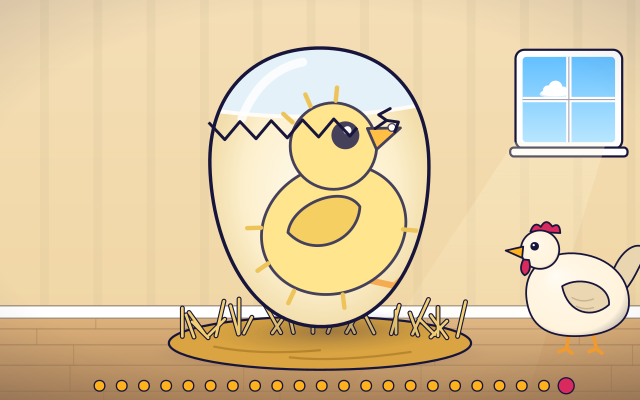
The interactive parts didn't load. The explanations below still work; try reloading the page.
21 days inside an egg
- A mother hen sits on her eggs for three weeks. Her warm body keeps them at just the right temperature. But what is happening inside the shell?
- Imagine the shell is made of glass. Inside is the yellow yolk, the clear egg white, and a pocket of air at the round end. On the yolk is one tiny pale spot.
- In the warmth, the spot starts to grow. By the second day a tiny heart is beating. Thin red tubes spread over the yolk to carry food to the chick.
- Day by day the chick takes shape: big eyes first, then a beak, wings, legs and toes. Soft down feathers cover its body. The yolk shrinks, because the chick is eating it.
- By day nineteen the chick fills the egg. It pulls the last of the yolk into its tummy, pokes its beak into the air pocket and takes its first breath. You can hear it peep.
- On day twenty-one the chick taps a hole with a hard bump on its beak, called an egg tooth. It turns and cracks a ring around the shell, pushes the top off and wriggles out. A few hours later it is dry and fluffy.
Look inside a see-through egg
This is what you would see on day 11 if the shell were made of glass. Tap each part.
- The shell. The shell is hard armor, but it is not sealed. It has thousands of holes, too small to see, that let fresh air in and stale air out.
- The air cell. At the round end of the egg is a pocket of air. It gets bigger as the egg slowly dries out. Just before hatching, the chick breathes this air.
- The egg white. The egg white is mostly water, with some protein. It is the chick's water supply and a wobbly cushion that protects it from bumps.
- The yolk. The yolk is the chick's packed lunch, full of fat and protein. It shrinks as the chick grows. The last part is pulled into the chick's tummy before hatching.
- The blood vessels. Thin blood vessels spread over the yolk like tiny roads. They collect food and carry it to the chick. Others run under the shell to pick up air.
- The growing chick. On day 11 the chick has eyes, a beak, wings, legs and toes, and its first down feathers. It moves and stretches inside the egg.
Travel through 21 days
Move the day slider and watch the see-through egg. What grows? What shrinks? Slide all the way to day 21.
Experiment: What happens to the yolk as the chick grows?
- Start at day 0 and look at the size of the yolk.
- Slide slowly to day 10, then to day 19. Compare the yolk and the chick.
- Go on to day 21 and watch the chick hatch.
What we found: The yolk shrinks while the chick grows, because the yolk is the chick's food. The air pocket slowly gets bigger too. By day 21 the egg is full of chick!
Turn on JavaScript to try it yourself.
Be the mother hen
Keep the egg in the warm green zone as the weather changes, and tap the egg to turn it when the arrow appears. Hatch the chick in 21 days!
What a chick needs to grow
A hen's egg looks simple, but it is packed like a suitcase for a long trip. The yellow yolk is food. The clear egg white is water and a soft cushion. At the round end there is a pocket of air. And the hard shell has thousands of tiny holes that let air pass through, so the chick can breathe.
The chick starts as a pale spot on the yolk, smaller than a lentil. If the egg is kept warm, the spot starts to grow. On day two it already has a beating heart. Blood vessels spread across the yolk to collect food. Then come eyes, a beak, wings and legs, and by day thirteen the chick is covered in down.
The mother hen does two important jobs. She keeps the eggs warm with her body, at about 37.5 degrees Celsius. And she turns them with her beak many times a day, so the chick does not stick to one side of the shell. People who hatch eggs in a machine called an incubator have to do the same two jobs.
On day twenty-one the chick is ready. It breathes the air in the air pocket, then taps a hole in the shell with its egg tooth. It cracks a ring around the shell, pushes, and tumbles out, wet and tired. The spaceship comparison is good, but not perfect: a spaceship is sealed, and an egg must breathe through its shell. And remember that the eggs in your kitchen were never going to be chicks. They are not fertilized, so nothing inside them can grow.
Key words
- Embryo
- A baby animal at its earliest stage, while it is still forming.
- Yolk
- The yellow part of the egg: the chick's store of food.
- Albumen
- The egg white: mostly water, with protein. It cushions the chick and gives it water.
- Air cell
- The pocket of air at the round end of the egg.
- Incubate
- To keep eggs warm so the chicks inside can grow.
- Egg tooth
- A small, hard bump on the tip of a chick's beak, used to break the shell. It falls off a few days later.
Check your thinking
-
What is the yolk for?
Show the answer
It is the chick's food. The yolk is a packed lunch of fat and protein. The chick grows on a spot on top of it.
-
Why must the eggs be kept warm?
Show the answer
The chick only grows when the egg is warm. Growing needs steady warmth, close to the hen's body temperature.
-
How does the chick get air while it is inside the shell?
Show the answer
Through thousands of tiny holes in the shell. The shell has pores, too small to see, that let air in and out.
-
What does the chick use to crack the shell?
Show the answer
A hard bump on its beak called an egg tooth. The egg tooth is a hard point on the beak. It falls off a few days after hatching.
-
Why do hens, and incubators, turn the eggs?
Show the answer
So the embryo does not stick to the shell membranes. Turning keeps the embryo and its membranes moving freely, so they do not stick to one side.
-
Why will an egg from the supermarket never hatch, even if it is kept warm?
Show the answer
It was not fertilized, so there is no embryo to develop. Hens lay eggs whether or not a rooster is present. Without fertilization, the germinal disc cannot develop.
You're a Animals expert!
You watched, looked inside, tried it, solved the challenge and went deeper. Pick another question below, or switch the age at the top to see this topic another way.
More about animals
 #215
Animals
How do ducks keep their feathers water-resistant?
Inspect feather structure, animate preening, and compare water on different surfaces.
#215
Animals
How do ducks keep their feathers water-resistant?
Inspect feather structure, animate preening, and compare water on different surfaces.
 #216
Animals
How do squirrels store and find food?
Hide virtual nuts and explore how changing landmarks affect finding them again.
#216
Animals
How do squirrels store and find food?
Hide virtual nuts and explore how changing landmarks affect finding them again.
 #217
Animals
How does hibernation help animals survive winter?
Follow changes in activity, temperature, and energy use during a simulated winter.
#217
Animals
How does hibernation help animals survive winter?
Follow changes in activity, temperature, and energy use during a simulated winter.
 #218
Animals
How do snails build their shells?
Follow calcium into a growing shell using a simplified growth model.
#218
Animals
How do snails build their shells?
Follow calcium into a growing shell using a simplified growth model.
Keep exploring
Games to play next
- Habitat Builder 3DFind the right home for frogs, camels, polar bears and more.
- Classification ExplorerSort living things by what you can see, then follow and build yes-or-no keys.
- Forest Trails PhotosCreep up on the animals of a big forest valley and take the closest, best wildlife photos you can, without startling them.
Draw it or make it
- How to draw a chickDrawing lesson
Guide for grown-ups
- How to start homeschooling: a step-by-step guide for familiesA guide for parents · 7 min read
Science games by grade
Science worksheets by grade
- Preschool Science Worksheets
- Pre-K Science Worksheets
- Kindergarten Science Worksheets
- 1st Grade Science Worksheets
- 2nd Grade Science Worksheets
- 3rd Grade Science Worksheets
- 4th Grade Science Worksheets
- 5th Grade Science Worksheets
- 6th Grade Science Worksheets
- 7th Grade Science Worksheets
- 8th Grade Science Worksheets