How do birds build nests?
With only a beak and her own body, a bird builds a strong, deep, soft-lined cup that holds her eggs in the wind.
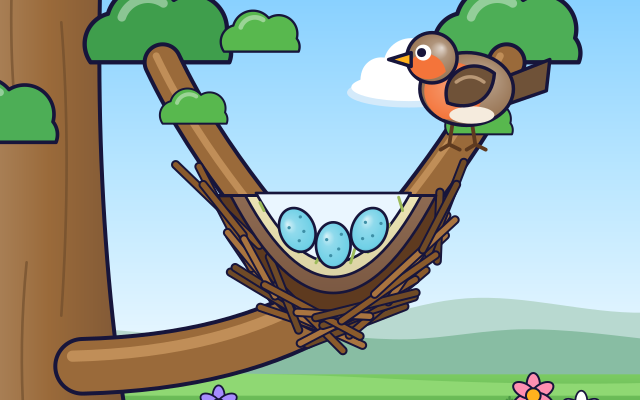
The big idea: Each material in a nest has a job: stiff twigs make the frame, mud glues it, a deep cup shape keeps the eggs from rolling out, and a soft lining keeps them warm.
It's like a bike helmet: a hard shell outside for strength and soft padding inside for comfort. A nest has a twig shell and a fluffy lining.
The interactive parts didn't load. The explanations below still work; try reloading the page.
How a robin builds her nest
- In spring, a robin gets ready to lay eggs. She needs a place that is strong, hidden and warm. She has no hands, only a beak, her feet and her body.
- She picks a fork between two branches and brings twigs, one at a time. She pokes and tucks them together until they make a rough, strong ring.
- She sits in the middle, pushes with her chest and turns around and around. Her own body is the mold, so the cup fits her exactly.
- Next she brings beakfuls of wet mud and smears them inside the twigs. When the mud dries, it glues the twigs into one hard, heavy bowl.
- Last, she lines the cup with fine, dry grass and soft feathers. The lining cushions the eggs and traps warm air around them.
- She lays her blue eggs. When the wind shakes the tree, the deep cup keeps the eggs from rolling out, and her warm body covers them like a lid.
Look inside a robin's nest
This nest has been cut in half so you can see its layers. Tap each one.
- The branch fork. The nest is wedged where branches split. The fork holds it from below and from the sides, and leaves hide it from hungry animals.
- The twig frame. The outside is a frame of twigs and stiff grass. The pieces cross over each other, so they hold together like a basket.
- The mud layer. Inside the twigs is a layer of dried mud. It works like glue and makes the nest heavy enough to stay put on a windy day.
- The soft lining. The inside is lined with fine grass and feathers. It is soft, so the eggs do not crack, and fluffy, so it holds warmth.
- The cup shape. The nest is a deep bowl. If an egg rolls, the sloping sides send it back to the middle, and the high rim keeps it in when the branch sways.
- The eggs. A robin lays three to five blue eggs. The parent sits on them to keep them warm until the chicks hatch, about two weeks later.
Build a nest and test it
Tap the piles to send the robin for materials, and choose the shape of the nest. Then test it with model eggs in the wind.
Experiment: What happens in the wind test if the nest has twigs and a soft lining, but no mud?
- Add twigs and soft lining, but no mud. Press Test with eggs.
- Now add mud and test again.
- Try the flat shape and the deep cup. Which one keeps the eggs in?
What we found: Twigs alone are a loose pile, and wind shakes them apart. Mud glues them into one strong bowl. The shape matters too: eggs roll off a flat nest, but a deep cup keeps them in.
Turn on JavaScript to try it yourself.
Storm-proof nest
A storm is coming! Build a nest that keeps 3 eggs safe in a strong wind, in as few trips as you can.
Why nests are built the way they are
A bird's nest is not a house where the bird lives all year. It is a nursery: a safe place for eggs and chicks. Eggs are round, so they roll. They are fragile, so they crack. And they must be kept warm, or the chicks inside will not grow. A good nest solves all three problems.
A robin starts with a frame of twigs and stiff grass in the fork of a tree. Then she sits in the middle and turns around and around, pushing with her chest, until the frame becomes a bowl. She smears wet mud inside. When the mud dries, it glues everything into one strong cup. Finally she adds a lining of fine grass and feathers that is soft and warm.
The bowl shape is clever. If an egg rolls up the side, it rolls back down to the middle. When wind sways the branch, the high rim keeps the eggs inside. The parent then sits on top like a warm lid.
Other birds build other designs. Weaver birds knot strips of grass into hanging pouches. Swallows stick hundreds of mud pellets to a wall. Eagles pile up huge platforms of sticks. Some shore birds just scrape a dip in the sand. A bike helmet is a good comparison for a robin's nest, but a helmet protects against one hard knock, while a nest has to work every hour for weeks. If you find a nest, look from far away and never touch it: the parents need to feel safe to come back.
Key words
- Cup nest
- A bowl-shaped nest, the kind robins and many other songbirds build.
- Frame
- The stiff outer part that gives a nest its strength.
- Lining
- The soft inner layer of fine grass, moss, hair or feathers.
- Insulation
- Something that keeps warmth from escaping, like a blanket.
- Incubate
- To keep eggs warm so that the chicks inside can grow.
- Stable equilibrium
- When something pushed a little way rolls back to where it started, like a marble in a bowl.
Check your thinking
-
What is the job of the soft lining?
Show the answer
To cushion the eggs and hold in warmth. A soft, fluffy lining stops the eggs from cracking and keeps warm air around them.
-
A nest is made of twigs only, with no mud. What is likely to happen in a strong wind?
Show the answer
The twigs shake loose. Without something to bind them, the twigs can slide apart when the branch shakes.
-
Why is the nest shaped like a deep bowl and not a flat plate?
Show the answer
Eggs that roll come back to the middle, and the rim keeps them in. The sloping sides send a rolling egg back to the center, even when the branch sways.
-
How does a robin shape the cup of her nest?
Show the answer
She presses with her chest while turning around. Her body is the mold, so the cup is exactly the right size for her to cover the eggs.
-
A thin branch can carry only a light nest, but a gale is coming. Which change adds strength for the least extra weight?
Show the answer
More twigs in the frame. Twigs add a good amount of strength for little weight. Mud is stronger but much heavier, and lining adds warmth, not strength.
-
You find a nest with eggs in a bush. What should you do?
Show the answer
Look from far away and leave it alone. The parents need to feel safe to come back and keep the eggs warm.
You're a Animals expert!
You watched, looked inside, tried it, solved the challenge and went deeper. Pick another question below, or switch the age at the top to see this topic another way.
More about animals
 #214
Animals
How does a chick grow and hatch inside an egg?
Use a transparent egg and time slider to explore development and hatching.
#214
Animals
How does a chick grow and hatch inside an egg?
Use a transparent egg and time slider to explore development and hatching.
 #215
Animals
How do ducks keep their feathers water-resistant?
Inspect feather structure, animate preening, and compare water on different surfaces.
#215
Animals
How do ducks keep their feathers water-resistant?
Inspect feather structure, animate preening, and compare water on different surfaces.
 #216
Animals
How do squirrels store and find food?
Hide virtual nuts and explore how changing landmarks affect finding them again.
#216
Animals
How do squirrels store and find food?
Hide virtual nuts and explore how changing landmarks affect finding them again.
 #217
Animals
How does hibernation help animals survive winter?
Follow changes in activity, temperature, and energy use during a simulated winter.
#217
Animals
How does hibernation help animals survive winter?
Follow changes in activity, temperature, and energy use during a simulated winter.
Keep exploring
Games to play next
- Forest Trails PhotosCreep up on the animals of a big forest valley and take the closest, best wildlife photos you can, without startling them.
- Habitat Builder 3DFind the right home for frogs, camels, polar bears and more.
- Classification ExplorerSort living things by what you can see, then follow and build yes-or-no keys.
Guide for grown-ups
- How to start homeschooling: a step-by-step guide for familiesA guide for parents · 7 min read
Science games by grade
Science worksheets by grade
- Preschool Science Worksheets
- Pre-K Science Worksheets
- Kindergarten Science Worksheets
- 1st Grade Science Worksheets
- 2nd Grade Science Worksheets
- 3rd Grade Science Worksheets
- 4th Grade Science Worksheets
- 5th Grade Science Worksheets
- 6th Grade Science Worksheets
- 7th Grade Science Worksheets
- 8th Grade Science Worksheets