How do aquifers store groundwater?
Under your feet, rain fills the gaps between grains of sand and gravel. That hidden store of water is an aquifer.
The big idea: An aquifer is not an underground lake. It is sand, gravel or cracked rock whose gaps are full of water that soaked down from the rain.
It's like a jar of marbles with water poured in: the marbles do not soak up anything, but the gaps between them fill up from the bottom.
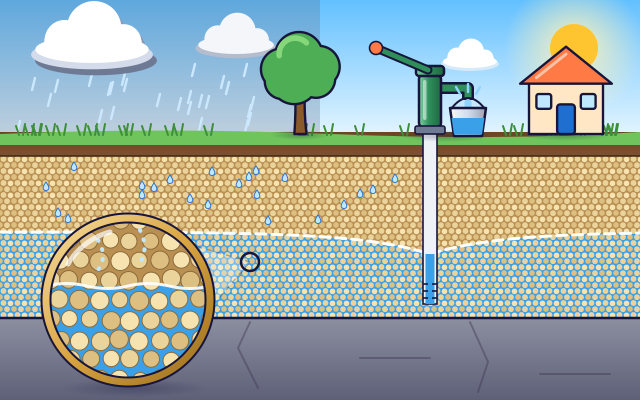
The interactive parts didn't load. The explanations below still work; try reloading the page.
The hidden water under a field
- Rain falls on a field. Some runs off to streams and some dries up, but a lot of it sinks into the soil. Where does it go?
- Look closely at the ground. It is made of grains with gaps between them. The water trickles down through those gaps, from one to the next.
- Deep down the water meets solid rock that it cannot pass. So the gaps fill up from the bottom. The top of the soaked ground is called the water table.
- This soaked layer is an aquifer. It is not an underground lake or river. It is wet sand and gravel, like a giant sponge, and the water creeps through it very slowly.
- A well is a hole drilled down below the water table. A pump lifts the water out of the gaps, and more water flows through the sand to take its place.
- In dry months, pumping makes the water table fall. When the rain returns, it fills the aquifer again, but slowly. So we should take only as much as the rain puts back.
Look inside the ground
Tap each part, from the rain cloud down to the solid rock. Watch what the water does there.
- Rain. All groundwater starts as rain or melted snow. The part that soaks in refills the aquifer.
- Topsoil. Rain soaks into the soil first. Roots drink some of it, and the rest keeps sinking.
- Gaps between grains. The magnifier shows the grains close up. The water is in the gaps between them. The grains themselves stay solid.
- Damp zone. Above the water table the ground is only damp. Water is passing through on its way down, and the gaps still have air in them.
- Water table. The water table is the top of the soaked ground. It rises after rain and falls in dry weather or when wells pump a lot.
- Aquifer. Below the water table every gap is full of water. This soaked layer is the aquifer, and it can hold a huge amount.
- Solid rock. This rock has almost no gaps, so water cannot sink through it. It is the floor that holds the aquifer's water up.
- Well and pump. The well is a pipe that reaches below the water table. The pump lifts water up, and the water table dips a little around the well.
Gravel, sand or clay?
Choose the ground, make it rain and pump the well. Which ground lets water soak in and move best?
Experiment: Which ground lets rain soak down to the water table fastest?
- Pick Gravel and press Make it rain. Watch the drops and the magnifier.
- Pick Clay and make it rain again. Where does the water stay?
- Try pumping the well in each kind of ground.
What we found: Gravel wins. Its big gaps let water rush down and flow easily to a well. Sand is slower. In clay the gaps are so tiny that most rain stays on top as puddles, and a well soon runs dry.
Turn on JavaScript to try it yourself.
Share the well
Choose how many families share the well. Give water to as many as you can for two years without the well running dry.
The water hiding under our feet
When people imagine water under the ground, they often picture a dark lake or a river in a cave. Real groundwater almost never looks like that. It sits in the small gaps between grains of sand and gravel, and in cracks in rock. The ground is like a sponge: it looks solid, but it is full of tiny spaces.
Rain soaks into the soil and trickles down from gap to gap. When it reaches a layer it cannot pass, such as solid rock, it starts to fill the gaps from the bottom up. The top of this soaked zone is called the water table. If you dig a hole deeper than the water table, water seeps into the bottom of it. That is exactly what a well is.
Not all ground works the same way. Gravel has big gaps, so water moves through it quickly. Sand has smaller gaps and is slower. Clay is made of tiny flat specks packed so closely that water can hardly move at all. Clay can hold a lot of water, but it will not let go of it, so a well in clay runs dry.
An aquifer refills slowly. A heavy rainstorm may take weeks or months to reach the water table. If we pump water out faster than rain puts it back, the water table drops and wells have to be drilled deeper. Looking after an aquifer means taking only what the rain returns, and keeping the ground above it clean, because whatever soaks in can end up in the water.
Key words
- Aquifer
- A layer of sand, gravel or cracked rock whose gaps are full of water that wells can use.
- Water table
- The top of the ground that is completely soaked with water.
- Porosity
- How much of the ground is empty gaps that can hold water.
- Permeability
- How easily water can move through the ground.
- Recharge
- Rain or melted snow that soaks down and adds water to an aquifer.
- Cone of depression
- The dip in the water table around a well that is being pumped.
Check your thinking
-
Where is the water in an aquifer?
Show the answer
In the gaps between grains of sand and gravel. Groundwater fills the spaces between grains. The grains stay solid, and there is no open lake.
-
A well is drilled, but it ends above the water table. What happens?
Show the answer
It stays dry, because the gaps there are not full of water. Above the water table the ground is only damp. Water will only seep into a well that reaches the soaked zone.
-
Why does a well in clay run dry so quickly?
Show the answer
Clay's gaps are so tiny that water can hardly move to the well. Clay holds plenty of water, but its gaps are too small for the water to flow, so the well empties faster than it refills.
-
In sand with a specific yield of 0.2, 60 mm of recharge reaches the water table. How far does the water table rise?
Show the answer
300 mm. The water only fills the drainable pore space, one fifth of the volume, so the level rises five times farther: 60 ÷ 0.2 = 300 mm.
-
A town pumps more water every year than the rain puts back. What happens to the water table?
Show the answer
It keeps getting lower. If more goes out than comes in, the store shrinks, just like a piggy bank you keep taking from.
You're a Earth & weather expert!
You watched, looked inside, tried it, solved the challenge and went deeper. Pick another question below, or switch the age at the top to see this topic another way.
More about earth & weather
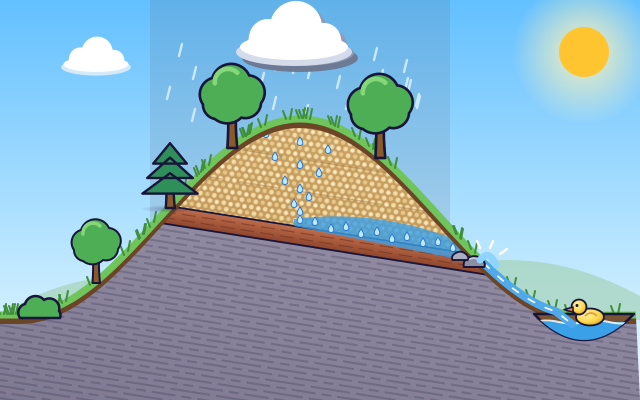 #463
Earth & weather
How do natural springs bring water to the surface?
Follow groundwater until rock layers and terrain direct it above ground.
#463
Earth & weather
How do natural springs bring water to the surface?
Follow groundwater until rock layers and terrain direct it above ground.
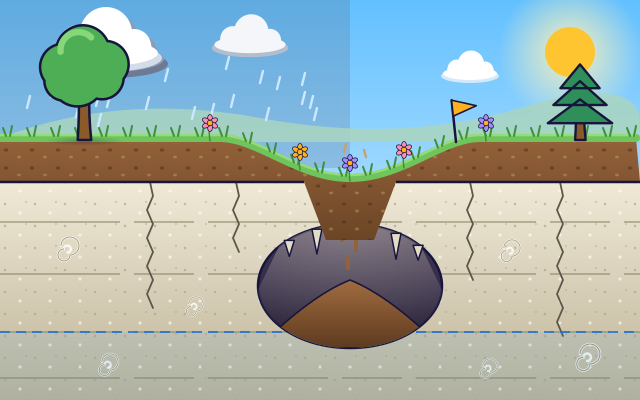 #464
Earth & weather
How do sinkholes form?
Explore dissolving rock and underground cavities beneath a model landscape.
#464
Earth & weather
How do sinkholes form?
Explore dissolving rock and underground cavities beneath a model landscape.
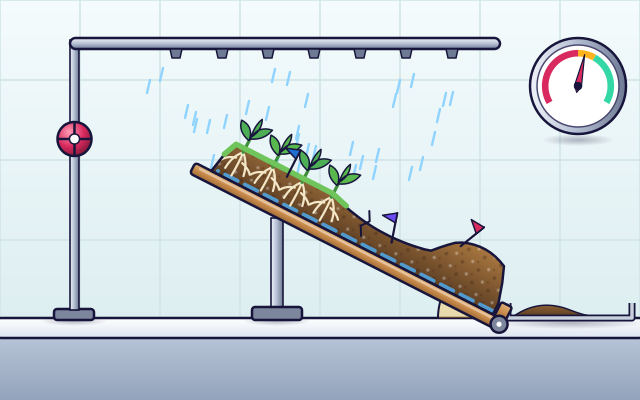 #465
Earth & weather
How do landslides happen?
Change slope, water content, and vegetation and compare ground stability.
#465
Earth & weather
How do landslides happen?
Change slope, water content, and vegetation and compare ground stability.
 #466
Earth & weather
How does soil form?
Follow rock weathering, organic matter, organisms, and time into layered soil.
#466
Earth & weather
How does soil form?
Follow rock weathering, organic matter, organisms, and time into layered soil.
Keep exploring
Games to play next
- River MysterySomething changed the river. Sample sites with a limited budget, follow the evidence and find where the change begins.
- Weather LabPredict the weather in a box, then run a fair test to find out why.
- Landform ExplorerMountains, valleys, peninsulas and deltas — learn the shapes of the land and find them on Earth.
Guide for grown-ups
- How to start homeschooling: a step-by-step guide for familiesA guide for parents · 7 min read
Science games by grade
Science worksheets by grade
- Preschool Science Worksheets
- Pre-K Science Worksheets
- Kindergarten Science Worksheets
- 1st Grade Science Worksheets
- 2nd Grade Science Worksheets
- 3rd Grade Science Worksheets
- 4th Grade Science Worksheets
- 5th Grade Science Worksheets
- 6th Grade Science Worksheets
- 7th Grade Science Worksheets
- 8th Grade Science Worksheets