How do landslides happen?
Gravity is always pulling soil downhill. A slope slides when it gets too steep or too wet for the soil's grip to hold.
The big idea: A slope stays put while the grip between its grains is stronger than gravity's pull downhill. Steepness adds pull, water takes away grip, and roots add grip.
It's like a book on a tilted tray: it stays until the tray is too steep, and it slides sooner if the tray is wet and slippery.
The interactive parts didn't load. The explanations below still work; try reloading the page.
Why slopes slide: a model hill
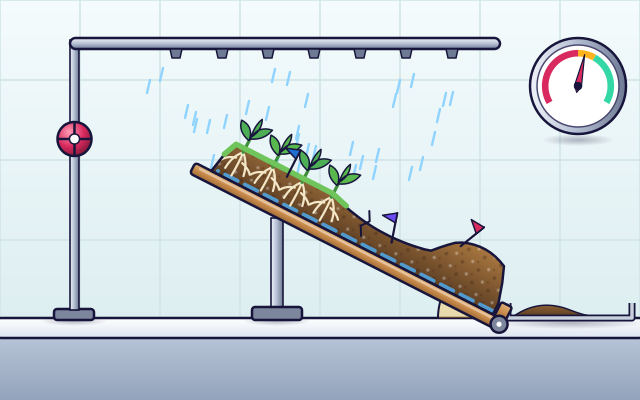
- To find out why hillsides sometimes slide, scientists build a model: a layer of soil on a table that can tilt. Nothing here can get hurt, so they can test anything.
- Two things are in a tug of war. Gravity pulls the soil down the slope. The grip between the rough grains, called friction, holds it in place. For now, grip is winning.
- Tilt the table and the pull down the slope grows while the grip shrinks. At about 36 degrees the pull wins, and the dry soil slides to the bottom.
- This slope is gentler, and it holds. Then the rain machine soaks it. Water fills the gaps and pushes the grains apart, so they grip less. The wet soil slides.
- Now cover the same slope with plants. Their roots thread through the soil and tie it together like a net. The rain comes again, and this time the slope holds.
- Engineers use what the model shows: gentle slopes, plenty of plants and drains that let water out. After long, heavy rain, stay away from steep slopes, and tell a grown-up if you see new cracks in the ground.
Look inside the slope model
Tap each part of the model and watch what it does to the slope.
- Tilting table. A jack lifts one end of the table. The higher it goes, the steeper the model hill becomes.
- Soil grains. Up close, soil is rough grains pressed together. Their rubbing, called friction, is what holds a slope up.
- Pull and grip. The red arrow is gravity pulling soil down the slope. The green arrow is the grip holding it. While green is longer, the slope stays.
- Rain machine. The rain machine soaks the soil. Water in the gaps pushes the grains apart, so they cannot grip each other as well.
- Roots. Roots weave through the soil and tie the grains together. Plants also drink some of the water.
- Slip surface. The soil sits on a hard board, like soil on solid rock. Water collects along it, and that is where the slide starts.
- Safety dial. The dial compares grip with pull. In the green, the slope is holding well. In the red, pull has won and the soil slides.
What makes the slope slide?
Change the slope angle, the water in the soil and the plants. Watch the arrows and the safety dial. Find two different ways to make the soil slide.
Experiment: You soak the soil with water. What happens to the steepest slope it can hold?
- With dry, bare soil, raise the angle slowly until the soil slides. Note the angle.
- Lower the slope, soak the soil, and raise the angle again.
- Now add plants and repeat with soaked soil.
What we found: Dry soil held until about 36 degrees, but soaked soil slid at only about 20. Water between the grains pushes them apart, so they lose their grip. Plants give some of the grip back.
Turn on JavaScript to try it yourself.
Steep, soaked and still standing
Build the steepest slope you can, at least 24°, that still stands when the storm soaks it.
The tug of war on every hillside
Every hillside is in a quiet tug of war. Gravity pulls the soil and rock downhill, all day, every day. What holds them in place is grip: the rough grains of soil rub against each other, and that rubbing, called friction, resists the pull. As long as grip is stronger than pull, nothing moves.
Two things can tip the balance. The first is steepness. On a steeper slope, more of the soil's weight pulls along the slope and less of it presses the grains together, so the pull grows as the grip shrinks. Dry sand cannot stand much steeper than about 35 degrees, which is why sand piles and dunes all have a similar shape.
The second is water. A little dampness can help grains stick, but when soil is soaked, water fills the gaps and pushes the grains apart. They press on each other less, so they grip less. That is why most landslides happen during or just after long, heavy rain or fast snowmelt.
Plants help in two ways. Their roots weave through the soil and tie it together, and they drink water out of the ground. People also make slopes safer by keeping them gentle, building walls at the bottom and adding drains. Landslides are rare, and they often give warnings: new cracks in the ground, or trees and fences that start to lean. After very heavy rain, stay away from steep slopes, and tell a grown-up if you notice signs like these. Our model is a simple one: real hills have many layers and shapes.
Key words
- Landslide
- Soil or rock moving down a slope because gravity's pull has become stronger than the forces holding it.
- Friction
- The grip between things that rub together, like grains of soil.
- Angle of repose
- The steepest angle at which a loose pile of dry grains will stay put. For dry sand it is about 34 degrees.
- Pore pressure
- The push of water trapped in the gaps between soil grains.
- Cohesion
- The stickiness that holds soil together, for example from clay or roots.
- Safety factor
- Strength divided by load. For a slope: the grip holding the soil divided by the pull moving it. Below 1, it slides.
Check your thinking
-
What makes a slope slide?
Show the answer
Gravity's pull down the slope becomes bigger than the soil's grip. A slope stays while grip beats pull. Make it steeper or wetter and the pull can win.
-
How do plants help a slope to stay in place?
Show the answer
Their roots tie the soil together and they drink some of the water. Roots work like a net in the soil, and plants also remove water that would weaken it.
-
Why are landslides more likely after days of heavy rain?
Show the answer
Water between the grains pushes them apart, so they grip less. Soaked soil loses much of its grip because the water holds the grains apart.
-
A dry sandy slope with no cohesion has a friction angle of 35°. It stands at 30°. What is its safety factor (tan 35° ≈ 0.70, tan 30° ≈ 0.58)?
Show the answer
About 1.2. With no cohesion and no water, the safety factor is tan(friction angle) divided by tan(slope angle): 0.70 ÷ 0.58 ≈ 1.2.
-
After very heavy rain you see new cracks across a steep bank near your path. What should you do?
Show the answer
Keep away from the bank and tell a grown-up. New cracks can be a warning that the ground is starting to move. Stay clear and let adults check it.
You're a Earth & weather expert!
You watched, looked inside, tried it, solved the challenge and went deeper. Pick another question below, or switch the age at the top to see this topic another way.
More about earth & weather
 #466
Earth & weather
How does soil form?
Follow rock weathering, organic matter, organisms, and time into layered soil.
#466
Earth & weather
How does soil form?
Follow rock weathering, organic matter, organisms, and time into layered soil.
 #467
Earth & weather
How do waves change coastlines?
Compare erosion and sediment movement around beaches, cliffs, and headlands.
#467
Earth & weather
How do waves change coastlines?
Compare erosion and sediment movement around beaches, cliffs, and headlands.
 #468
Earth & weather
How does air pollution form and spread?
Trace model emissions, particles, wind, and atmospheric reactions across a town.
#468
Earth & weather
How does air pollution form and spread?
Trace model emissions, particles, wind, and atmospheric reactions across a town.
 #469
Earth & weather
How do greenhouse gases warm the planet?
Compare incoming sunlight and outgoing heat in a simplified atmospheric model.
#469
Earth & weather
How do greenhouse gases warm the planet?
Compare incoming sunlight and outgoing heat in a simplified atmospheric model.
Keep exploring
Games to play next
- Weather LabPredict the weather in a box, then run a fair test to find out why.
- Landform ExplorerMountains, valleys, peninsulas and deltas — learn the shapes of the land and find them on Earth.
- River MysterySomething changed the river. Sample sites with a limited budget, follow the evidence and find where the change begins.
Guide for grown-ups
- How to start homeschooling: a step-by-step guide for familiesA guide for parents · 7 min read
Science games by grade
Science worksheets by grade
- Preschool Science Worksheets
- Pre-K Science Worksheets
- Kindergarten Science Worksheets
- 1st Grade Science Worksheets
- 2nd Grade Science Worksheets
- 3rd Grade Science Worksheets
- 4th Grade Science Worksheets
- 5th Grade Science Worksheets
- 6th Grade Science Worksheets
- 7th Grade Science Worksheets
- 8th Grade Science Worksheets