How does soil form?
Soil is not just dirt. It is crumbled rock mixed with rotted leaves, water, air and living things, built up slowly in layers.
The big idea: Rain and ice crumble rock into small bits. Plants and animals add dead leaves that rot into dark humus, and worms mix it all together. That takes hundreds of years.
It's like baking a crumble: first you need crumbs (broken rock), then you stir in something rich (rotted leaves). Worms are the spoon.
The interactive parts didn't load. The explanations below still work; try reloading the page.
How rock turns into soil
- Long ago this hillside was bare rock. No soil, no plants. So where did all the soil under our feet come from? It was made, very slowly, right here.
- Rainwater seeps into cracks. When it freezes it swells and pushes the crack wider, so pieces break off. Heat, cold and rain keep at it until the rock crumbles into bits.
- Tough living things arrive first: crusty lichens and soft moss. They cling to the rock and help break it down. Then small plants take root, and their roots pry the cracks open.
- Plants drop leaves, and plants and animals die. Fungi and tiny bacteria rot them into a dark, crumbly material called humus. Humus holds water and feeds new plants.
- Earthworms, beetles and ants pull dead leaves underground and mix them with the rock crumbs. Their tunnels let air and water reach the roots. Now it is real topsoil.
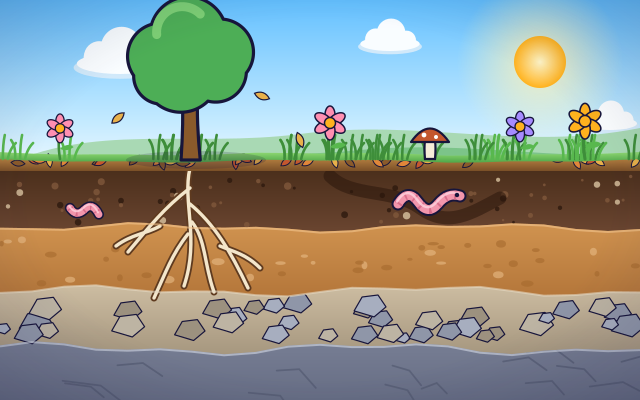
- After hundreds and thousands of years the soil has layers: leaf litter, dark topsoil, paler subsoil, broken rock and solid bedrock. Deep soil can hold up a whole forest.
Look inside the soil
This hole shows the soil from top to bottom. Tap each layer and each helper.
- Leaf litter. The top layer is dead leaves, twigs and other bits that are just starting to rot. It protects the soil like a blanket.
- Topsoil. Topsoil is dark because it is full of humus, the rotted remains of plants and animals. Most roots and most soil life are here.
- Subsoil. Subsoil has less humus, so it is paler and harder. Water carries clay and rusty iron down from above and leaves them here.
- Broken rock. This is rock that has cracked and crumbled but has not turned into soil yet. It is what the soil above was made from.
- Bedrock. Bedrock is the solid rock underneath everything. Cracks in its top are where new soil begins.
- Earthworm. Earthworms pull leaves down, eat them with soil, and leave crumbly droppings called casts. Their tunnels let in air and water.
- Roots and fungi. Roots hold soil in place, split rock as they grow and take up water. Thin white threads of fungi help them reach farther.
- Air and water spaces. Soil is full of tiny gaps called pores. Some hold water, some hold air. Roots and soil animals need both.
Soil maker: rain, plants, worms and time
Switch the rain, the plants and the worms on and off, and slide the years. What does bare rock need to become deep, dark soil?
Experiment: What does rock need, besides rain and time, to become dark, rich soil?
- Turn on the rain only and slide the years all the way up. Look at the color of the ground.
- Now turn on the plants and the worms too.
- Compare: which ground has a dark top layer?
What we found: Rain and time alone only make crumbled rock: pale grit with nothing to feed plants. It takes living things to make real soil. Plants add dead leaves that rot into dark humus, and worms mix the humus into the crumbs.
Turn on JavaScript to try it yourself.
Grow soil for an apple tree
Each tap is 200 years of work by one helper. Build 12 centimeters of dark topsoil before the time runs out.
What soil is made of
Scoop up a handful of soil and you are holding four things at once. About half of it is tiny bits of rock: sand, silt and clay. A small part is humus, the dark remains of dead plants and animals. The rest is gaps filled with water and air. All four matter, because roots need food, water and air together.
The rocky part comes from weathering. Rain soaks into cracks. When the water freezes it swells and pushes the crack open. Hot days and cold nights make rock swell and shrink until it flakes. Rainwater is also a tiny bit sour, so it slowly eats away at some rocks. After a very long time, solid rock becomes grit.
Grit is not soil yet. Living things finish the job. Plants drop leaves, fungi and bacteria rot them into humus, and worms, ants and beetles stir the humus into the grit. Their tunnels let rain soak in instead of running off.
Soil forms so slowly that people treat it as precious. A layer as thick as your finger can take hundreds of years to make, but heavy rain can wash it off a bare field in one storm. That is why farmers keep plants growing on the land, and why roots, leaf litter and gentle digging protect the ground.
Key words
- Weathering
- The slow breaking and crumbling of rock by water, ice, heat and living things.
- Humus
- Dark, crumbly material left when dead plants and animals rot.
- Topsoil
- The dark upper layer of soil, rich in humus, where most roots and soil life are found.
- Bedrock
- The solid rock that lies under the soil.
- Horizon
- One layer of soil. Each layer has its own color and feel.
- Erosion
- Soil or rock being carried away by water, wind or ice.
Check your thinking
-
What first breaks solid rock into small pieces?
Show the answer
Weathering by water, ice and heat. Water freezing in cracks, and heating and cooling, crack rock into bits. That is weathering.
-
Why is topsoil darker than the layers below it?
Show the answer
It is full of humus from rotted plants and animals. Humus is dark, and most of it is made and mixed in near the surface, where the leaves fall.
-
A hillside has rain and lots of time, but nothing ever lives on it. What will you find there?
Show the answer
Crumbled rock with no dark topsoil. Rain and time make grit. Without plants there are no dead leaves, so no humus forms.
-
Why do farmers try to keep plants growing on a field, even in winter?
Show the answer
Roots and leaves stop rain from washing the soil away. Soil takes hundreds of years to make, but one storm can wash it off bare ground. Plant cover holds it.
-
In which horizon do clay and iron oxides washed down from above tend to collect?
Show the answer
The B horizon (subsoil). Water leaches fine clay and iron from the A horizon and deposits them in the B horizon, the zone of accumulation.
-
Which list goes from the top of the soil to the bottom?
Show the answer
Leaf litter, topsoil, subsoil, broken rock, bedrock. Leaves land on top and rot into the topsoil. Below it are the subsoil, the broken rock and the solid bedrock.
You're a Earth & weather expert!
You watched, looked inside, tried it, solved the challenge and went deeper. Pick another question below, or switch the age at the top to see this topic another way.
More about earth & weather
 #467
Earth & weather
How do waves change coastlines?
Compare erosion and sediment movement around beaches, cliffs, and headlands.
#467
Earth & weather
How do waves change coastlines?
Compare erosion and sediment movement around beaches, cliffs, and headlands.
 #468
Earth & weather
How does air pollution form and spread?
Trace model emissions, particles, wind, and atmospheric reactions across a town.
#468
Earth & weather
How does air pollution form and spread?
Trace model emissions, particles, wind, and atmospheric reactions across a town.
 #469
Earth & weather
How do greenhouse gases warm the planet?
Compare incoming sunlight and outgoing heat in a simplified atmospheric model.
#469
Earth & weather
How do greenhouse gases warm the planet?
Compare incoming sunlight and outgoing heat in a simplified atmospheric model.
 #470
Earth & weather
How does carbon move through the environment?
Follow carbon between air, plants, animals, soil, oceans, and fuels.
#470
Earth & weather
How does carbon move through the environment?
Follow carbon between air, plants, animals, soil, oceans, and fuels.
Keep exploring
Games to play next
- Globe ExplorerSpin a real 3D globe, flip to the flat map, and find continents, oceans and countries.
- Weather LabPredict the weather in a box, then run a fair test to find out why.
- Landform ExplorerMountains, valleys, peninsulas and deltas — learn the shapes of the land and find them on Earth.
Guide for grown-ups
- How to start homeschooling: a step-by-step guide for familiesA guide for parents · 7 min read
Science games by grade
Science worksheets by grade
- Preschool Science Worksheets
- Pre-K Science Worksheets
- Kindergarten Science Worksheets
- 1st Grade Science Worksheets
- 2nd Grade Science Worksheets
- 3rd Grade Science Worksheets
- 4th Grade Science Worksheets
- 5th Grade Science Worksheets
- 6th Grade Science Worksheets
- 7th Grade Science Worksheets
- 8th Grade Science Worksheets