How do atomic clocks keep accurate time?
Every clock counts something that repeats. An atomic clock counts the steadiest beat we know: the note that cesium atoms answer to.
The big idea: A clock is only as steady as the thing it counts. Pendulums and crystals change a little with heat and age. Atoms of one kind are all exactly alike, so a clock that keeps checking itself against atoms stays right.
It's like tuning a guitar string to a tuning fork that can never go out of tune. The atoms are the fork, and the clock keeps checking itself against them.
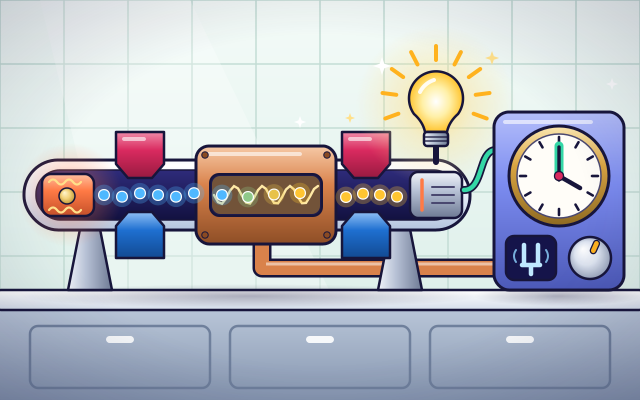
The interactive parts didn't load. The explanations below still work; try reloading the page.
From swinging pendulums to humming atoms
- Every clock has something that repeats, like this swinging pendulum. The clock counts the swings: so many swings make a minute, and so many make an hour.
- After many days the clocks no longer agree. When the room warms up, the pendulum grows a tiny bit longer and swings slower. The quartz clock drifts too, only less. Which one is right?
- Zoom in until you can see atoms. Every atom of the metal cesium is exactly like every other one. Each of them answers to one special note, and that note never changes.
- The clock sends atoms down a tube and through microwaves. Turn the knob to change the microwave note. When it matches the atoms' note, most of them flip, and the detector lamp glows brightly.
- A quartz crystal makes the microwaves. If the crystal drifts, fewer atoms flip and the lamp dims. The clock notices and nudges the crystal back, again and again, so it never wanders far.
- Atomic clocks fly on navigation satellites and sit in laboratories around the world. Your phone listens to their time signals to find where you are. The best ones would not lose a second in millions of years.
Look inside a cesium clock
Tap each part of the clock. Follow the atoms from the warm oven on the left to the detector on the right.
- Cesium oven. A small oven warms a drop of cesium metal. Atoms boil off and shoot out through a tiny hole in a thin, straight beam.
- First sorting magnet. The atoms come in two kinds, shown as blue and gold. This magnet bends the two kinds different ways, so only the blue ones travel on down the tube.
- Microwave cavity. Microwaves fill this copper box. If their note matches the atoms' note, the atoms flip from blue to gold as they fly through. If the note is wrong, they stay blue.
- Second sorting magnet. A second magnet sorts the atoms again. Gold atoms that flipped fly straight on to the detector. Blue ones that did not flip are bent away into a little cup.
- Detector. The detector counts the gold atoms that arrive. Many atoms mean the microwaves are on the right note. Fewer atoms mean the note has slipped.
- Quartz crystal. A quartz crystal vibrates millions of times a second and makes the clock's ticks and its microwaves. It is very steady, but on its own it slowly drifts.
- Feedback loop. A wire carries the detector's count back to the control box. If the count drops, the box nudges the crystal until the count is high again. The clock corrects itself all day long.
- Counter and clock. The counter counts the crystal's steady vibrations and turns them into seconds, minutes and hours. Because the atoms keep the crystal right, the time stays right.
Tune the clock to the atoms
Turn the knob to change the microwave note. Find the spot where the most atoms flip. Then warm the room and see what happens to the clock.
Experiment: The room warms up and the quartz crystal changes its beat. What will keep the clock right?
- Turn the knob until the lamp is as bright as it can be.
- Make the room warm or cool. Watch the lamp and the two clock hands.
- Switch on "Let the atoms steer" and change the room again.
What we found: A crystal on its own changes its beat when the room changes, so the clock drifts. When the atoms steer, the clock sees that fewer atoms are flipping and turns the knob back by itself. The atoms never change, so the clock stays right.
Turn on JavaScript to try it yourself.
Find the hidden note
The atoms' note is somewhere on the dial. Send puffs of atoms to test spots, climb to the top of the hill, then lock the clock. Fewer tests earn more stars.
Why atoms keep the best time
Every clock counts something that repeats. A grandfather clock counts the swings of a pendulum. A quartz watch counts the vibrations of a tiny crystal that shivers 32,768 times every second. The steadier the repeating thing, the better the clock.
The trouble is that pendulums and crystals are things that people make, so no two are exactly alike, and they change. A pendulum grows a little longer on a warm day and swings more slowly. A crystal changes with heat and with age. A good quartz watch may still gain or lose a second every few days.
Atoms are different. Every atom of cesium is exactly the same as every other one, and it always will be. A cesium atom flips from one state to another only when microwaves hit it at one exact note. So an atomic clock turns its microwaves up and down until the most atoms flip. Then it knows its note is right, and it counts that note to make seconds.
The comparison with a tuning fork is good, but it breaks down in one place: a real tuning fork can be bent or rust. Atoms cannot wear out. That is why the best cesium clocks would be wrong by less than one second after a hundred million years, and why satellites, phone networks and the internet all set their time from them.
Key words
- Oscillator
- Something that repeats at a steady rate, like a pendulum or a vibrating crystal.
- Frequency
- How many times something repeats each second. It is measured in hertz.
- Resonance
- The one special note that makes something respond strongly, like a swing that goes high only when you push in time with it.
- Drift
- How much a clock slowly gains or loses compared with the true time.
- Feedback loop
- A system that checks its own result and corrects itself, over and over.
- UTC
- Coordinated Universal Time: world time, made by averaging hundreds of atomic clocks.
Check your thinking
-
What does every clock need?
Show the answer
Something that repeats steadily, and a way to count it. Pendulum, crystal or atom: a clock counts something that repeats.
-
Why are atoms better timekeepers than pendulums?
Show the answer
Every atom of one kind is exactly alike and never changes. Things people build change with heat and age. Atoms of one kind are identical and stay that way.
-
The lamp on the detector gets dimmer. What does that tell the clock?
Show the answer
The microwave note has slipped away from the atoms' note. The atoms never change. If fewer flip, the crystal must have drifted, so the clock turns it back.
-
In a longer tube the atoms spend more time in the microwaves. What happens to the resonance peak?
Show the answer
It gets narrower, so its center can be found more exactly. The width of the peak is about one divided by the time in the field. More time gives a narrower peak and a tighter lock.
-
Why do navigation satellites carry atomic clocks?
Show the answer
A phone finds its place from tiny differences in time signals. The signals travel so fast that a tiny mistake in time becomes a big mistake in position.
-
A warm day makes a pendulum a little longer. What happens to the clock?
Show the answer
It runs slow, because a longer pendulum swings more slowly. A longer pendulum takes more time for each swing, so the clock counts fewer ticks and falls behind.
You're a Measuring & instruments expert!
You watched, looked inside, tried it, solved the challenge and went deeper. Pick another question below, or switch the age at the top to see this topic another way.
More about measuring & instruments
 #479
Measuring & instruments
How does a magnetic compass find north?
Rotate a compass in a model magnetic field and compare its direction with a map.
#479
Measuring & instruments
How does a magnetic compass find north?
Rotate a compass in a model magnetic field and compare its direction with a map.
 #480
Measuring & instruments
How do time zones work?
Compare local clock readings around a globe and explore coordinated standard times.
#480
Measuring & instruments
How do time zones work?
Compare local clock readings around a globe and explore coordinated standard times.
 #101
Measuring & instruments
How do quartz clocks and digital watches keep time?
Watch quartz vibrations become counted electrical pulses that advance clock hands or a digital display.
#101
Measuring & instruments
How do quartz clocks and digital watches keep time?
Watch quartz vibrations become counted electrical pulses that advance clock hands or a digital display.
 #102
Measuring & instruments
How do mechanical watches work without batteries?
Wind a mainspring and follow energy through gears, an escapement, and a swinging balance wheel.
#102
Measuring & instruments
How do mechanical watches work without batteries?
Wind a mainspring and follow energy through gears, an escapement, and a swinging balance wheel.
Keep exploring
Games to play next
- Clock TowerKeep the town on time: set the tower clock's hands just right.
- Globe ExplorerSpin a real 3D globe, flip to the flat map, and find continents, oceans and countries.
- Mapmaker QuestFollow directions to make a map, then read its legend, compass rose and scale.
Guide for grown-ups
- How to start homeschooling: a step-by-step guide for familiesA guide for parents · 7 min read
Science games by grade
Science worksheets by grade
- Preschool Science Worksheets
- Pre-K Science Worksheets
- Kindergarten Science Worksheets
- 1st Grade Science Worksheets
- 2nd Grade Science Worksheets
- 3rd Grade Science Worksheets
- 4th Grade Science Worksheets
- 5th Grade Science Worksheets
- 6th Grade Science Worksheets
- 7th Grade Science Worksheets
- 8th Grade Science Worksheets