How do time zones work?
The Earth turns once a day, so the Sun rises at different moments around the world. Time zones give every place a clock that fits its own day.
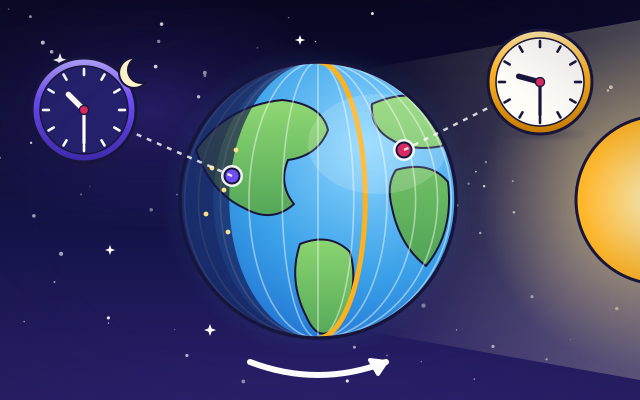
The big idea: As the Earth spins, sunlight sweeps around it. Places to the east meet the morning first. So the world is divided into time zones, and each zone sets its clocks about one hour apart from the next.
It's like a wave going around a stadium: people stand up one section after another. Morning sweeps around the Earth the same way, one time zone after another.
The interactive parts didn't load. The explanations below still work; try reloading the page.
Why clocks differ around the world
- It is morning, and the sun is rising outside your window. You call a friend who lives far away. For her it is already night! How can it be two different times at once?
- The Earth is a ball that spins all the way around once every day. The Sun lights only the half that faces it. That half has daytime, and the other half has night.
- When your town faces the Sun most directly, it is noon: the Sun is highest in the sky. As the Earth turns, noon arrives next for the towns to the west of you, and later still for towns beyond them.
- If every town used its own noon, clocks would differ by a few minutes from one town to the next. So the world is divided into 24 slices called time zones. Everyone in a slice uses the same time.
- One line on the globe is the starting line. The time there is called UTC. Every zone is a number of hours ahead of it or behind it. Zones to the east are ahead, and zones to the west are behind.
- Fly east and you move your watch forward, an hour for each zone you cross. Fly west and you move it back. On the far side of the world is the date line: cross it, and the date changes too.
A map of the world's time
The globe is rolled out into a flat map, so you can see the whole world at once. Tap each part.
- Day side. This half of the world is facing the Sun right now. It is daytime here: morning at the left edge of the bright part, afternoon at the right.
- Night side. This half of the world is facing away from the Sun. It is night here. As the Earth turns, the dark part slides around the world.
- Noon line. Along this line the Sun is at its highest. It is exactly noon here. The noon line moves west all day long as the Earth turns.
- A time zone. A time zone is one slice of the world, running from top to bottom. Everyone inside it sets their clocks to the same time, one hour different from the slices beside it.
- Prime meridian. This is the starting line for the world's time. It runs through Greenwich, in London. The time here is called UTC, and every other zone is counted from it.
- Date line. Halfway around the world from the starting line is the date line. A new calendar day begins here. Step across it and the date jumps by one day.
- The spinning Earth. The Earth spins around a line through its North and South Poles. One full spin takes one day, and it always turns toward the east.
Clocks around the globe
Spin the globe and watch the city clocks. Pick your city and a friend's city and compare their times.
Experiment: It is noon in London. Tokyo is far to the east. What time is it there?
- Spin the globe until the London clock shows 12.
- Choose Tokyo as your friend's city and read its clock.
- Now choose a city to the west, such as New York. Is it earlier or later there?
What we found: Places to the east meet the Sun first, so their clocks are ahead. When it is noon in London it is already 9 in the evening in Tokyo, and only 7 in the morning in New York, to the west.
Turn on JavaScript to try it yourself.
Call your friend
You live in London. Find a time when both you and your friend are awake, between 8 in the morning and 8 at night, and call.
How time zones work
The Earth spins around once every day. At any moment the Sun lights half of it. If you stand on the bright half, it is daytime. As the Earth carries you around to the dark half, the Sun seems to set and night begins.
Because the Earth turns toward the east, places to the east of you meet the sunrise before you do. When the Sun is highest in your sky, at noon, it is already afternoon for people to the east, and still morning for people to the west.
Long ago every town set its clocks by its own noon. That worked until trains and telegraphs connected faraway towns, and every station had a slightly different time. So the world was divided into 24 time zones. Everyone in a zone uses the same time, and each zone is one hour different from the next. All the zones are counted from one starting line that runs through Greenwich in London.
The stadium wave comparison breaks down in one place: time zones jump a whole hour at a border, while the real sunrise slides smoothly along. Zone borders also zigzag around countries. And far out in the Pacific Ocean is the date line, where a new calendar day begins.
Key words
- Rotation
- The spinning of the Earth. One full spin is one day.
- Longitude
- How far east or west a place is, measured in degrees around the globe.
- Time zone
- A region where everyone sets their clocks to the same time.
- UTC
- World time: the time at the starting line, from which all zones are counted.
- Prime meridian
- The line of zero longitude, running through Greenwich in London.
- International Date Line
- The line near 180 degrees of longitude where the calendar date changes.
Check your thinking
-
Why do different places have different times?
Show the answer
The Earth spins, so the Sun rises at different moments in different places. As the Earth turns, each place meets the Sun at its own moment.
-
It is noon in London. In a city far to the east it is
Show the answer
already afternoon or evening. Eastern places meet the Sun first, so their clocks are ahead.
-
How many main time zones is the world divided into?
Show the answer
24, one for each hour of the day. The Earth takes 24 hours to spin once, so there are 24 one-hour zones.
-
It is 22:00 on Monday in London (UTC). What is the time in Tokyo, at UTC plus 9?
Show the answer
07:00 on Tuesday. 22 + 9 = 31, which is 24 + 7: seven o'clock in the morning of the next day.
-
You fly east across three time zones. What should you do with your watch?
Show the answer
Move it forward three hours. Clocks to the east are ahead, one hour for each zone.
You're a Measuring & instruments expert!
You watched, looked inside, tried it, solved the challenge and went deeper. Pick another question below, or switch the age at the top to see this topic another way.
More about measuring & instruments
 #101
Measuring & instruments
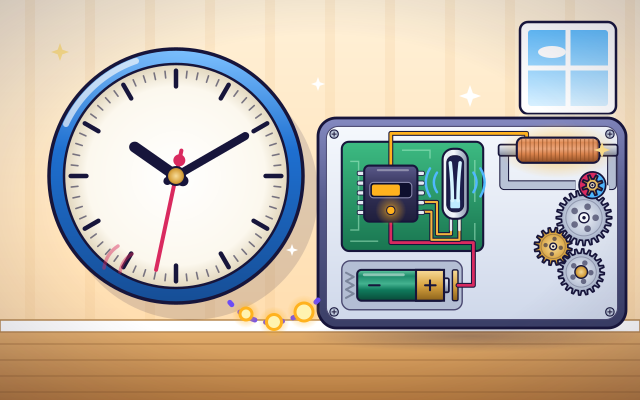
How do quartz clocks and digital watches keep time?
Watch quartz vibrations become counted electrical pulses that advance clock hands or a digital display.
#101
Measuring & instruments
How do quartz clocks and digital watches keep time?
Watch quartz vibrations become counted electrical pulses that advance clock hands or a digital display.
 #102
Measuring & instruments
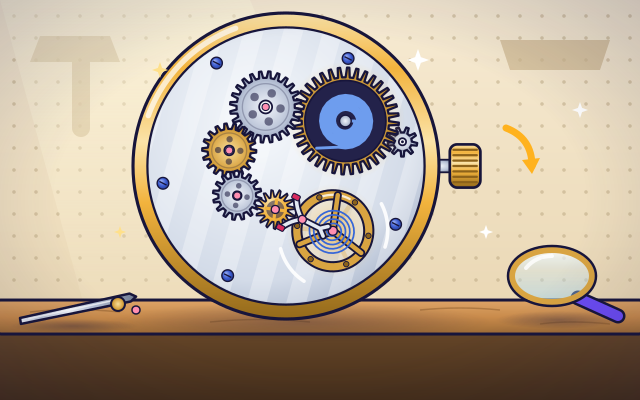
How do mechanical watches work without batteries?
Wind a mainspring and follow energy through gears, an escapement, and a swinging balance wheel.
#102
Measuring & instruments
How do mechanical watches work without batteries?
Wind a mainspring and follow energy through gears, an escapement, and a swinging balance wheel.
 #173
Measuring & instruments
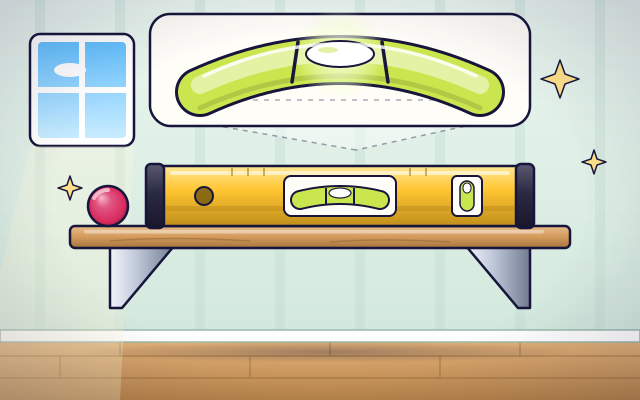
How does a spirit level show whether something is level?
Tilt a model shelf and watch the bubble move within its curved vial.
#173
Measuring & instruments
How does a spirit level show whether something is level?
Tilt a model shelf and watch the bubble move within its curved vial.
 #174
Measuring & instruments
How does a plumb bob show a vertical line?
Hang a virtual weight beside walls and compare their alignment with the string.
#174
Measuring & instruments
How does a plumb bob show a vertical line?
Hang a virtual weight beside walls and compare their alignment with the string.
Keep exploring
Games to play next
- Globe ExplorerSpin a real 3D globe, flip to the flat map, and find continents, oceans and countries.
- Clock TowerKeep the town on time: set the tower clock's hands just right.
- Mapmaker QuestFollow directions to make a map, then read its legend, compass rose and scale.
Guide for grown-ups
- How to start homeschooling: a step-by-step guide for familiesA guide for parents · 7 min read
Science games by grade
Science worksheets by grade
- Preschool Science Worksheets
- Pre-K Science Worksheets
- Kindergarten Science Worksheets
- 1st Grade Science Worksheets
- 2nd Grade Science Worksheets
- 3rd Grade Science Worksheets
- 4th Grade Science Worksheets
- 5th Grade Science Worksheets
- 6th Grade Science Worksheets
- 7th Grade Science Worksheets
- 8th Grade Science Worksheets