How do quartz clocks and digital watches keep time?
A sliver of quartz shivers thousands of times a second. A chip counts the shivers and gives the clock one push every second.
The big idea: A battery makes a quartz crystal vibrate at a very steady speed. A chip counts the vibrations and, every time it reaches the right number, sends one pulse of electricity that moves the second hand one step.
It's like a spinning jump rope: it turns at a steady beat, and a friend counts the turns and shouts "Now!" every time the count is reached.
The interactive parts didn't load. The explanations below still work; try reloading the page.
How a clock counts a second
- The second hand jumps once every second, all day and all night. Nobody winds this clock. So what tells it exactly when to tick?
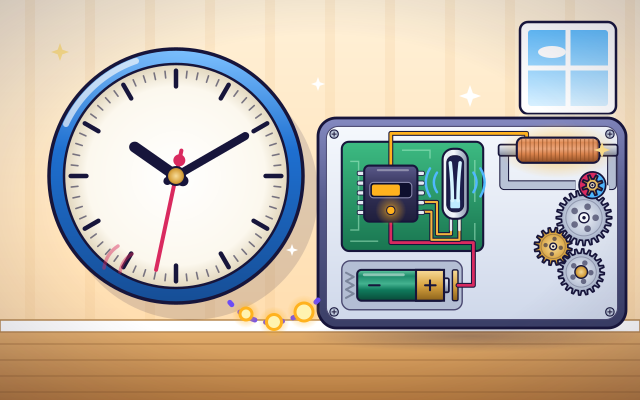
- Behind the face is a small box. A battery pushes electricity through thin metal paths to a tiny computer chip. Without the battery, nothing moves.
- Inside a little metal can is a sliver of quartz crystal shaped like a tuning fork. Electricity makes it bend back and forth, always at the very same speed: 32,768 times every second.
- The shivers are far too fast to move a clock hand. So the chip counts them. Each time it has counted 32,768 shivers, exactly one second has passed, and it sends out one pulse of electricity.
- The pulse runs through a coil of wire, which turns it into a magnet for a moment. That flips a tiny magnet wheel half a turn. Gears pass the turn along, and the second hand moves one step.
- A digital watch has the same crystal and the same counting chip. It just skips the motor and gears. Each pulse adds one to the seconds shown on the screen.
Look behind the clock face
This is the little box behind the clock face. Tap each part to see it work.
- Battery. The battery pushes electricity around the clock. It needs so little that one battery lasts a year or more.
- Quartz crystal. A sliver of quartz shaped like a tuning fork, sealed in a little metal can. Electricity makes it vibrate 32,768 times a second, always at the same speed.
- Counting chip. A tiny computer chip keeps the crystal shivering and counts every shiver. After 32,768 of them, one second has passed, and it sends out one pulse.
- Coil. Thousands of turns of very thin copper wire. When a pulse of electricity flows through it, the coil becomes a magnet for a moment.
- Magnet wheel. A tiny wheel that is a magnet. Each time the coil switches on, it pushes and pulls the wheel half a turn.
- Gears. Small gears pass the turning along and slow it down, so each flip of the magnet wheel moves the second hand just one little step.
- Hands. The thin second hand takes 60 steps to go all the way around. Then the minute hand has moved on by one minute.
Clock lab: count the shivers
Put the battery in, then change how many vibrations the chip counts before each tick. Compare your clock with the true time.
Experiment: What happens if the chip sends a pulse after counting only half as many vibrations?
- Tap the battery to put it in and watch both clocks tick together.
- Choose "Half as many" and compare your clock with the true time.
- Now choose "Twice as many" and compare again.
What we found: The crystal always shivers at the same speed, so the count decides how long a tick is. Count half as many and each tick comes twice as soon, so the clock runs fast. Count twice as many and it runs slow. Only 32,768 gives exactly one second.
Turn on JavaScript to try it yourself.
Clock repair shop
This clock is broken. Fix it so that it shows exactly one minute when a true minute has passed.
Why quartz keeps such good time
Every clock needs two things: something that repeats at a steady beat, and something that counts the beats. An old pendulum clock uses a swinging weight for the beat. A quartz clock uses a tiny piece of quartz, which is a hard, clear crystal. Sand is mostly made of quartz.
Quartz has a special trick. If you squeeze or bend it, it makes a tiny bit of electricity. And if you give it a tiny bit of electricity, it bends. So the chip in the clock gives the crystal little electric nudges, and the crystal shivers back and forth like a tuning fork that never stops ringing. It shivers 32,768 times every second, and it is very hard to make it go faster or slower. That is why quartz clocks keep good time.
No clock hand could move that fast, so the chip counts. Every time it has counted 32,768 shivers, it knows that one second has gone by, and it sends one pulse of electricity to a coil. The coil becomes a magnet for a moment and flips a tiny magnet wheel. Gears carry that little turn to the second hand: tick!
Our comparison with a friend counting jump-rope turns is not perfect. A person gets tired and loses count. The crystal never gets tired, and the chip never loses count. A quartz clock is usually wrong by only about 15 seconds in a whole month.
Key words
- Quartz
- A hard, clear crystal. A tiny piece of it keeps the beat in most clocks and watches.
- Vibration
- A fast back-and-forth movement, like a ringing tuning fork.
- Frequency
- How many times something vibrates each second.
- Piezoelectric
- Able to make electricity when squeezed, and to bend when given electricity.
- Pulse
- A short burst of electricity. The clock makes one every second.
- Frequency divider
- The part of the chip that counts vibrations and gives out one pulse for each full count.
Check your thinking
-
Which part gives a quartz clock its steady beat?
Show the answer
The vibrating quartz crystal. The crystal vibrates at a very steady speed. The battery only supplies the power.
-
Why does a quartz clock stop when its battery runs out?
Show the answer
Nothing pushes electricity to the crystal, the chip and the motor. The crystal needs little electric nudges to keep vibrating, and the motor needs pulses to step.
-
A faulty chip sends a pulse after counting only half of 32,768 vibrations. What does the clock do?
Show the answer
It runs twice as fast. Half the count is reached in half a second, so the hand steps twice every second.
-
Why do watch makers choose a crystal that vibrates exactly 32,768 times a second?
Show the answer
It is 2 to the power 15, so halving it 15 times gives exactly 1 per second. Simple circuits halve a frequency easily. Fifteen halvings of 32,768 give 1 hertz. A day has 86,400 seconds.
-
How does a pulse of electricity move the second hand?
Show the answer
The coil becomes a magnet and flips a tiny magnet wheel, which turns the gears. Electricity in a coil makes magnetism. That pushes the magnet wheel half a turn, and the gears pass it on.
-
What is different inside a digital watch?
Show the answer
It has no motor or gears: the pulses change numbers on a screen. A digital watch uses the same crystal and counting chip. Each pulse adds one second on the display.
You're a Measuring & instruments expert!
You watched, looked inside, tried it, solved the challenge and went deeper. Pick another question below, or switch the age at the top to see this topic another way.
More about measuring & instruments
 #102
Measuring & instruments
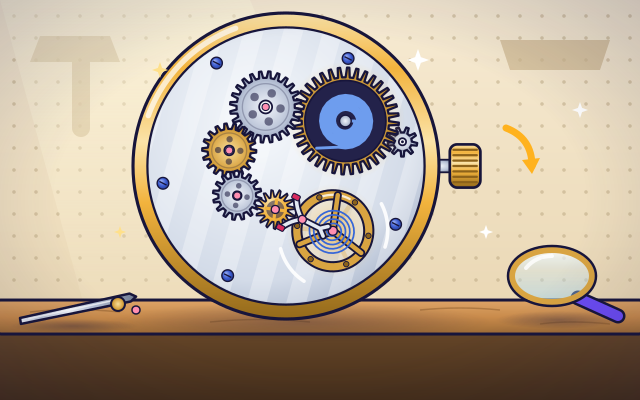
How do mechanical watches work without batteries?
Wind a mainspring and follow energy through gears, an escapement, and a swinging balance wheel.
#102
Measuring & instruments
How do mechanical watches work without batteries?
Wind a mainspring and follow energy through gears, an escapement, and a swinging balance wheel.
 #173
Measuring & instruments
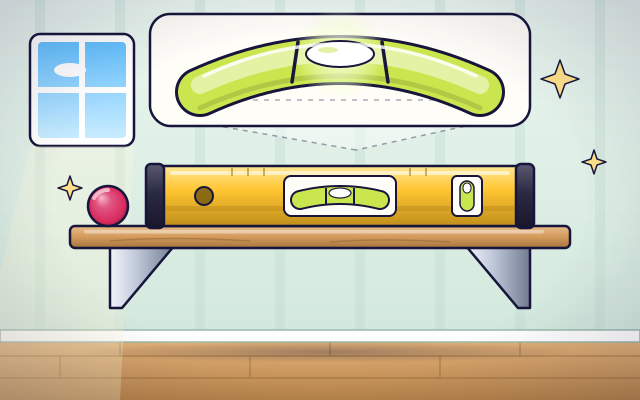
How does a spirit level show whether something is level?
Tilt a model shelf and watch the bubble move within its curved vial.
#173
Measuring & instruments
How does a spirit level show whether something is level?
Tilt a model shelf and watch the bubble move within its curved vial.
 #174
Measuring & instruments
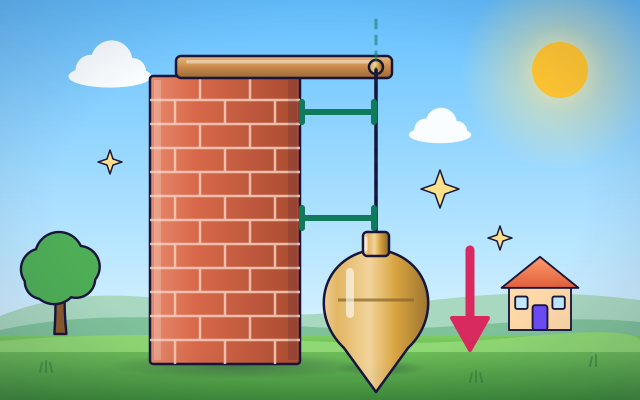
How does a plumb bob show a vertical line?
Hang a virtual weight beside walls and compare their alignment with the string.
#174
Measuring & instruments
How does a plumb bob show a vertical line?
Hang a virtual weight beside walls and compare their alignment with the string.
 #175
Measuring & instruments
How does a retractable tape measure work?
Inspect the spring, spool, hook, and locking mechanism inside a transparent case.
#175
Measuring & instruments
How does a retractable tape measure work?
Inspect the spring, spool, hook, and locking mechanism inside a transparent case.
Keep exploring
Games to play next
- Clock TowerKeep the town on time: set the tower clock's hands just right.
- Algebra BalanceKeep the scale level and the equation true, step by step.
- Globe ExplorerSpin a real 3D globe, flip to the flat map, and find continents, oceans and countries.
Guide for grown-ups
- How to start homeschooling: a step-by-step guide for familiesA guide for parents · 7 min read
Science games by grade
Science worksheets by grade
- Preschool Science Worksheets
- Pre-K Science Worksheets
- Kindergarten Science Worksheets
- 1st Grade Science Worksheets
- 2nd Grade Science Worksheets
- 3rd Grade Science Worksheets
- 4th Grade Science Worksheets
- 5th Grade Science Worksheets
- 6th Grade Science Worksheets
- 7th Grade Science Worksheets
- 8th Grade Science Worksheets