How does a magnetic compass find north?
The needle of a compass is a small magnet that lines up with the Earth's own magnetism, so its red end always points north.
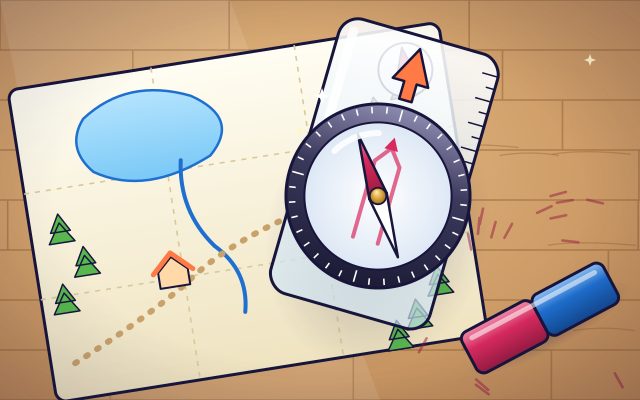
The big idea: The Earth is a giant magnet. A compass needle is a small magnet that can spin freely, so the Earth turns it until its red end points north. Then a map can show you which way to go.
It's like a weather vane: the wind you cannot see turns it to show the wind's direction. The Earth's magnetism, which you also cannot see, turns the needle to show north.
The interactive parts didn't load. The explanations below still work; try reloading the page.
How a compass finds north
- The path splits in two. The map says the lake is to the north. But in a forest every direction looks the same. How can you tell which way is north?
- Hold a compass flat and still. The needle swings back and forth, then settles. Its red end points north, every time, wherever you are standing.
- Bring a bar magnet close and the needle turns toward it. Every magnet has two ends, called poles. Opposite poles pull together and matching poles push apart, so the needle must be a magnet too.
- The Earth itself is a giant magnet. Its magnetism reaches all around the planet in invisible lines. Every compass needle turns to line up with those lines, and so it points north.
- Now turn the compass in your hand. The case and the dial go around, but the needle stays where it is, still pointing north. Turn the case until the N on the dial sits under the red end.
- Put the compass by the map. Turn the map until its north arrow points the same way as the needle. Now everything on the map lines up with the real world, and you can see which path leads to the lake.
Look inside a hiking compass
Tap each part of the compass. Some of them move when you find them!
- Magnetic needle. The needle is a thin strip of steel that has been made into a magnet. It is light and balanced, so the Earth's weak magnetism is enough to turn it. The red end points north.
- Pivot. The needle balances on a sharp point, like a spinning top. There is almost no rubbing, so even a very gentle push can turn it.
- Liquid-filled capsule. The needle sits in a sealed capsule full of clear liquid. The liquid slows the needle's wobbling, so it settles quickly and you can read it even while walking.
- Turning dial. The ring around the capsule turns. It is marked with N, E, S and W for north, east, south and west, and with degrees from 0 to 360 for directions in between.
- Orienting arrow. Under the needle is an outline of an arrow that turns with the dial. Turn the dial until the red needle sits inside the outline. Hikers remember it as "red in the shed".
- Baseplate and travel arrow. The clear plate has a big arrow on it. Point the arrow where you want to go, or turn yourself until the needle is in the shed, and then walk the way the arrow points.
Compass, magnet and map
Turn the compass and watch the needle. Then drag the magnet close. Does the compass still agree with the map?
Experiment: You turn the whole compass around in a circle. What does the needle do?
- Slide "Turn the compass" all the way round. Watch the needle and the dial.
- Drag the magnet close to the compass. Compare the two headings.
- Flip the magnet. Which end does the red needle like?
What we found: The needle stays pointing north while the case turns under it. That is why a compass works whichever way you hold it. A magnet nearby pulls the needle away from north, and then the compass no longer agrees with the map. Keep compasses away from magnets and iron!
Turn on JavaScript to try it yourself.
Treasure by compass
First line the map up with the compass. Then turn the compass to the direction in the clue and dig!
Why the needle points north
Every magnet has two ends, called its north pole and its south pole. If you bring two magnets together, a north pole and a south pole pull toward each other, but two north poles, or two south poles, push apart. Around every magnet there is an invisible area where its pull can be felt. This is called its magnetic field.
The Earth has a magnetic field too. Deep inside the planet, hot liquid iron is always moving, and that movement turns the Earth into one enormous magnet. Its field reaches everywhere on the surface and far out into space.
A compass needle is a small, light magnet balanced on a sharp point so it can spin. The Earth's field turns it, just as wind turns a weather vane, until one end points north. That end is painted red. Because the needle keeps pointing north however you hold the compass, you can use it to turn a map the right way round and to walk in a straight line through a forest or fog.
The weather vane comparison breaks down in one place: wind changes from hour to hour, but the Earth's field is steady. Two things can fool a compass, though. A magnet or a lump of iron nearby pulls the needle aside. And magnetic north is not exactly at the North Pole, so in many places the needle points a little to one side of true north.
Key words
- Magnetic pole
- One of the two ends of a magnet, north or south, where its pull is strongest.
- Magnetic field
- The invisible area around a magnet where its push or pull can be felt.
- Bearing
- A direction given as an angle, measured clockwise from north. East is 90 degrees.
- Orienting a map
- Turning a map until its north points to real north, so the map matches the land.
- Declination
- The small angle between where the needle points and true north.
Check your thinking
-
What is a compass needle made of?
Show the answer
A light magnet that can spin freely. It is a small magnet on a sharp point, free to turn.
-
You turn around in a circle holding a compass. What does the needle do?
Show the answer
It keeps pointing north while the case turns around it. The Earth's magnetism holds the needle still while the case moves.
-
A magnet lies on the table next to your compass. What should you do before you trust the compass?
Show the answer
Move the compass far away from the magnet. A magnet nearby pulls the needle away from north. Far from it, the needle points north again.
-
Magnetic north is 10 degrees east of true north where you stand. Your compass heading is 60 degrees. What is your true heading?
Show the answer
70 degrees. The compass measures from magnetic north, which is already 10 degrees east of true north, so the true heading is 60 + 10 = 70 degrees.
-
Why does the needle point north all over the world?
Show the answer
The Earth is a giant magnet with a field all around it. The Earth's own magnetism reaches everywhere on its surface.
You're a Measuring & instruments expert!
You watched, looked inside, tried it, solved the challenge and went deeper. Pick another question below, or switch the age at the top to see this topic another way.
More about measuring & instruments
 #480
Measuring & instruments
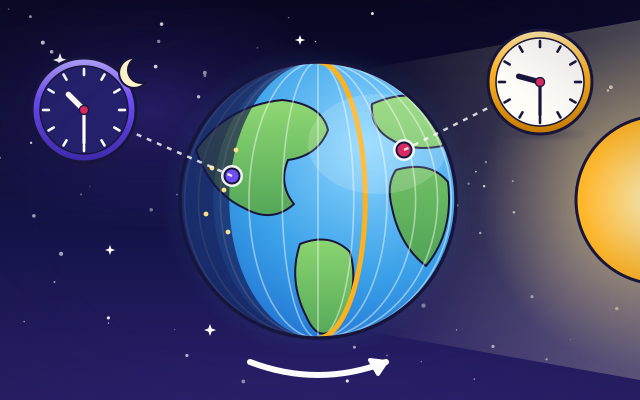
How do time zones work?
Compare local clock readings around a globe and explore coordinated standard times.
#480
Measuring & instruments
How do time zones work?
Compare local clock readings around a globe and explore coordinated standard times.
 #101
Measuring & instruments
How do quartz clocks and digital watches keep time?
Watch quartz vibrations become counted electrical pulses that advance clock hands or a digital display.
#101
Measuring & instruments
How do quartz clocks and digital watches keep time?
Watch quartz vibrations become counted electrical pulses that advance clock hands or a digital display.
 #102
Measuring & instruments
How do mechanical watches work without batteries?
Wind a mainspring and follow energy through gears, an escapement, and a swinging balance wheel.
#102
Measuring & instruments
How do mechanical watches work without batteries?
Wind a mainspring and follow energy through gears, an escapement, and a swinging balance wheel.
 #173
Measuring & instruments
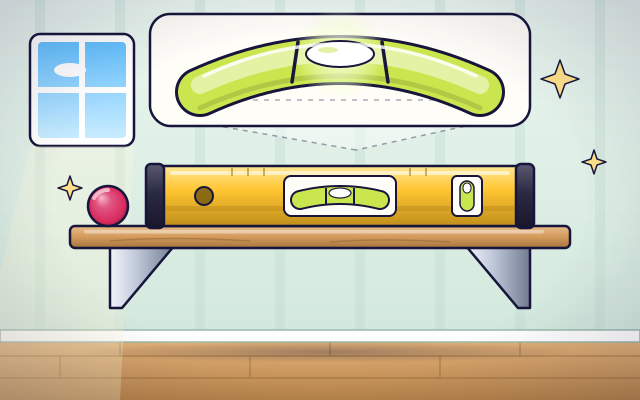
How does a spirit level show whether something is level?
Tilt a model shelf and watch the bubble move within its curved vial.
#173
Measuring & instruments
How does a spirit level show whether something is level?
Tilt a model shelf and watch the bubble move within its curved vial.
Keep exploring
Games to play next
- Mapmaker QuestFollow directions to make a map, then read its legend, compass rose and scale.
- Clock TowerKeep the town on time: set the tower clock's hands just right.
- Data DetectiveRead the clues hidden in graphs — and build your own.
Guide for grown-ups
- How to start homeschooling: a step-by-step guide for familiesA guide for parents · 7 min read
Science games by grade
Science worksheets by grade
- Preschool Science Worksheets
- Pre-K Science Worksheets
- Kindergarten Science Worksheets
- 1st Grade Science Worksheets
- 2nd Grade Science Worksheets
- 3rd Grade Science Worksheets
- 4th Grade Science Worksheets
- 5th Grade Science Worksheets
- 6th Grade Science Worksheets
- 7th Grade Science Worksheets
- 8th Grade Science Worksheets