How do adult teeth replace baby teeth?
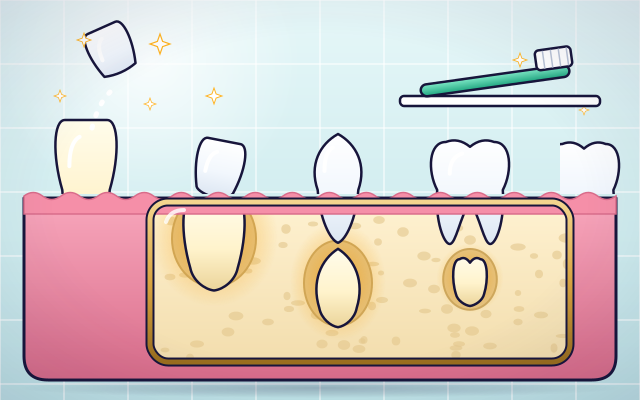
Under your gums, bigger teeth are growing. See how they push up, loosen the baby teeth and take their places.
The big idea: Adult teeth grow inside the jaw below the baby teeth. As one moves up, the baby tooth's root dissolves, the tooth gets loose and falls out, and the adult tooth grows into the gap.
It's like a seat saved for a friend: each baby tooth keeps a place in your jaw until the bigger tooth below is ready to take it.
The interactive parts didn't load. The explanations below still work; try reloading the page.
From baby teeth to adult teeth
- Mia is six, and one of her front teeth has started to wobble. Nothing is wrong. Something has been getting ready under her gums for years.
- Look below the gum line. Each baby tooth has a root that holds it in the jaw. And under every one, a bigger adult tooth is growing in its own little pocket.
- As the adult tooth moves up, your body slowly dissolves the root of the baby tooth above it. With less and less root to hold it, the baby tooth starts to wiggle.
- When the root is nearly gone, only the gum holds the baby tooth. One more wiggle and out it comes, leaving a gap.
- The adult tooth pokes through the gum and grows into the gap over a few weeks. It is bigger and stronger, and its own root keeps growing for two or three more years.
- From about age six to twelve, all twenty baby teeth are replaced. Extra molars also grow in at the back where there were no teeth before, because your jaw has grown.
Inside a baby tooth, with a surprise below
Tap each part of this tooth cut in half. Do not miss what is hiding underneath!
- Enamel. Enamel is the white outer coat of the tooth. It is the hardest material in your body, hard enough for a lifetime of chewing.
- Dentin. Dentin is the yellowish layer under the enamel. It makes up most of the tooth and is a little softer and springier, so the tooth does not crack.
- Pulp. The pulp is the soft center of the tooth. Tiny blood vessels feed the tooth here, and nerves let you feel hot, cold and pressure.
- Root. The root is the part you never see. It reaches down into the jaw and holds the tooth firmly, like the roots of a tree. A baby tooth's root dissolves before the tooth falls out.
- Gum. The gum is the pink skin around the neck of the tooth. It seals the gap so food and germs stay out.
- Jawbone. The jawbone holds every tooth in its own socket. It keeps growing through childhood, making room for more and bigger teeth.
- Adult tooth waiting. Tucked between the roots is the adult tooth that will take this spot. Its top, the crown, is built first. The root comes later, as the tooth moves up.
The tooth timeline
Drag the window along the jaw to see below the gums. Move the age slider and watch roots shrink and adult teeth rise. Tap any tooth to check it.
Experiment: What happens to a baby tooth's root before the tooth falls out?
- Set the age to 5 and drag the window over the front tooth on the left.
- Slide the age slowly to 6, then 7. Watch that tooth's root and the tooth below it.
- Keep going to age 12 and watch the other teeth take their turns.
What we found: The root dissolves. As the adult tooth pushes up from below, your body slowly takes the baby tooth's root apart. With no root left, the tooth wobbles and falls out, and the adult tooth grows into the gap.
Turn on JavaScript to try it yourself.
Which tooth is next?
Use the window to look under the gums. Tap the baby tooth that will fall out next: the one with the least root left. Solve three jaws.
Two sets of teeth
You get two sets of teeth in your life. The first set, the 20 baby teeth, starts to appear when you are about six months old and is complete by about age three. They are just the right size for a small jaw, and they help you chew, speak clearly and smile.
While you use your baby teeth, a second set is quietly growing inside your jawbones. Under each baby tooth, a bigger adult tooth takes shape, crown first. When it is ready, it begins to move up. Your body then dissolves the root of the baby tooth above it. With no root, the baby tooth wobbles and falls out, and the adult tooth grows into the gap.
The change usually starts at about six with the bottom front teeth and finishes at about twelve. Extra adult molars also grow in at the back, where there were never any baby teeth, because your jaw has grown longer. By your early teens you have 28 adult teeth, and up to four wisdom teeth may come much later.
A baby tooth is a bit like a seat saved for a friend, but nobody carries it away: your own body takes its root apart. Losing teeth a year earlier or later than your friends is normal. Adult teeth do not get replaced, so brushing twice a day and seeing a dentist helps them last a lifetime.
Key words
- Baby teeth
- Your first set of 20 teeth. Dentists call them primary teeth.
- Adult teeth
- Your second set of teeth, which has to last for life. Dentists call them permanent teeth.
- Crown and root
- The crown is the part of a tooth you can see. The root is the hidden part that holds it in the jaw.
- Resorption
- When the body slowly dissolves something it made, such as a baby tooth's root.
- Erupt
- What a tooth does when it moves up through the gum and appears in the mouth.
Check your thinking
-
Why does a baby tooth become loose?
Show the answer
Its root dissolves as the adult tooth moves up under it. The root is what holds a tooth in. When your body dissolves it, the tooth has nothing to hold on with.
-
Where do adult teeth grow before they appear?
Show the answer
Inside the jawbone, under the baby teeth. Adult teeth take years to form inside the jaw before they push through the gum.
-
Why do new molars grow at the back where there were no baby teeth?
Show the answer
Your jaw has grown longer, so there is room for more teeth. A grown jaw is longer than a small child's, so extra chewing teeth fit in behind.
-
A child has all four first permanent molars and new lower central incisors, but still has baby canines with long roots. About how old is the child?
Show the answer
About 7. First molars and lower central incisors erupt at about 6 to 7. Canines are not replaced until about 9 to 12.
-
Which part of an adult tooth is finished first?
Show the answer
The crown, the part you will see. The crown forms first, deep in the jaw. The root grows afterward, as the tooth moves up.
You're a Human body expert!
You watched, looked inside, tried it, solved the challenge and went deeper. Pick another question below, or switch the age at the top to see this topic another way.
More about human body
 #264
Human body
How does tooth decay develop?
Explore plaque, acids, enamel damage, and protective saliva on a model tooth.
#264
Human body
How does tooth decay develop?
Explore plaque, acids, enamel damage, and protective saliva on a model tooth.
 #265
Human body
How do hair and nails grow?
Follow newly produced cells into growing hair and nails beneath a skin cutaway.
#265
Human body
How do hair and nails grow?
Follow newly produced cells into growing hair and nails beneath a skin cutaway.
 #266
Human body
How do fingerprints form?
Explore developing skin ridges and compare loops, arches, and whorls.
#266
Human body
How do fingerprints form?
Explore developing skin ridges and compare loops, arches, and whorls.
 #267
Human body
Why do we get goosebumps?
Activate tiny muscles attached to hair follicles and observe changes in the skin.
#267
Human body
Why do we get goosebumps?
Activate tiny muscles attached to hair follicles and observe changes in the skin.
Keep exploring
Games to play next
- Body ExplorerTap, match and label your way around the amazing human body.
- Life Skills & Health QuizzesOlly's Life Skills Quiz Show: healthy habits, safety, feelings, money, time and kind, safe screens.
- Label LabPut the right labels on beautiful science diagrams, from bean plants to heart chambers.
Guide for grown-ups
- How to start homeschooling: a step-by-step guide for familiesA guide for parents · 7 min read
Science games by grade
Science worksheets by grade
- Preschool Science Worksheets
- Pre-K Science Worksheets
- Kindergarten Science Worksheets
- 1st Grade Science Worksheets
- 2nd Grade Science Worksheets
- 3rd Grade Science Worksheets
- 4th Grade Science Worksheets
- 5th Grade Science Worksheets
- 6th Grade Science Worksheets
- 7th Grade Science Worksheets
- 8th Grade Science Worksheets