How do hair and nails grow?
New cells are made at the root, harden and get pushed out as hair and nails. See it happen under the skin.
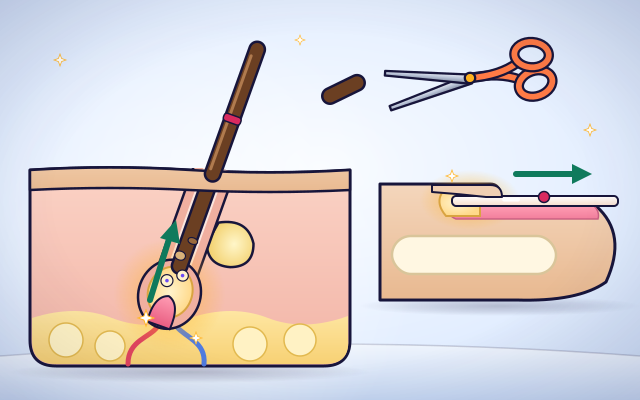
The big idea: Hair and nails are made at their roots. New cells push the older ones outward, and the older cells harden into a tough material called keratin. The part you see is no longer alive, so cutting it does not hurt.
It's like toothpaste squeezed from a tube: new paste is added at the bottom, and it pushes the older paste out at the top.
The interactive parts didn't load. The explanations below still work; try reloading the page.
How hair and nails grow
- A haircut does not hurt, and neither does trimming your nails. Yet both keep growing back. Where does the new hair come from?
- Zoom in under the skin. Every hair grows out of a tiny tube called a follicle. At the bottom is the root, shaped like a little onion.
- In the root, cells divide again and again, fed by blood. Each batch of new cells pushes the older ones up the tube, like toothpaste from a tube.
- On the way up, the cells fill with a tough material called keratin and stop being alive. Packed together, they are the hair you see. That is why a haircut does not hurt.
- A nail has a root too, hidden under the skin at its base. New cells are made there, harden with keratin, and the whole nail slides slowly toward your fingertip.
- Hair grows about one centimeter each month, and fingernails about three millimeters. They never stop, so we cut and trim them. It is all growth from the root.
A hair and a nail, cut open
Tap each part of the hair and the fingertip to see what it does.
- Hair shaft. The shaft is the part of a hair above the skin. It is made of hardened cells that are no longer alive, so it has no feeling.
- Follicle. The follicle is a tiny tube in the skin that holds the hair and shapes it as it grows. A round tube makes straight hair, and an oval tube makes curly hair.
- Hair root. The root, or bulb, is the living part at the bottom of the follicle. Cells here divide all the time to build the hair.
- Blood supply. A knot of tiny blood vessels, called the papilla, pokes into the root. It delivers the food and oxygen the busy cells need.
- Oil gland. A small gland beside the follicle makes an oil called sebum. It keeps your hair and skin soft and a little waterproof.
- Nail. The nail you can see is a hard plate of keratin. It protects your fingertip and helps you pick up tiny things and scratch an itch.
- Nail root. The nail root, or matrix, is hidden under the skin at the base of the nail. It makes the new cells. The pale half-moon you may see on a nail is the front edge of it.
- Nail bed. The nail bed is the living skin under the nail. It is rich in blood, which is why nails look pink. The nail slides forward over it.
Where does the growing happen?
Paint a stripe on the hair and a dot on the nail. Then let the weeks pass and watch where the marks go. Tap the roots to see new cells being made.
Experiment: Where does a hair grow from?
- Press Paint the marks. A stripe appears on the hair at the skin, and a dot at the base of the nail.
- Slide the weeks forward and watch the stripe and the dot.
- Look at the hair between the skin and the stripe. Where did it come from?
What we found: The stripe moves away from the skin, and brand-new hair appears underneath it. So hair grows from the root, not from the tip. Nails do the same: the dot slides toward the fingertip as new nail is made behind it.
Turn on JavaScript to try it yourself.
Where will the stripe be?
A stripe has just been painted on the hair, right at the skin. Hair grows about 2.5 millimeters a week. Set the flag where the stripe will be in 4 weeks, then press Let time pass.
Growing from the root
Hair and nails are made of the same tough material, called keratin. Keratin also makes up the outer layer of your skin, and in other animals it forms claws, hooves, horns, beaks and feathers.
Every hair grows from a follicle, a tiny tube in your skin. At the bottom of the tube is the root, where cells divide all the time, fed by tiny blood vessels. New cells push the older ones up the tube. On the way, the older cells fill with keratin, harden and stop being alive. By the time a hair pokes out of your skin, it is not living anymore. That is why a haircut does not hurt, but pulling a hair does: the root is alive and has nerves around it.
Nails grow the same way. The nail root hides under the skin at the base of the nail. It makes new cells, they harden, and the whole nail slides slowly forward over the pink nail bed. Fingernails grow about three millimeters a month, and toenails more slowly.
The toothpaste comparison is not perfect: toothpaste stays soft, but these cells harden as they travel. Hair also takes breaks. After growing for a few years, a follicle rests, the old hair falls out and a new one starts. Losing 50 to 100 hairs a day is normal.
Key words
- Keratin
- The tough material that hair, nails and the outer layer of skin are made of.
- Follicle
- The tiny tube in the skin that a hair grows from.
- Hair bulb
- The living root at the bottom of a follicle, where new hair cells are made.
- Nail matrix
- The nail's root, hidden under the skin at the base of the nail, where new nail cells are made.
- Cell
- One of the tiny building blocks that all living things are made of.
Check your thinking
-
Where does a hair grow from?
Show the answer
From the root at the bottom of the follicle. Cells divide in the root and push the older hair upward. The tip is the oldest part.
-
Why does cutting your hair or nails not hurt?
Show the answer
The part you cut is made of hardened cells that are no longer alive and has no nerves. No living cells and no nerves means no pain. The living root under the skin is the part that can feel.
-
You paint a dot at the base of a fingernail. Where is the dot a month later?
Show the answer
About 3 millimeters closer to the fingertip. New nail is made behind the dot and pushes it forward, about 3 millimeters a month.
-
What are hair and nails made of?
Show the answer
Keratin, the same tough stuff as claws and hooves. Keratin is a tough protein. Animals use it for claws, hooves, horns, beaks and feathers too.
-
A scalp follicle enters its resting phase. What happens to its hair?
Show the answer
It stops growing, is shed after a few months and a new hair starts. Follicles cycle through growth and rest. Shedding 50 to 100 resting hairs a day is normal.
You're a Human body expert!
You watched, looked inside, tried it, solved the challenge and went deeper. Pick another question below, or switch the age at the top to see this topic another way.
More about human body
 #266
Human body
How do fingerprints form?
Explore developing skin ridges and compare loops, arches, and whorls.
#266
Human body
How do fingerprints form?
Explore developing skin ridges and compare loops, arches, and whorls.
 #267
Human body
Why do we get goosebumps?
Activate tiny muscles attached to hair follicles and observe changes in the skin.
#267
Human body
Why do we get goosebumps?
Activate tiny muscles attached to hair follicles and observe changes in the skin.
 #268
Human body
How does a sneeze happen?
Follow an irritation signal and coordinate the muscles involved in a sneeze animation.
#268
Human body
How does a sneeze happen?
Follow an irritation signal and coordinate the muscles involved in a sneeze animation.
 #269
Human body
How do hiccups happen?
Animate a diaphragm contraction and the associated rapid closure of the vocal folds.
#269
Human body
How do hiccups happen?
Animate a diaphragm contraction and the associated rapid closure of the vocal folds.
Keep exploring
Games to play next
- Body ExplorerTap, match and label your way around the amazing human body.
- Label LabPut the right labels on beautiful science diagrams, from bean plants to heart chambers.
- Science QuizzesOlly's Science Quiz Show: plants, animals, the body, weather, space and more, for every grade.
Guide for grown-ups
- How to start homeschooling: a step-by-step guide for familiesA guide for parents · 7 min read
Science games by grade
Science worksheets by grade
- Preschool Science Worksheets
- Pre-K Science Worksheets
- Kindergarten Science Worksheets
- 1st Grade Science Worksheets
- 2nd Grade Science Worksheets
- 3rd Grade Science Worksheets
- 4th Grade Science Worksheets
- 5th Grade Science Worksheets
- 6th Grade Science Worksheets
- 7th Grade Science Worksheets
- 8th Grade Science Worksheets