How do fingerprints form?
Before you were born, a fast-growing layer of skin wrinkled into ridges. The shape of each soft fingertip pad steered them into an arch, a loop or a whorl.
The big idea: A layer of skin grew too fast for its space and folded into ridges. A tall pad made a whorl, a leaning pad a loop and a flat pad an arch. Tiny nudges made every print different.
It's like a rug pushed from both ends: it has nowhere to go, so it buckles into folds. A fast-growing layer of skin buckled into ridges the same way.
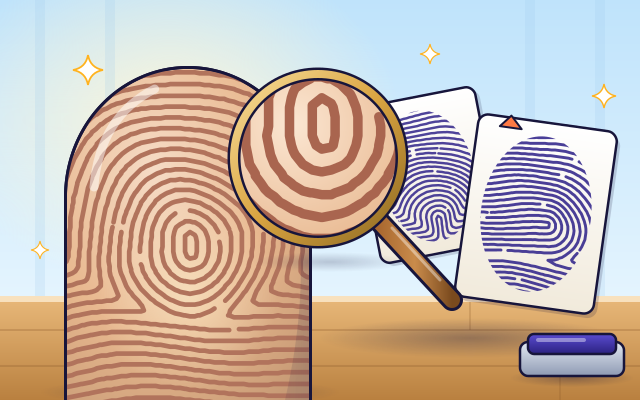
The interactive parts didn't load. The explanations below still work; try reloading the page.
How a fingertip got its pattern
- Maya touches the window, and her finger leaves a mark: a fingerprint. It is a copy of the tiny lines on her fingertip. How did those lines get there?
- Up close, the lines are raised ridges with grooves between them. Ridges help your fingers grip, like the tread on a shoe, and they help you feel tiny bumps.
- Long before you were born, your hand was smaller than a grape and your fingertips were smooth. Each one had a soft, rounded bump called a pad.
- Skin is made of layers. One layer in the middle grew faster than the layers around it. With nowhere to go, it folded, and the folds pushed up ridges on the surface.
- Ridges begin in three places: the middle of the pad, the tip, and the crease. They spread like ripples until they meet. The shape of the pad decides whether you get an arch, a loop or a whorl.
- Tiny differences while the ridges grew, a little push here, a little stretch there, changed the details. So every finger of every person is different, even for identical twins. And your prints stay the same for life.
A tiny block of fingertip skin
We cut out a tiny block of fingertip skin and made it much bigger. Tap each part to see what it does.
- Ridge. A raised line of thick skin. Ridges give your fingers grip, and they leave the print when you touch something.
- Groove. The valley between two ridges. Grooves give water somewhere to go, so damp fingers can still grip.
- Sweat pore. A tiny opening on top of a ridge. A little sweat comes out here. It is part of what you leave behind in a fingerprint.
- Sweat gland. A coiled tube deep in the skin. It makes sweat and sends it up a thin tube to the pore.
- Growing layer. The bottom layer of the outer skin. It makes new skin cells all the time. Before you were born it folded, and its folds still hold your fingerprint pattern.
- Touch sensor. A tiny sensor just under the ridges. When a ridge is pressed or rubbed, the sensor sends a signal along a nerve to your brain.
Print lab: pad shape and pattern
Change the height and lean of the soft pad, then watch the ridges spread. Can you collect an arch, a loop and a whorl?
Experiment: Which pad makes ridges that go round and round in rings (a whorl)?
- Choose the flat pad. What do the ridges do?
- Choose the tall pad in the center. Then lean it left and right.
- Press Grow again. What stays the same, and what changes?
What we found: A flat pad gives an arch, a tall pad in the center gives a whorl, and a pad that leans gives a loop. Growing the same pad again gives the same family of pattern but new small details. That is why prints can look alike and still never match.
Turn on JavaScript to try it yourself.
Match the mystery prints
Three mystery prints, one at a time. Shape the pad so your fingertip grows the same pattern, then press Grow the ridges. For 3 stars, match every print on the first try.
Why your fingerprints are yours alone
Look closely at your fingertip. You will see thin, curving lines. They are raised strips of skin called ridges, with grooves between them. Ridges help you grip a pencil or a damp glass, a bit like the tread on a shoe. They also help the touch sensors under your skin feel tiny bumps and textures.
Your ridges grew long before you were born, when your hand was smaller than a grape. Back then each fingertip was smooth, with a soft bump called a pad. Then a layer of skin under the surface started growing faster than the layers around it. It had no room to spread out, so it folded, like a rug pushed from both ends. The folds pushed up the ridges. A rug's folds flop flat again, but your skin's folds were locked in for good.
The ridges did not appear all at once. They started in three places and spread like ripples until they met. The shape of the pad steered them. A tall, round pad made the ridges circle around it in a whorl. A pad that leaned to one side made a loop. A low, flat pad made an arch. Loops are the most common pattern, whorls come second, and arches are the rarest.
While the ridges grew, tiny things nudged them: how the finger was pressed, how fast it grew, what it touched. Those nudges changed the small details, such as where one ridge ends or splits in two. That is why nobody else has your fingerprints, not even an identical twin. And because the pattern lives in the deep growing layer of your skin, it stays the same your whole life. A small cut heals, and the same ridges grow back.
Key words
- Ridge
- A thin raised line of skin on a fingertip.
- Pad
- The soft bump on each fingertip before birth. Its shape steers the pattern.
- Arch, loop and whorl
- The three families of fingerprint pattern: ridges that rise like a hill, ridges that turn around and go back, and ridges that circle around.
- Growing layer
- The bottom layer of the outer skin, where new skin cells are made.
- Delta
- A little triangle in a print where ridges coming from three directions meet.
- Minutiae
- The tiny details of a print, such as where a ridge ends or splits.
Check your thinking
-
When do fingerprints form?
Show the answer
Before birth, while the hand is still tiny. The ridges grow and lock in long before birth, and after that the pattern never changes.
-
How do ridges help your fingers?
Show the answer
They help you grip and feel textures. Ridges work a bit like the tread on a shoe, and they help the touch sensors under them feel tiny bumps.
-
Which pad shape makes a whorl?
Show the answer
A tall, round pad in the center. Around a tall, centered pad the ridges have room to close into rings: a whorl.
-
Why do identical twins have different fingerprints?
Show the answer
Tiny chance nudges changed the details while the ridges grew. Twins often have the same family of pattern, but the small details were shaped by tiny pushes and stretches that were different for each of them.
-
You get a small paper cut on your fingertip. What happens to the print there when it heals?
Show the answer
The same ridges grow back. The pattern lives in the deep growing layer, so new skin grows back in the same shape.
-
A print has two deltas and ridges that close into rings around the core. Which family is it?
Show the answer
A whorl. Closed rings around the core with a delta on each side make a whorl. A loop has one delta and a plain arch has none.
You're a Human body expert!
You watched, looked inside, tried it, solved the challenge and went deeper. Pick another question below, or switch the age at the top to see this topic another way.
More about human body
 #267
Human body
Why do we get goosebumps?
Activate tiny muscles attached to hair follicles and observe changes in the skin.
#267
Human body
Why do we get goosebumps?
Activate tiny muscles attached to hair follicles and observe changes in the skin.
 #268
Human body
How does a sneeze happen?
Follow an irritation signal and coordinate the muscles involved in a sneeze animation.
#268
Human body
How does a sneeze happen?
Follow an irritation signal and coordinate the muscles involved in a sneeze animation.
 #269
Human body
How do hiccups happen?
Animate a diaphragm contraction and the associated rapid closure of the vocal folds.
#269
Human body
How do hiccups happen?
Animate a diaphragm contraction and the associated rapid closure of the vocal folds.
 #270
Human body
How do we produce our voices?
Adjust airflow and vocal folds, then shape sounds with mouth and tongue positions.
#270
Human body
How do we produce our voices?
Adjust airflow and vocal folds, then shape sounds with mouth and tongue positions.
Keep exploring
Games to play next
- Body ExplorerTap, match and label your way around the amazing human body.
- Label LabPut the right labels on beautiful science diagrams, from bean plants to heart chambers.
- Science QuizzesOlly's Science Quiz Show: plants, animals, the body, weather, space and more, for every grade.
Guide for grown-ups
- How to start homeschooling: a step-by-step guide for familiesA guide for parents · 7 min read
Science games by grade
Science worksheets by grade
- Preschool Science Worksheets
- Pre-K Science Worksheets
- Kindergarten Science Worksheets
- 1st Grade Science Worksheets
- 2nd Grade Science Worksheets
- 3rd Grade Science Worksheets
- 4th Grade Science Worksheets
- 5th Grade Science Worksheets
- 6th Grade Science Worksheets
- 7th Grade Science Worksheets
- 8th Grade Science Worksheets