How does the body keep its balance?
Your inner ears, your eyes and sensors all over your body send messages that your brain combines to keep you steady.
The big idea: Your brain keeps you upright by combining three kinds of messages: tilt and turning from your inner ears, the view from your eyes, and the feeling of your muscles, joints and feet.
It's like a full cup of water on a tray: tilt it and the water slides to the low side; spin it and the water lags behind. Your inner ear feels that.
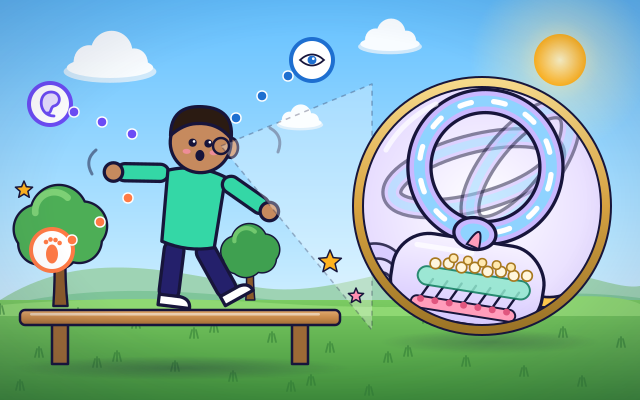
The interactive parts didn't load. The explanations below still work; try reloading the page.
Three senses, one steady body
- Mia balances on a beam. She wobbles a little, but tiny corrections keep her up. Every moment, her body has to know which way it is leaning. How does it find out?
- Deep inside your head, behind each ear, sits the inner ear. Part of it is for hearing. The rest is for balance: three curved tubes, called canals, and two small sacs.
- In each sac, tiny chalky stones rest on a layer of jelly, on top of cells with fine hairs. Tilt your head and gravity drags the stones downhill. The jelly bends the hairs, so the cells send a message: you are tilting!
- Each canal is a loop full of liquid. When your head turns, the tube turns with it, but the liquid lags behind, like water in a spinning cup. It pushes a jelly flap and bends the hairs inside. Stop suddenly and the liquid keeps going, so you feel dizzy.
- The inner ear does not work alone. Your eyes see the ground and the horizon. Sensors in your muscles, joints and the soles of your feet feel how your body is bent and where your weight is pressing.
- All three sets of messages race to the brain. It compares them, works out which way you are tipping and tells your muscles to pull you back, in about a tenth of a second. You do not even have to think about it.
Look inside the balance system
Tap each part on Mia and in the zoomed-in inner ear. Watch what each one does.
- Canals. Three loops full of liquid. When you turn your head, the liquid lags behind and pushes a tiny jelly flap. Each loop feels a different kind of turn: nodding, shaking your head or tipping it to the side.
- Ear stones. Tiny chalky stones rest on jelly above cells with fine hairs. When your head tilts, or when a car or an elevator speeds up, the heavy stones slide and bend the hairs.
- Balance nerve. The hair cells pass their messages to the balance nerve, a bundle of thousands of tiny wires that runs from the inner ear to the brain.
- Eyes. Your eyes see the floor, the walls and the horizon. If the whole view starts to slide, your brain knows you are moving or tipping. That is why balancing is harder with your eyes shut.
- Muscle and foot sensors. Tiny sensors in your muscles and joints feel how much each one is stretched and bent. The skin under your feet feels where your weight presses. Together they tell your brain how your body is arranged.
- Balance center. Parts of the brain near the back of your head collect all the messages. They compare them, decide which way you are tipping and send orders to your muscles, all without you thinking about it.
The wobble test
Tip Mia and let go to see how fast she steadies. Then cover her eyes, give her a squishy mat or spin her first, and test again.
Experiment: What happens to Mia's wobble if her eyes are covered AND she stands on squishy foam?
- Give Mia a push with all her senses working. Watch the wobble dial.
- Cover her eyes and push again.
- Add the squishy mat and push once more.
What we found: With every sense working, Mia steadies quickly. Cover her eyes and she wobbles a little more. Blur the feeling from her feet as well and she wobbles a lot, because her brain has only her inner ears to go on. Balance is teamwork between three senses.
Turn on JavaScript to try it yourself.
Cross the tricky beam
Each part of the beam fools one of Mia's senses. For each part, choose which sense her brain should turn down. Then press Walk.
How your balance sense works
You have more than five senses. One of the extra ones is your sense of balance, and its main sensor hides deep inside each ear. This inner ear has three loops filled with liquid and two small sacs that hold tiny stones on a bed of jelly.
The loops feel turning. When you spin, the liquid lags behind and pushes a little flap. The sacs feel tilting and speeding up. When you tip your head, gravity slides the stones downhill, and they bend tiny hairs. Each bend becomes a message that travels along the balance nerve to your brain.
Your inner ears have two partners. Your eyes watch the floor, the walls and the horizon. Sensors in your muscles, your joints and the soles of your feet feel how your body is bent and where your weight is pressing. Your brain compares all three reports and sends orders to your muscles in about a tenth of a second.
The cup of water comparison is not perfect. Water in a cup sloshes for a long time, but the inner ear has thick jelly and narrow tubes that calm the liquid quickly. That is why dizziness after a spin fades in a few seconds. While it lasts, your ears say you are still turning and your eyes say you have stopped, and your brain is muddled until they agree again.
Key words
- Inner ear
- The deepest part of the ear. It holds the hearing organ and the balance organs.
- Canals
- Three liquid-filled loops in the inner ear that feel turning.
- Ear stones (otoliths)
- Tiny chalky crystals that slide on jelly when your head tilts.
- Proprioception
- The sense that tells you where your body parts are without looking.
- Cerebellum
- A part of the brain at the back of your head that helps you balance and move smoothly.
Check your thinking
-
What tells your brain that your head is tilting?
Show the answer
Tiny stones that slide on jelly in the inner ear. Gravity pulls the stones downhill, and they bend the hairs of sensing cells.
-
Why is it harder to balance with your eyes closed?
Show the answer
Your brain gets less information about which way is up. Your eyes are one of three sources of balance information. Without them the brain has less to go on.
-
Why do you feel dizzy after spinning around and stopping?
Show the answer
The liquid in the canals keeps moving after you stop. Your ears say you are still turning while your eyes say you have stopped.
-
You stand on a thick, squishy cushion in a dark room. Which sense is doing most of the work?
Show the answer
The inner ears. The dark takes away your eyes and the cushion blurs the feeling from your feet. Only the inner ears are left.
-
Why does the inner ear have three canals instead of one?
Show the answer
Each lies in a different plane, so together they sense rotation in any direction. A canal only senses rotation in its own plane. Three planes at right angles cover every possible rotation.
-
All three senses are clear and equally reliable. What gives the steadiest estimate of tilt?
Show the answer
Averaging all three. Independent errors partly cancel when signals are averaged, so three good signals beat any one of them.
-
What does your brain tell your muscles when you start to tip over?
Show the answer
Pull me back up!. Your brain sends quick orders to your muscles to pull you straight again.
You're a Human body expert!
You watched, looked inside, tried it, solved the challenge and went deeper. Pick another question below, or switch the age at the top to see this topic another way.
More about human body
 #257
Human body
What happens while we sleep?
Move through sleep stages and compare brain activity, breathing, and movement.
#257
Human body
What happens while we sleep?
Move through sleep stages and compare brain activity, breathing, and movement.
 #258
Human body
How does the brain form memories?
Explore attention, repeated experiences, and changing connections in a simplified brain model.
#258
Human body
How does the brain form memories?
Explore attention, repeated experiences, and changing connections in a simplified brain model.
 #259
Human body
How do hormones guide growth?
Follow chemical messages from glands to tissues and explore their developmental roles.
#259
Human body
How do hormones guide growth?
Follow chemical messages from glands to tissues and explore their developmental roles.
 #260
Human body
How do body cells make copies of themselves?
Arrange division stages and follow chromosomes as one model cell becomes two.
#260
Human body
How do body cells make copies of themselves?
Arrange division stages and follow chromosomes as one model cell becomes two.
Keep exploring
Games to play next
- Body ExplorerTap, match and label your way around the amazing human body.
- Label LabPut the right labels on beautiful science diagrams, from bean plants to heart chambers.
- Science QuizzesOlly's Science Quiz Show: plants, animals, the body, weather, space and more, for every grade.
Guide for grown-ups
- How to start homeschooling: a step-by-step guide for familiesA guide for parents · 7 min read
Science games by grade
Science worksheets by grade
- Preschool Science Worksheets
- Pre-K Science Worksheets
- Kindergarten Science Worksheets
- 1st Grade Science Worksheets
- 2nd Grade Science Worksheets
- 3rd Grade Science Worksheets
- 4th Grade Science Worksheets
- 5th Grade Science Worksheets
- 6th Grade Science Worksheets
- 7th Grade Science Worksheets
- 8th Grade Science Worksheets