How do body cells make copies of themselves?
To grow and to mend, a body cell copies its instructions and then splits into two cells that are exactly alike.
The big idea: Before a cell divides, it copies every one of its chromosomes, the instruction books of the cell. Then it pulls the copies apart and pinches in two, so each new cell gets a complete set.
It's like photocopying a recipe book to share: copy every page, sort the pages into two piles, and hand one whole book to each kitchen.
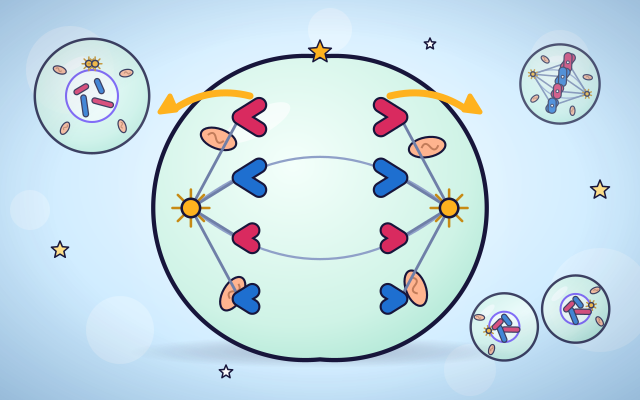
The interactive parts didn't load. The explanations below still work; try reloading the page.
How a cell copies itself
- Leo has scraped his knee, and some skin cells are gone. His body will mend the gap with new cells. But cells cannot be delivered from somewhere else. A neighbor cell has to make a copy of itself.
- Inside the cell's nucleus are threads called chromosomes. They hold the cell's instructions. First the cell copies each one. The copy stays joined to the original, so each chromosome now looks like an X.
- The wall of the nucleus melts away. From each end of the cell, thin fibers grow out and grab every X, one fiber from each side. They tug until all the chromosomes are lined up along the middle.
- Then the fibers pull. Each X splits at the join, and its two halves are dragged to opposite ends of the cell. Now there is one complete set of chromosomes at each end.
- A new wall forms around each set of chromosomes, making two nuclei. Then the cell pinches in around its middle, tighter and tighter, until it splits into two.
- Now there are two cells with exactly the same instructions as the first one. One of them fills the gap in Leo's skin. Each can grow and divide again: one, two, four, eight.
The parts that divide a cell
The small cell is resting. The big one is dividing. Tap each part to see what it does.
- Nucleus. The nucleus is the control room of the cell. It holds the chromosomes. Most of the time they are long, loose threads, too thin to see one by one.
- Chromosomes. Chromosomes carry the instructions for building and running your body. Before a cell divides, they coil up tight, like thread wound onto a spool, so they can be moved without tangling.
- Two copies. Each X is a chromosome and its copy, held together at one point. The two halves carry exactly the same instructions. When the cell divides, one half goes to each new cell.
- Spindle fibers. Spindle fibers are thin protein threads. They work like ropes: one from each side grabs each X, and then they shorten and pull the two copies apart.
- Poles. At each end of the cell is a pole, a kind of anchor point. The fibers grow out from the poles, and the copies of the chromosomes are pulled toward them.
- Cell membrane. The membrane is the thin skin around the cell. When the chromosomes have been shared out, the membrane pinches inward around the middle until one cell becomes two.
Take a cell through its division
Drag the handle slowly through the division, forward and back. Tap one chromosome to mark it, and follow where its two copies end up.
Experiment: The first cell has 4 chromosomes. How many will each of the two new cells have?
- Tap one chromosome to mark it. Count the chromosomes at the start.
- Drag the handle to the copy step. What does the marked one look like now?
- Go on to the end. Count the chromosomes in each new cell.
What we found: Each new cell has 4 chromosomes, the same as the first cell. Copying comes first, so for a while there are 8 strands. Then the copies are shared out, one of each to each side. That is why every one of your body cells carries the same full set of instructions.
Turn on JavaScript to try it yourself.
Arrange the stages
Five pictures of a dividing cell are shuffled. Tap them in order, from the resting cell to two new cells.
Why and how cells divide
You are made of tiny living units called cells, far too small to see. You started life as a single cell. That cell divided into two, those two into four, and so on. Today your body has tens of trillions of cells, and every one of them came from a cell that divided.
Each cell has a nucleus that holds its chromosomes. These are long threads that carry the instructions for building and running your body. A new cell is no use without them. So before a cell divides, it makes an exact copy of every chromosome. The copy stays attached, which gives each chromosome its X shape.
Then comes the sharing out. Thin fibers grow from the two ends of the cell and line the X shapes up along the middle. The fibers pull, and each X splits: one copy goes to each end. A new nucleus forms around each set. Finally the cell pinches in around the middle and becomes two cells.
Both new cells have exactly the same chromosomes as the first cell. That is how a scraped knee heals with skin that matches the rest of you. The recipe book comparison is not perfect, though. Nobody sorts the pages: the cell's own fibers do the pulling. And the cell does not just hand over a book. It splits itself in half too.
Key words
- Cell
- The tiny living building block that all plants and animals are made of.
- Chromosome
- A thread in the nucleus that carries the cell's instructions.
- Nucleus
- The part of the cell that holds the chromosomes.
- Spindle
- The set of fibers that pulls the copied chromosomes apart.
- Mitosis
- The way a body cell shares out its copied chromosomes to make two cells that are alike.
Check your thinking
-
What must a cell do before it can divide?
Show the answer
Copy every chromosome. Each new cell needs a full set of instructions, so everything is copied first.
-
One cell divides, and then each new cell divides again. How many cells are there?
Show the answer
Four. The number doubles each time: 1, then 2, then 4.
-
Why do the chromosomes line up in the middle of the cell before they are pulled apart?
Show the answer
So that one copy of each can be pulled to each side. With a fiber from each side on every X, the two copies are sure to go to opposite ends.
-
A skin cell has 46 chromosomes. It divides to help heal a scrape. How many chromosomes does each new skin cell have?
Show the answer
46. All 46 are copied and then shared out, so each new cell gets the same 46.
-
In which stage do the sister chromatids separate and move to opposite poles?
Show the answer
Anaphase. In anaphase the link between the sisters is cut and the spindle fibers shorten, drawing one chromatid of each pair to each pole.
-
One cell divides every hour. About how many cells are there after 10 hours?
Show the answer
About 1,000. The number doubles each hour: 2 multiplied by itself ten times is 1,024.
You're a Human body expert!
You watched, looked inside, tried it, solved the challenge and went deeper. Pick another question below, or switch the age at the top to see this topic another way.
More about human body
 #261
Human body
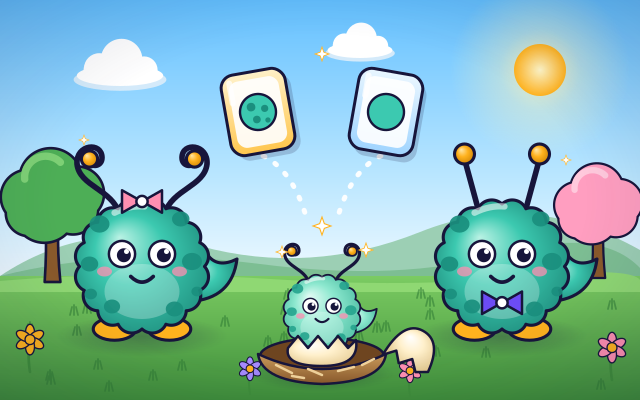
How do inherited traits pass through families?
Combine fictional gene versions and compare outcomes using a clearly simplified inheritance model.
#261
Human body
How do inherited traits pass through families?
Combine fictional gene versions and compare outcomes using a clearly simplified inheritance model.
 #262
Human body
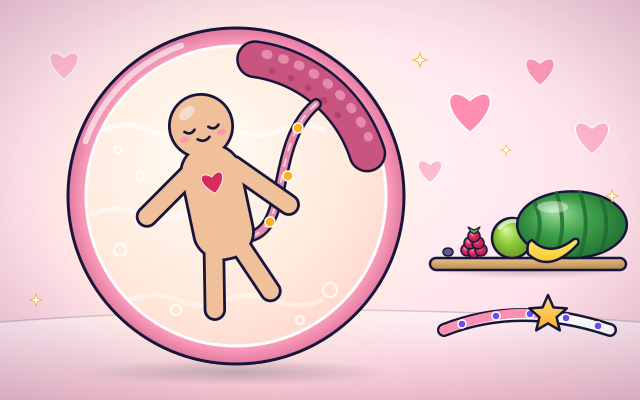
How does a baby develop before birth?
Follow a gentle developmental timeline exploring growth, the placenta, and changing proportions.
#262
Human body
How does a baby develop before birth?
Follow a gentle developmental timeline exploring growth, the placenta, and changing proportions.
 #263
Human body
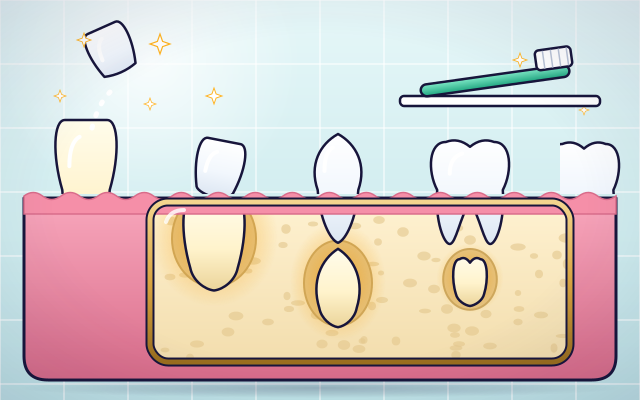
How do adult teeth replace baby teeth?
Reveal changes above and below the gums through a dental-development timeline.
#263
Human body
How do adult teeth replace baby teeth?
Reveal changes above and below the gums through a dental-development timeline.
 #264
Human body
How does tooth decay develop?
Explore plaque, acids, enamel damage, and protective saliva on a model tooth.
#264
Human body
How does tooth decay develop?
Explore plaque, acids, enamel damage, and protective saliva on a model tooth.
Keep exploring
Games to play next
- Body ExplorerTap, match and label your way around the amazing human body.
- Label LabPut the right labels on beautiful science diagrams, from bean plants to heart chambers.
- Science QuizzesOlly's Science Quiz Show: plants, animals, the body, weather, space and more, for every grade.
Guide for grown-ups
- How to start homeschooling: a step-by-step guide for familiesA guide for parents · 7 min read
Science games by grade
Science worksheets by grade
- Preschool Science Worksheets
- Pre-K Science Worksheets
- Kindergarten Science Worksheets
- 1st Grade Science Worksheets
- 2nd Grade Science Worksheets
- 3rd Grade Science Worksheets
- 4th Grade Science Worksheets
- 5th Grade Science Worksheets
- 6th Grade Science Worksheets
- 7th Grade Science Worksheets
- 8th Grade Science Worksheets