How does the brain form memories?
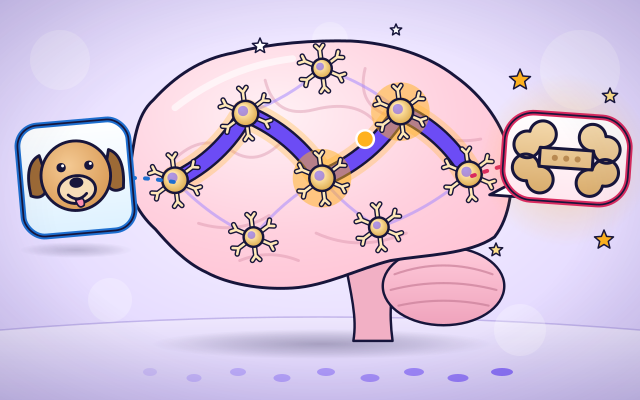
A memory is a path between brain cells. Paying attention starts it, and practice and sleep make it last.
The big idea: When you pay attention to something, brain cells that are active together link up. Every time you use that link it gets stronger, and links you never use fade away.
It's like a path across a field: one walk barely bends the grass, but walking it again and again wears a clear trail. A path nobody uses grows over.
The interactive parts didn't load. The explanations below still work; try reloading the page.
How a memory is made
- Leo meets a puppy in the park, and her owner says her name: Biscuit. A minute ago Leo did not know it. How does his brain keep a brand-new fact?
- A ball bounces, a kite flies, a bell rings. Leo's brain cannot keep everything, so attention works like a spotlight. What he focuses on gets in. The rest fades almost at once.
- In his brain, one group of cells fires for the sight of the puppy and another for the sound of her name. Because they fire at the same moment, a connection between them grows. That new link is the start of a memory.
- At first the link is thin and easy to lose. Each time Leo sees the puppy and says her name, the signal runs along the same path and makes it stronger, like a trail worn into grass.
- That night, while Leo sleeps, a part of his brain called the hippocampus replays the day's new paths. The important ones are copied into long-term storage. Weak links that were never used fade away.
- A week later Leo sees the puppy again. The sight of her is a clue. It sets the strong path firing, and the name pops into his head: Biscuit!
Inside a brain that is learning
Tap each part of this model brain. The round window zooms in on two brain cells.
- Brain cell. A brain cell, or neuron, has branches that collect signals and one long fiber that sends an electrical signal on to other cells. Your brain has billions of them.
- Connection. Where two cells meet there is a tiny gap. Chemical messengers carry the signal across it. Each time the connection is used, it works a little better. That change is how a memory is stored.
- Attention spotlight. The front of your brain helps you focus on one thing and ignore the rest. Whatever is in this spotlight has the best chance of being remembered.
- Memory maker. The hippocampus, deep in the brain, ties together the sights, sounds and feelings of an event into one new memory. It is curled like a seahorse, which is what its name means.
- Long-term store. The wrinkled outer layer of the brain, the cortex, is where memories are kept for the long term. Over days and weeks, with help from sleep, a memory comes to rest there.
- Feelings tag. The amygdala reacts to strong feelings. When something is exciting, funny or surprising, it tells the memory maker: keep this one! That is why you remember special days so well.
Build a memory and test it
Tap the puppy to practice, then test the memory. Let some days go by. Try practicing with the TV on. What makes the path strong, and what makes it last?
Experiment: Leo practices three times in one day and then stops. What happens to the path over the next few days?
- Tap the puppy three times, then press Test.
- Press Next day a few times and test again. Is the name still there?
- Press Start over. This time practice once, then go to the next day, and repeat. Compare.
What we found: A path that is not used gets thinner, so a name practiced only on one day soon fades. Practicing again after a night's sleep makes the path strong again and also makes it fade more slowly. A little practice on several days beats a lot on one day. This is a simplified model.
Turn on JavaScript to try it yourself.
Plan the practice
Leo will see Biscuit again on day 14. He has four practices to use in the first week. Choose the days, then run the plan. Can he still remember her name?
How your brain keeps a memory
Your brain is made of billions of tiny cells called neurons. Each one is joined to thousands of others. When you see, hear or think about something, a particular group of neurons sends signals to one another.
When you learn something new, such as a puppy's name, the neurons for the puppy and the neurons for the name are busy at the same moment. That makes the connections between them stronger. Later, seeing the puppy sets off the same group, and the name comes back to you. A memory is not kept in one spot like a photo in a drawer. It is a path of strong connections.
Paths get stronger with use. Each time you recall the name, the connections work a little better. Paths you never use get weaker, which is why you forget things. Practice works best when you spread it out: a little today, a little tomorrow and a little next week beats one long session.
Two more things help. Paying attention matters, because your brain only keeps what you focus on. And sleep matters, because your brain replays new paths at night and stores the important ones. The footpath comparison is not perfect: a real path is worn down by walking, but a brain connection is built up by use, and one neuron can be part of many memories at once.
Key words
- Neuron
- A brain cell that sends and receives signals.
- Synapse
- The tiny gap where one brain cell passes a signal to the next.
- Hippocampus
- A seahorse-shaped part deep in the brain that helps make new memories.
- Consolidation
- The slow saving of a new memory so that it lasts.
- Spacing effect
- You remember better when you spread practice out over several days.
Check your thinking
-
What happens to the connection between brain cells each time you practice something?
Show the answer
It gets stronger. Using a connection strengthens it, like walking a path through grass.
-
Why is it hard to remember something you heard while doing something else?
Show the answer
Without attention, the brain makes only a weak connection. Attention is the spotlight that lets information in. Without it the new link is very weak.
-
You have a spelling test in a week. Which plan helps you remember the words longest?
Show the answer
Ten minutes a day on several days. Practice that is spread out makes paths that fade more slowly.
-
What does your brain do with new memories while you sleep?
Show the answer
It replays them and stores the important ones. During sleep the brain replays the day's new paths, which helps them last.
-
Why can the sight of the puppy bring back her name?
Show the answer
Activity spreads from the puppy neurons across strengthened synapses to the name neurons. A cue reactivates part of the pattern, and strong connections spread the activity to the rest of it.
-
Where in the brain is a single memory, such as a friend's name, kept?
Show the answer
In a pattern of connections spread across many neurons. A memory is a pattern of connection strengths across a network, not an item in one location.
You're a Human body expert!
You watched, looked inside, tried it, solved the challenge and went deeper. Pick another question below, or switch the age at the top to see this topic another way.
More about human body
 #259
Human body
How do hormones guide growth?
Follow chemical messages from glands to tissues and explore their developmental roles.
#259
Human body
How do hormones guide growth?
Follow chemical messages from glands to tissues and explore their developmental roles.
 #260
Human body
How do body cells make copies of themselves?
Arrange division stages and follow chromosomes as one model cell becomes two.
#260
Human body
How do body cells make copies of themselves?
Arrange division stages and follow chromosomes as one model cell becomes two.
 #261
Human body
How do inherited traits pass through families?
Combine fictional gene versions and compare outcomes using a clearly simplified inheritance model.
#261
Human body
How do inherited traits pass through families?
Combine fictional gene versions and compare outcomes using a clearly simplified inheritance model.
 #262
Human body
How does a baby develop before birth?
Follow a gentle developmental timeline exploring growth, the placenta, and changing proportions.
#262
Human body
How does a baby develop before birth?
Follow a gentle developmental timeline exploring growth, the placenta, and changing proportions.
Keep exploring
Games to play next
- Body ExplorerTap, match and label your way around the amazing human body.
- Label LabPut the right labels on beautiful science diagrams, from bean plants to heart chambers.
- Science QuizzesOlly's Science Quiz Show: plants, animals, the body, weather, space and more, for every grade.
Guide for grown-ups
- How to start homeschooling: a step-by-step guide for familiesA guide for parents · 7 min read
Science games by grade
Science worksheets by grade
- Preschool Science Worksheets
- Pre-K Science Worksheets
- Kindergarten Science Worksheets
- 1st Grade Science Worksheets
- 2nd Grade Science Worksheets
- 3rd Grade Science Worksheets
- 4th Grade Science Worksheets
- 5th Grade Science Worksheets
- 6th Grade Science Worksheets
- 7th Grade Science Worksheets
- 8th Grade Science Worksheets