How do bats find their way in the dark?
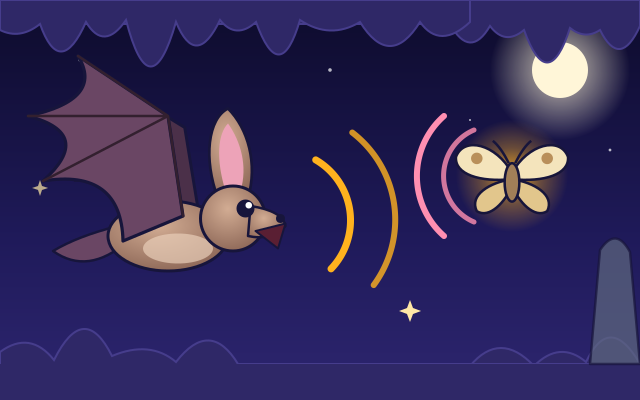
Bats send out squeaky calls and listen for the echoes. The echoes tell them what is around them, even at night.
The big idea: A bat makes high calls and listens for echoes. A near bug sends its echo back quickly. A far bug's echo takes longer. Two ears tell the bat which way to turn.
It's like
The interactive parts didn't load. The explanations below still work; try reloading the page.
Hunting with echoes
- At sunset, bats pour out of their cave to hunt insects. Bats can see, but at night it is very dark. They have a better trick.
- The bat makes a call. The sound spreads out like ripples. It is so high that people can't hear it. We call it ultrasound.
- When the sound hits a moth, some of it bounces back toward the bat. That bounced sound is an echo, and the bat's big ears catch it.
- A near moth's echo comes back quickly. A far moth's echo takes longer, because the sound has farther to travel. The bat can tell the difference!
- An echo from one side reaches the nearer ear a tiny bit sooner and sounds a bit louder there. That tells the bat which way the bug is.
- As it closes in, the bat calls faster and faster to keep track of the moth. Then it scoops the moth up with its wing or tail. Dinner!
A bat's sound tools
Tap each part of the bat to see how it helps it hunt with sound.
- Mouth and voice box. The bat's voice box makes very loud, very high calls, and they come out of its open mouth. People can't hear most of them.
- Nose leaf. Some bats call through their nose instead of their mouth. A leaf-shaped flap around the nose helps point the sound forward, like a flashlight beam.
- Big ears. Big ears catch quiet echoes, like cupped hands. The bat can turn them to listen in different directions.
- Tragus. The tragus is a small flap inside the ear. Echoes from above and below bounce off it a little differently, so it helps the bat tell up from down.
- Brain. The brain measures how long each echo took to come back. A short time means close, a long time means far. It turns echoes into a picture of the cave.
- Eyes. Bats are not blind. They use their eyes for long distances and at dusk, and their echoes for close-up hunting in the dark.
- Wings. A bat's wing is a hand with very long fingers. Stretchy skin between them makes the wing. Bats can bend their fingers to twist and turn fast.
- Tail pouch. Skin between the legs and tail can curl into a pouch. Some bats scoop insects into it, then grab them with their mouth.
Echo timer: near and far
Send clicks into the dark cave. Move the moth near and far. Watch the echo clock: when does the echo come back?
Experiment: If the moth is farther away, when does its echo come back?
- Put the moth close to the bat and press Click!
- Watch where the echo mark lands on the echo clock.
- Move the moth far away and click again. Compare.
What we found: The farther away the moth is, the later its echo comes back, because the sound has to travel there and back again. Bats use this to judge distance.
Turn on JavaScript to try it yourself.
Cave hunt
Click to find the moths and rocks with echoes. Catch 4 moths before the cave ends, and try not to bump the rocks.
Seeing with sound
Sound is a wave that travels through the air. When it hits something, part of the sound bounces back. That bounced sound is an echo. You can hear echoes yourself if you shout in a big empty hall or near a cliff.
Bats use echoes all the time. An insect-eating bat makes calls many times a second while it flies. Most of the calls are so high that people can't hear them. Each echo tells the bat that something is out there.
The time the echo takes is the clue. Sound travels fast, but not instantly. A moth that is close sends its echo back very quickly. A moth that is far away sends it back later. The bat's brain measures this tiny difference.
Two ears tell the bat the direction. An echo from the left reaches the left ear first and sounds a little louder there. Bats aren't the only animals that do this: dolphins and some whales use echoes underwater, and ships use the same idea, called sonar.
Key words
- Echo
- Sound that bounces off something and comes back.
- Echolocation
- Finding things by making sounds and listening to their echoes.
- Ultrasound
- Sound too high for people to hear.
- Frequency
- How high or low a sound is.
- Feeding buzz
- The very fast run of calls a bat makes just before it catches an insect.
- Sonar
- A technology that uses echoes of sound to find things, usually underwater.
Check your thinking
-
What is the sound that bounces back to a bat called?
Show the answer
An echo. Sound that bounces off something and comes back is an echo.
-
Are bats blind?
Show the answer
No, bats can see. All bats can see. Many use echoes too, for hunting in the dark.
-
A moth is far away. Compared with a near moth, its echo comes back...
Show the answer
Later. The sound has to travel farther there and back, so it takes longer.
-
How does a bat know if a moth is on its left or right?
Show the answer
The echo reaches one ear first and louder. The ear on the moth's side hears the echo a tiny bit sooner and louder.
-
What does a bat do as it gets very close to a moth?
Show the answer
Calls faster and faster. Fast calls give fast updates, so the bat can follow the moth's dodges.
-
Which other animal also finds things with echoes?
Show the answer
Dolphins. Dolphins and some whales click underwater and listen for echoes.
You're a Animals expert!
You watched, looked inside, tried it, solved the challenge and went deeper. Pick another question below, or switch the age at the top to see this topic another way.
More about animals
 #98
Animals
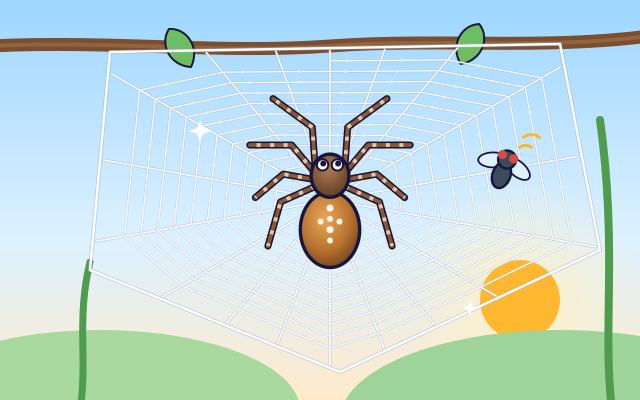
How do spiders spin webs?
Explore silk production and build an orb web using anchor lines, spokes, and a spiral. Touch different sections and watch vibrations travel.
#98
Animals
How do spiders spin webs?
Explore silk production and build an orb web using anchor lines, spokes, and a spiral. Touch different sections and watch vibrations travel.
 #100
Animals
How do coral reefs grow?
Zoom into reef-building coral polyps and watch their skeletons accumulate over time. Explore how growing reefs provide shelter for many other living things.
#100
Animals
How do coral reefs grow?
Zoom into reef-building coral polyps and watch their skeletons accumulate over time. Explore how growing reefs provide shelter for many other living things.
 #201
Animals
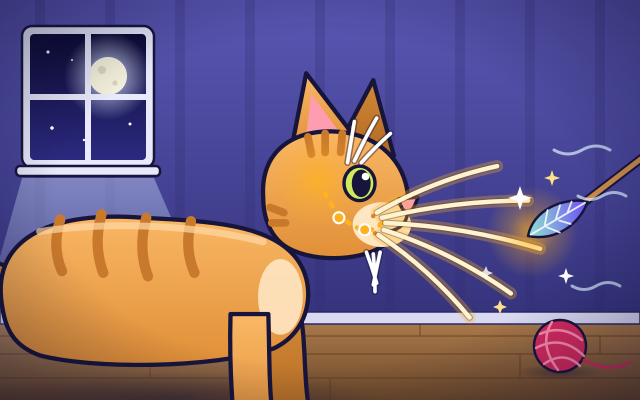
How do a cat's whiskers work?
Explore how whiskers detect contact and nearby air movement around a virtual cat.
#201
Animals
How do a cat's whiskers work?
Explore how whiskers detect contact and nearby air movement around a virtual cat.
 #202
Animals
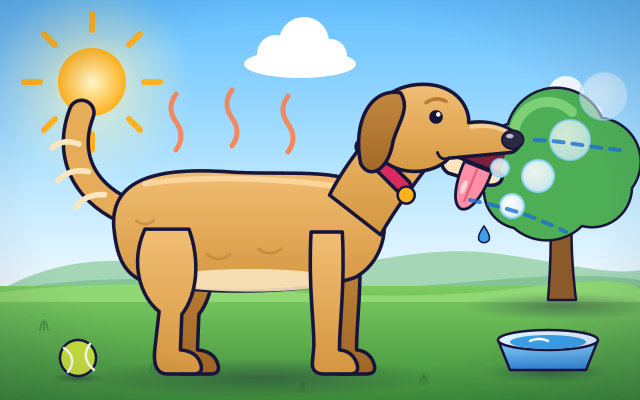
How does panting help dogs cool down?
Follow airflow and compare evaporation under different simulated conditions.
#202
Animals
How does panting help dogs cool down?
Follow airflow and compare evaporation under different simulated conditions.
Keep exploring
Games to play next
- Habitat Builder 3DFind the right home for frogs, camels, polar bears and more.
- Classification ExplorerSort living things by what you can see, then follow and build yes-or-no keys.
- Forest Trails PhotosCreep up on the animals of a big forest valley and take the closest, best wildlife photos you can, without startling them.
Guide for grown-ups
- How to start homeschooling: a step-by-step guide for familiesA guide for parents · 7 min read
Science games by grade
Science worksheets by grade
- Preschool Science Worksheets
- Pre-K Science Worksheets
- Kindergarten Science Worksheets
- 1st Grade Science Worksheets
- 2nd Grade Science Worksheets
- 3rd Grade Science Worksheets
- 4th Grade Science Worksheets
- 5th Grade Science Worksheets
- 6th Grade Science Worksheets
- 7th Grade Science Worksheets
- 8th Grade Science Worksheets