How do a cat's whiskers work?
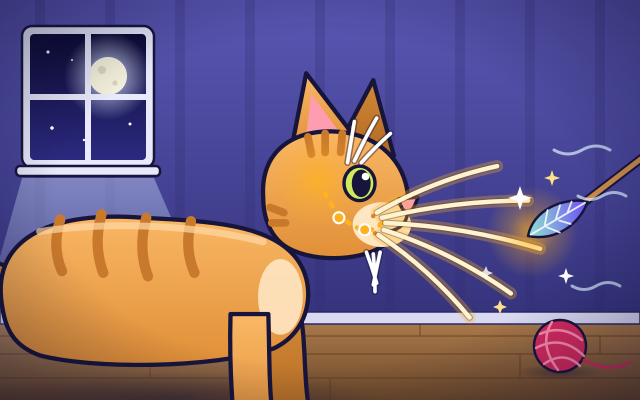
Whiskers are stiff feeler hairs. They tell a cat what is close by, even when it cannot see.
The big idea: A whisker cannot feel anything itself. When it bends, nerves around its root feel the movement and send a message to the brain.
It's like holding a long stick with your eyes shut: the stick feels nothing, but your hand feels every bump and wobble at its far end.
The interactive parts didn't load. The explanations below still work; try reloading the page.
How whiskers feel the world
- It is night and the room is nearly dark. The cat still walks around the chair and the box without bumping into them. How does it know where things are?
- The answer is on its face. Whiskers are much thicker and stiffer than fur, and they stick out about as wide as the cat's body.
- A whisker is just hair, so it feels nothing. But its root sits in a deep pocket packed with nerve endings. When the whisker moves, the nerves feel it.
- When the tip touches the box, the whisker bends. Its root pushes on the nerves, and they send a quick message to the brain: something is right there!
- Whiskers do not even need to touch. Air flowing around the chair leg pushes on them very gently. That tiny push tells the cat something is near.
- Because whiskers are about as wide as the body, the cat can test a gap with its face first. If the whiskers do not get squashed, the rest of the cat should fit.
Look closely at a cat's whiskers
Tap each group of whiskers on the cat. Then look in the magnifying window to see what is under the skin.
- Muzzle whiskers. The longest whiskers grow in rows on each side of the nose. The cat can swing them forward to feel what is in front of its mouth, or fold them back out of the way.
- Eyebrow whiskers. A few whiskers grow above each eye. If a twig or a blade of grass brushes them, the cat blinks right away, and its eyes stay safe.
- Chin whiskers. Short whiskers under the chin feel what is just below the cat's face, like the edge of a bowl or the ground it is sniffing.
- Leg whiskers. Cats have whiskers on the back of their front legs too. They help the cat feel what its paws are holding and where to step when it climbs.
- Whisker pocket. The root of each whisker sits in a deep pocket called a follicle. A soft, squishy cushion around it lets the root rock back and forth when the tip is pushed.
- Nerve endings. Lots of nerve endings wrap around the whisker root. When the root moves, they send electric messages along a nerve toward the brain.
- The brain's touch map. The brain collects the messages from all the whiskers and builds a kind of touch picture of what is near the cat's face.
Touch and air: what can whiskers feel?
Drag the feather onto the whiskers, then move it away and turn up the fan. Watch the whiskers bend and the amber messages run to the brain.
Experiment: Can a cat's whiskers feel something that is not touching them?
- Drag the feather until it touches the whisker tips. Watch the signal.
- Move the feather far away so nothing touches.
- Turn the fan up and watch the whiskers and the signal again.
What we found: Whiskers feel a touch, but they also feel moving air. Even a gentle breeze bends them a tiny bit, and the nerves at the root notice. That is how a cat can sense things near it without touching them.
Turn on JavaScript to try it yourself.
Hunt in the dark
The room is dark and a wind-up toy mouse is hiding. Send the cat to sniff around. Its whiskers feel more air movement the closer it gets. Then pounce on the right box!
How whiskers really work
A whisker looks like a hair, and it is one, but it is a very special hair. It is thicker and stiffer than fur, and its root goes much deeper into the skin. The hair itself has no feeling at all. All the feeling happens at the root.
Each root sits in a little pocket filled with a soft cushion and wrapped in nerve endings. When the tip of the whisker is pushed, even a tiny bit, the whisker rocks in its pocket and the root presses on the nerves. They send a message to the brain in a flash.
Whiskers do not have to touch anything. Moving air pushes on them too. When air flows around a table leg, or a mouse scurries past, the air near the cat's face moves a little differently, and the whiskers feel it. This is very useful at night and right under the cat's nose, where its eyes cannot focus well.
Whiskers are about as wide as the cat's body, so a cat can poke its face into a gap to check for room. Whiskers fall out and grow back by themselves, but they should never be cut. A cat with trimmed whiskers can feel confused and unsure, a bit like you would with a blindfold on.
Key words
- Whisker (vibrissa)
- A thick, stiff feeler hair with lots of nerves around its root.
- Follicle
- The little pocket in the skin that a hair grows from.
- Nerve ending
- The tip of a nerve, which feels something and sends a message to the brain.
- Lever
- A stiff bar that turns about a point, so a push on one end moves the other end.
- Air current
- Air that is moving, like a breeze or a draft.
Check your thinking
-
Which part actually feels it when a whisker touches something?
Show the answer
The nerves around the whisker's root. The whisker is only hair. When it bends, the nerves at its root feel the movement.
-
How can a cat sense a chair leg in the dark without touching it?
Show the answer
Its whiskers feel the air moving around the leg. Air flows differently around things. That gentle change pushes on the whiskers, and the nerves notice.
-
In the model, air speed doubles from 2 m/s to 4 m/s. About how much harder does the air push on a whisker?
Show the answer
About four times as hard. Drag grows roughly with the square of speed, so twice the speed gives about four times the push.
-
Why are a cat's whiskers about as wide as its body?
Show the answer
So the cat can check whether it will fit through a gap. If the whiskers fit without being squashed, the rest of the cat should fit too.
-
What would happen if a cat's whiskers were cut short?
Show the answer
The cat would lose an important sense and feel unsure. Whiskers are a sense, like touch in your fingertips. Without them a cat judges gaps and nearby things badly.
You're a Animals expert!
You watched, looked inside, tried it, solved the challenge and went deeper. Pick another question below, or switch the age at the top to see this topic another way.
More about animals
 #202
Animals
How does panting help dogs cool down?
Follow airflow and compare evaporation under different simulated conditions.
#202
Animals
How does panting help dogs cool down?
Follow airflow and compare evaporation under different simulated conditions.
 #203
Animals
How do pets learn commands and routines?
Teach a virtual pet actions using clear cues and consistent positive rewards.
#203
Animals
How do pets learn commands and routines?
Teach a virtual pet actions using clear cues and consistent positive rewards.
 #204
Animals
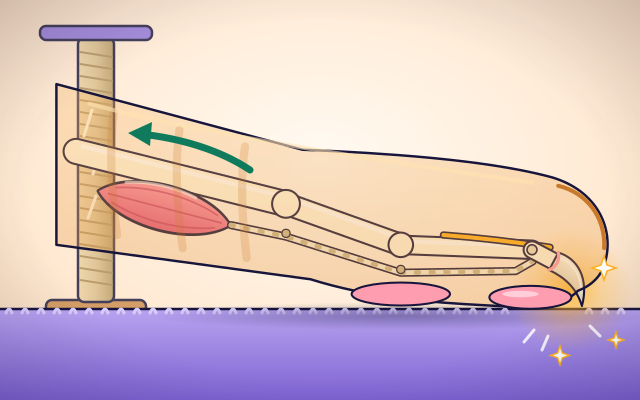
How do cats extend and retract their claws?
Operate the muscles and tendons inside a transparent paw.
#204
Animals
How do cats extend and retract their claws?
Operate the muscles and tendons inside a transparent paw.
 #205
Animals
How does an aquarium stay clean and healthy?
Balance feeding, filtration, oxygen, and helpful bacteria in a virtual aquarium.
#205
Animals
How does an aquarium stay clean and healthy?
Balance feeding, filtration, oxygen, and helpful bacteria in a virtual aquarium.
Keep exploring
Games to play next
- Habitat Builder 3DFind the right home for frogs, camels, polar bears and more.
- Classification ExplorerSort living things by what you can see, then follow and build yes-or-no keys.
- Forest Trails PhotosCreep up on the animals of a big forest valley and take the closest, best wildlife photos you can, without startling them.
Draw it or make it
- How to draw a sitting catDrawing lesson
- Cat FaceOrigami
Guide for grown-ups
- How to start homeschooling: a step-by-step guide for familiesA guide for parents · 7 min read
Science games by grade
Science worksheets by grade
- Preschool Science Worksheets
- Pre-K Science Worksheets
- Kindergarten Science Worksheets
- 1st Grade Science Worksheets
- 2nd Grade Science Worksheets
- 3rd Grade Science Worksheets
- 4th Grade Science Worksheets
- 5th Grade Science Worksheets
- 6th Grade Science Worksheets
- 7th Grade Science Worksheets
- 8th Grade Science Worksheets