How does hibernation help animals survive winter?
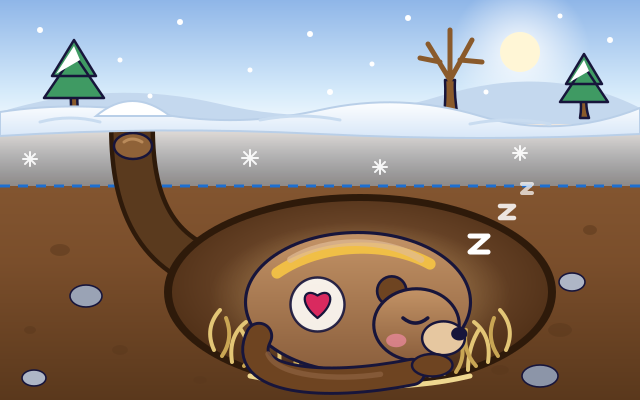
When winter takes the food away, a groundhog turns its body down low and lives on its fat until spring.
The big idea: Staying warm and active burns a lot of fuel. A hibernating animal lets its body cool and its heart slow, so it uses so little fuel that its fat lasts until spring.
It's like turning a house's heating right down while you are away all winter: one tank of fuel that would last a month now lasts until spring.
The interactive parts didn't load. The explanations below still work; try reloading the page.
A winter on almost no fuel
- All autumn the groundhog eats as much as it can. The extra food is stored under its skin as fat. Fat is its fuel tank for the winter.
- Then winter comes. The plants are dead or under snow, so there is no food. Worse, a warm body in cold air loses heat fast, and making more heat burns fuel quickly.
- The groundhog climbs down into a burrow it dug below the frozen soil. It plugs the tunnel with earth and curls up in a nest of dry grass.
- Now the amazing part. Its heart slows from about eighty beats a minute to about five. Its body cools until it is almost as cold as the burrow. It breathes only now and then.
- Every week or two the groundhog wakes for a short time. It shivers to warm itself up, shifts around, then sinks back into its deep sleep. Each wake-up uses a big bite of fat.
- In spring the soil warms and the plants grow again. The groundhog wakes for good and digs its way out. It is much thinner, but its fat lasted the whole winter.
Look inside a hibernating groundhog's burrow
Tap each part to see how it helps the groundhog last all winter.
- Fat store. A thick layer of fat under the skin is the only fuel the groundhog has until spring. It also helps to keep the heat in.
- Slow heart. An awake groundhog's heart beats about 80 times a minute. In deep hibernation it beats only about 5 times a minute.
- Slow breathing. The groundhog breathes about twice a minute instead of about sixteen times. Sometimes it does not breathe for a long while.
- Body thermostat. A part of the brain works like the thermostat on a heater. For winter it is turned way down, so the body is allowed to get cold.
- Warm-up fat. A patch of special brown fat near the shoulders works like a heater. It makes heat fast when it is time to wake up.
- Curled-up ball. The groundhog curls into a ball with its nose tucked in. A ball has less outside for heat to escape from.
- Grass nest. A nest of dry grass and leaves traps still air around the groundhog, like a blanket.
- Deep burrow. The sleeping room is dug below the frozen layer of soil. Down there it stays just above freezing all winter. A plug of soil closes the tunnel.
Run a winter: awake or hibernating?
Choose how the groundhog spends the winter, then watch its heart, its temperature and its fat store as the days go by.
Experiment: What happens to the groundhog's fat store if it hibernates instead of staying awake?
- Choose "Stay awake" and watch the day counter when the fat runs out.
- Choose "Hibernate" and watch the heart and the thermometer.
- Compare how much fat is left at the end.
What we found: Awake, the groundhog keeps its body at 37 degrees and its fat is gone in about five weeks. Hibernating, its heart slows to about 5 beats a minute, its body cools to about 5 degrees, and the same fat lasts all winter with some to spare.
Turn on JavaScript to try it yourself.
Plan the autumn
You have 30 autumn days. Share them between eating and digging, then start the winter. Can the fat last until spring?
How hibernation saves energy
Birds and mammals are warm-blooded. Their bodies burn food to stay at the same warm temperature all the time. That works well when there is plenty to eat. In winter it is a problem: there is little food, and a warm body in cold air loses heat quickly, so it needs even more fuel.
Some animals solve this by leaving, like birds that fly south. Some keep searching for food, like foxes and deer. Hibernators do something else. They get fat in autumn, hide in a safe place, and then turn their bodies down low. Their temperature drops, their hearts slow and they hardly breathe. A body running that slowly needs only a tiny amount of fuel.
Groundhogs, ground squirrels, dormice, hedgehogs and many bats are deep hibernators. Bears are different. A bear's winter sleep is lighter: its body cools by only a few degrees, and it can wake quickly. But it still goes for months without eating or drinking.
Hibernation is not one long sleep. Every week or two the animal warms up for a short while and then cools down again. Nobody is completely sure why. In spring it wakes for good, thin and hungry, just as the new plants appear.
Key words
- Hibernation
- A long winter rest in which an animal's body runs very slowly to save energy.
- Torpor
- The deep, cold, slow state of a hibernating animal.
- Metabolism
- All the ways a body uses food to stay alive, warm and moving.
- Arousal
- A short wake-up during hibernation, when the animal warms itself back to normal temperature.
- Frost line
- The depth below which the soil does not freeze in winter.
- Brown fat
- A special kind of fat that makes heat quickly.
Check your thinking
-
Why does a groundhog get fat in autumn?
Show the answer
Fat is the fuel it lives on all winter. The groundhog does not eat all winter. Its fat is its fuel tank.
-
What happens to a groundhog's heartbeat during hibernation?
Show the answer
It slows from about 80 beats a minute to about 5. A cold, resting body needs little oxygen, so the heart can beat very slowly. It never stops.
-
Why is the sleeping room dug deep, below the frozen soil?
Show the answer
It stays just above freezing there, so the groundhog does not have to burn fat to keep from freezing. Deep soil is protected from the icy air. A frozen nest would force the groundhog to use up its fat making heat.
-
During hibernation the groundhog wakes up for a short time every week or two. What does that cost?
Show the answer
A big bite of fat each time, because warming up is hard work. Warming a cold body all the way back up takes a lot of fuel, so each wake-up is costly.
-
How is a bear's winter sleep different from a groundhog's?
Show the answer
A bear's body cools only a little, and it can wake up quickly. Bears save energy too, but they stay only a few degrees cooler than normal, so their sleep is lighter.
You're a Animals expert!
You watched, looked inside, tried it, solved the challenge and went deeper. Pick another question below, or switch the age at the top to see this topic another way.
More about animals
 #218
Animals
How do snails build their shells?
Follow calcium into a growing shell using a simplified growth model.
#218
Animals
How do snails build their shells?
Follow calcium into a growing shell using a simplified growth model.
 #219
Animals
How does animal fur keep warmth in?
Compare coats and explore how trapped air affects heat loss.
#219
Animals
How does animal fur keep warmth in?
Compare coats and explore how trapped air affects heat loss.
 #220
Animals
How do cows digest grass?
Follow grass through a ruminant digestive system, including cud-chewing and microbial fermentation.
#220
Animals
How do cows digest grass?
Follow grass through a ruminant digestive system, including cud-chewing and microbial fermentation.
 #221
Animals
How do cows produce milk?
Trace nutrients into milk-producing tissue and follow milk through a simplified udder.
#221
Animals
How do cows produce milk?
Trace nutrients into milk-producing tissue and follow milk through a simplified udder.
Keep exploring
Games to play next
- Habitat Builder 3DFind the right home for frogs, camels, polar bears and more.
- Classification ExplorerSort living things by what you can see, then follow and build yes-or-no keys.
- Forest Trails PhotosCreep up on the animals of a big forest valley and take the closest, best wildlife photos you can, without startling them.
Draw it or make it
- Layered Woodland Habitat DioramaPaper craft
Guide for grown-ups
- How to start homeschooling: a step-by-step guide for familiesA guide for parents · 7 min read
Science games by grade
Science worksheets by grade
- Preschool Science Worksheets
- Pre-K Science Worksheets
- Kindergarten Science Worksheets
- 1st Grade Science Worksheets
- 2nd Grade Science Worksheets
- 3rd Grade Science Worksheets
- 4th Grade Science Worksheets
- 5th Grade Science Worksheets
- 6th Grade Science Worksheets
- 7th Grade Science Worksheets
- 8th Grade Science Worksheets