Why is the sky blue and a sunset red?
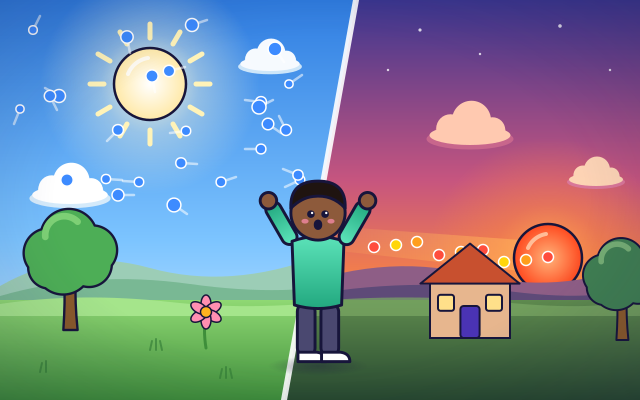
Air scatters blue light across the whole sky. At sunset the light crosses so much air that only orange and red are left.
The big idea: Sunlight is a mix of all colors. Tiny bits of air bounce the blue light in every direction, so blue reaches your eyes from the whole sky. At sunset the light crosses much more air, so the blue is bounced away and red is left.
It's like bumper cars at a fair: small blue cars bounce off in every direction, while big red trucks roll straight on. A longer track means more bumps.
The interactive parts didn't load. The explanations below still work; try reloading the page.
Why the sky changes color
- In the middle of the day the sky is blue and the Sun looks nearly white. At sunset the Sun turns orange and red. It is the same Sun and the same air. So what changes?
- Sunlight looks white, but it is every color of the rainbow mixed together. Each color is a wave. Red waves are long and stretched out. Blue and violet waves are short and close together.
- Earth is wrapped in a thin blanket of air called the atmosphere. Air is made of tiny molecules, far too small to see. Sunlight has to pass through them to reach you.
- The long red waves mostly slip past the molecules. The short blue waves are caught by them and sent off in all directions. This is called scattering.
- Scattered blue light bounces around the air and reaches your eyes from every part of the sky. So wherever you look, away from the Sun, you see blue.
- When the Sun is low, its light has to cross much more air to reach you. Along the way nearly all the blue is scattered out. What arrives is mostly orange and red.
Follow sunlight into the air
Tap each part of the picture to follow the light from the Sun down to the ground.
- The Sun. The Sun gives out light of every color at once. Mixed together, the colors look white. Never look straight at the Sun: it can hurt your eyes.
- White sunlight. In space nothing gets in the way, so all the colors travel together in a straight line. The beam is still white here.
- The atmosphere. The atmosphere is the layer of air around the Earth. It is much thinner than it looks here: if the Earth were an apple, the air would be about as thick as the peel.
- Air molecules. Air is made of tiny molecules, mostly nitrogen and oxygen. They are far smaller than a wave of light, and they scatter the short blue waves best.
- Scattered blue light. Blue and violet light is knocked out of the sunbeam and bounces around the air. This scattered blue is what makes the sky blue.
- Red and orange light. Red, orange and yellow light are scattered much less, so most of them stay in the beam and carry on straight to the ground.
- You, on the ground. Looking toward the Sun, you see the light that stayed in the beam. Looking anywhere else, you see scattered blue. Never stare at the Sun itself.
Move the Sun, watch the colors
Drag the Sun from high in the sky down to the horizon. Watch how far the light travels through the air, and which colors still reach the ground.
Experiment: What happens to the blue light in the sunbeam when the Sun is very low in the sky?
- Put the Sun high in the sky. Look at the dots that reach the ground.
- Drag the Sun down to the horizon and look again.
- Press Record at a high Sun and at a low Sun to compare.
What we found: When the Sun is high, its light takes a short path through the air and most colors arrive, so the Sun looks nearly white. When the Sun is low, the path is many times longer. Nearly all the blue is scattered away, and the light that arrives is orange and red.
Turn on JavaScript to try it yourself.
Match the Sun's color
The painter wants three different Suns. Move the Sun until its color matches the sample, then press Check. Match all three.
How air colors the sky
Sunlight looks white, but it is really all the colors of the rainbow traveling together. Each color is a wave of light with its own length. Red waves are the longest. Blue and violet waves are the shortest.
The air is made of molecules that are far too small to see. When sunlight meets them, the short blue waves are sent bouncing off in every direction, again and again. Scientists call this scattering. The long red waves are scattered much less, so they mostly carry on in a straight line.
All that scattered blue light fills the air. It reaches your eyes from every part of the sky, so the sky looks blue. Violet is scattered even more than blue, but the Sun sends out less violet and our eyes are not very good at seeing it.
At sunrise and sunset the Sun is low, so its light has to travel sideways through a much longer stretch of air. Almost all the blue is scattered out before the light reaches you. The orange and red are left, so the Sun and the sky around it glow with warm colors. The bumper car picture helps here, but real light is not made of little cars: it is a wave, and the molecules send it out again rather than bouncing it.
Key words
- Scattering
- When light is sent off in new directions by tiny things in its path.
- Wavelength
- The length of one wave of light. Each color has its own.
- Atmosphere
- The layer of air around the Earth.
- Molecule
- A tiny particle made of atoms joined together. Air is mostly nitrogen and oxygen molecules.
- Rayleigh scattering
- Scattering by particles much smaller than the wavelength. It is far stronger for short wavelengths such as blue.
- Air mass
- How much air sunlight crosses, compared with the amount when the Sun is straight overhead.
Check your thinking
-
Which color does the air scatter the most?
Show the answer
Blue. Blue waves are short, and the tiny air molecules scatter short waves best.
-
Why does sunlight cross more air at sunset than at noon?
Show the answer
The Sun is low, so the light comes in sideways through the layer of air. Light from a low Sun slants through the layer of air, so its path is many times longer than straight down.
-
At sunset, where has the blue light from the sunbeam gone?
Show the answer
It was scattered away along the long path through the air. The blue is still there, but it has been bounced out of the beam. Other people, farther along, see it as their blue sky.
-
Suppose a planet has twice as much air as Earth. For the same reddening as on Earth, the Sun there must be:
Show the answer
Higher in the sky, so the path through the air is shorter. The loss depends on the total air crossed. With twice the air, half the path length gives the same result.
-
An astronaut stands on the Moon, which has no air. What color is the daytime sky there?
Show the answer
Black, because there is no air to scatter the sunlight. With no air there is nothing to scatter light across the sky, so it stays black even when the Sun is up.
-
The Sun is high in the sky at noon. What does its light look like?
Show the answer
Nearly white, because the short path leaves most colors in. A short path removes only a little blue, so the mix that arrives is still close to white. Never look straight at the Sun to check!
You're a Light & sound expert!
You watched, looked inside, tried it, solved the challenge and went deeper. Pick another question below, or switch the age at the top to see this topic another way.
More about light & sound
 #433
Light & sound
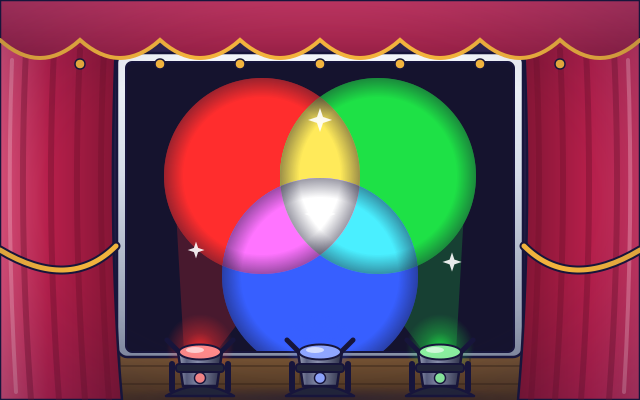
How do colored lights combine?
Overlap red, green, and blue beams to create different colors.
#433
Light & sound
How do colored lights combine?
Overlap red, green, and blue beams to create different colors.
 #434
Light & sound
How do color filters change what we see?
Place filters over lights and objects and compare transmitted colors.
#434
Light & sound
How do color filters change what we see?
Place filters over lights and objects and compare transmitted colors.
 #435
Light & sound
How do glow-in-the-dark materials work?
Charge a model material with light and follow its delayed light emission.
#435
Light & sound
How do glow-in-the-dark materials work?
Charge a model material with light and follow its delayed light emission.
 #436
Light & sound
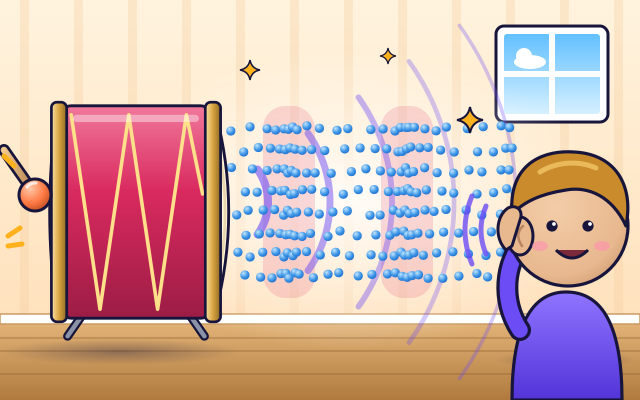
How does sound travel?
Follow vibrations through air, water, and solids using animated particles.
#436
Light & sound
How does sound travel?
Follow vibrations through air, water, and solids using animated particles.
Keep exploring
Games to play next
- Mirror MazeBend a beam of light with mirrors to light up every crystal — in the right order.
- Shadow SculptorStack cubes under three lamps until every shadow matches the outline.
- Listen and FindOlly whispers a clue or plays a sound. Can you find it in the picture?
Guide for grown-ups
- How to start homeschooling: a step-by-step guide for familiesA guide for parents · 7 min read
Science games by grade
Science worksheets by grade
- Preschool Science Worksheets
- Pre-K Science Worksheets
- Kindergarten Science Worksheets
- 1st Grade Science Worksheets
- 2nd Grade Science Worksheets
- 3rd Grade Science Worksheets
- 4th Grade Science Worksheets
- 5th Grade Science Worksheets
- 6th Grade Science Worksheets
- 7th Grade Science Worksheets
- 8th Grade Science Worksheets