How do colored lights combine?
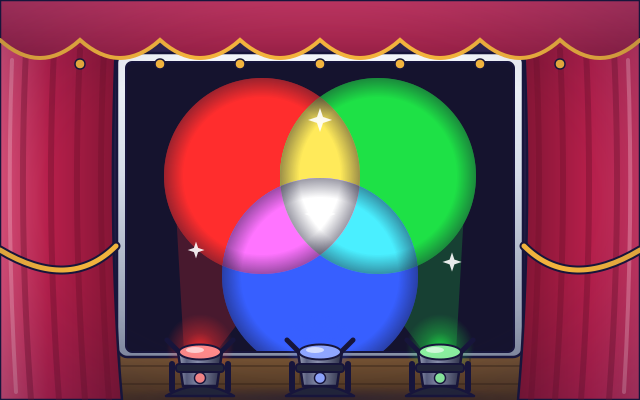
Overlap red, green and blue beams of light to make yellow, cyan, magenta and white. It is how every screen makes its colors.
The big idea: Light adds. Where red and green light overlap you see yellow, green and blue make cyan, red and blue make magenta, and all three make white. Your eyes do the mixing.
It's like spotlights at a school play: where two colored spotlights overlap on the stage, the floor is brighter and shows a new color.
The interactive parts didn't load. The explanations below still work; try reloading the page.
Mixing colored lights
- The theater is dark. Three spotlights switch on, one red, one green and one blue. Each makes its own circle of color on the white screen.
- The red and green circles slide together. Where they overlap, both lights land on the same spot, and that spot looks yellow!
- There are two more pairs. Green and blue lights make cyan, a bright blue-green. Red and blue lights make magenta, a bright pink-purple.
- Now all three circles overlap. In the middle, red, green and blue light all land together, and the screen looks white.
- Why does it work? At the back of your eye are cells called cones. Some notice red light best, some green and some blue. Your brain reads all three to decide the color.
- Screens use the same trick. Look very closely and a screen is made of tiny red, green and blue lights. Yellow on a screen is really red and green dots glowing side by side.
Look closer at the three lights
Tap each lamp, and each place where the lights overlap.
- Red lamp. The red lamp sends out only red light. Where it shines alone, the screen looks red.
- Green lamp. The green lamp sends out only green light. Where it shines alone, the screen looks green.
- Blue lamp. The blue lamp sends out only blue light. Where it shines alone, the screen looks blue.
- Yellow: red + green. Here red light and green light land on the same spot. Your eye gets both at once, and you see yellow.
- Cyan: green + blue. Here green light and blue light land together. You see cyan, a bright blue-green.
- Magenta: red + blue. Here red light and blue light land together. You see magenta, a bright pink-purple.
- White: all three. In the middle all three lights land together, and you see white. Adding more light always makes things brighter.
Overlap the beams
Drag the circles of light so they overlap. Tap a lamp to switch it off or on. Can you find yellow, cyan, magenta and white?
Experiment: What color will you see where the red light and the green light overlap?
- Drag the red circle onto the green circle. Look at the overlap.
- Try the other pairs, then bring all three together.
- Press Record for each new color you find.
What we found: Red and green light together look yellow, not brown. Light adds: every extra light makes the spot brighter. Green and blue make cyan, red and blue make magenta, and all three make white.
Turn on JavaScript to try it yourself.
Lighting director
The director holds up a color card. Set each lamp to off, half or full so the star matches it, then press Show time! Match three cards.
Why light adds up
When you mix paints, the more colors you add, the darker and muddier the mix gets. Light is different. When two lights shine on the same spot, that spot sends more light to your eyes, so it looks brighter. Mixing light is called additive mixing, because the lights add up.
The three most useful lights to mix are red, green and blue. Red and green light together look yellow. Green and blue make cyan. Red and blue make magenta. All three together, in equal amounts, look white. By making each light brighter or dimmer you can get orange, pink, purple, brown and nearly every other color.
It works because of your eyes. At the back of each eye are millions of tiny cells called cones. There are three kinds: one notices red light best, one green and one blue. Your brain compares the three signals and decides which color you are looking at. Red and green light together send the same signals as real yellow light, so you see yellow.
Every phone, tablet and TV uses this trick. The picture is made of tiny dots called pixels, and each pixel has a red, a green and a blue light inside. The lights are too small and too close together to see one by one, so their colors blend. The stage spotlight picture is very close to the truth, but on a screen the lights sit side by side instead of overlapping.
Key words
- Additive mixing
- Making new colors by shining lights on the same spot, so they add up.
- Primary colors of light
- Red, green and blue: three lights that can be mixed to make almost any color.
- Cyan, magenta, yellow
- The colors made by pairs of the light primaries: green + blue, red + blue, and red + green.
- Cone cells
- Tiny cells at the back of your eye that notice color. There are three kinds.
- Pixel
- One tiny dot of a screen's picture, made of a red, a green and a blue light.
- Metamers
- Two different mixes of light that look exactly the same color to the eye.
Check your thinking
-
What color do you see where red light and green light overlap?
Show the answer
Yellow. Light adds. Red and green together look yellow, and brighter than either one.
-
What do you see where red, green and blue lights all overlap?
Show the answer
White. Three lights together send your eyes all three colors at once, and that looks white. Paints would go dark, but light gets brighter.
-
A screen shows a yellow banana. Which of its tiny lights are glowing there?
Show the answer
The red and the green ones. Screens have only red, green and blue lights. Red and green glowing side by side blend into yellow.
-
With red at 100 percent and blue at 0, you slowly turn green up from 0 to 100. What does the color do?
Show the answer
It goes from red through orange to yellow. Adding more green to red shifts the ratio: a little green gives orange, and equal amounts give yellow.
-
Why does mixing all your paints make a dark color, but mixing all three lights makes white?
Show the answer
Paint soaks up light, but lights add more light. Each paint soaks up some of the light that hits it, so more paints leave less light. Each lamp adds light, so more lamps mean a brighter spot.
-
Green and blue lights are on. Red is off. What color is the overlap?
Show the answer
Cyan. Green and blue light together look cyan, a bright blue-green.
You're a Light & sound expert!
You watched, looked inside, tried it, solved the challenge and went deeper. Pick another question below, or switch the age at the top to see this topic another way.
More about light & sound
 #434
Light & sound
How do color filters change what we see?
Place filters over lights and objects and compare transmitted colors.
#434
Light & sound
How do color filters change what we see?
Place filters over lights and objects and compare transmitted colors.
 #435
Light & sound
How do glow-in-the-dark materials work?
Charge a model material with light and follow its delayed light emission.
#435
Light & sound
How do glow-in-the-dark materials work?
Charge a model material with light and follow its delayed light emission.
 #436
Light & sound
How does sound travel?
Follow vibrations through air, water, and solids using animated particles.
#436
Light & sound
How does sound travel?
Follow vibrations through air, water, and solids using animated particles.
 #437
Light & sound
How do echoes happen?
Send sound toward different surfaces and compare the returning sound and delay.
#437
Light & sound
How do echoes happen?
Send sound toward different surfaces and compare the returning sound and delay.
Keep exploring
Games to play next
- Mirror MazeBend a beam of light with mirrors to light up every crystal — in the right order.
- Shadow SculptorStack cubes under three lamps until every shadow matches the outline.
- Listen and FindOlly whispers a clue or plays a sound. Can you find it in the picture?
Guide for grown-ups
- How to start homeschooling: a step-by-step guide for familiesA guide for parents · 7 min read
Science games by grade
Science worksheets by grade
- Preschool Science Worksheets
- Pre-K Science Worksheets
- Kindergarten Science Worksheets
- 1st Grade Science Worksheets
- 2nd Grade Science Worksheets
- 3rd Grade Science Worksheets
- 4th Grade Science Worksheets
- 5th Grade Science Worksheets
- 6th Grade Science Worksheets
- 7th Grade Science Worksheets
- 8th Grade Science Worksheets