How do bones, muscles, and joints help us move?
Your skeleton is a frame of bones joined at joints, and muscles pull on the bones in pairs to move them.
The big idea: Muscles can only pull, never push. So they work in pairs: one muscle pulls a bone one way, and its partner pulls it back. Joints are the places where bones meet, and different joints let bones move in different ways.
It's like
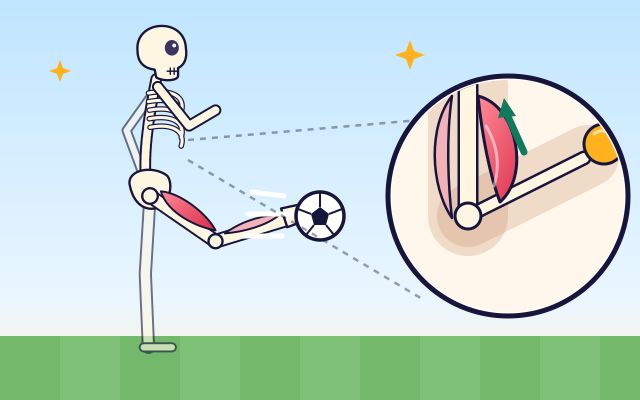
The interactive parts didn't load. The explanations below still work; try reloading the page.
Bones, joints and muscles
- Inside your body is a skeleton of more than 200 bones. It holds you up, gives you your shape and protects soft parts, like your brain inside your skull.
- Bones are alive. They have a hard outside, a spongy, lighter inside, and soft marrow in the middle that makes new blood cells. Bones grow as you grow.
- Joints are where bones meet. Your elbow is a hinge joint that bends one way, like a door. Your shoulder is a ball and socket joint that can swing all around.
- Muscles are joined to bones by tough cords called tendons. When a muscle contracts, it gets shorter and fatter and pulls the bone. Muscles can only pull, never push!
- So muscles work in pairs. Your biceps pulls to bend your elbow. To straighten it, your triceps on the back of your arm pulls, while the biceps relaxes.
- Walking uses many muscle pairs taking turns. The front of your thigh straightens your knee, the back bends it, and your calf pushes you off the ground with every step.
Bones, joints and muscles
Tap each part. Watch the joints move in their own special ways.
- Skull. The skull protects your brain. It is made of many bones joined tightly together. Only your jaw can move.
- Spine. Your spine is a stack of small bones called vertebrae, with soft cushions between them. It holds you up, lets you bend and protects your spinal cord.
- Ribcage. Your ribs curve around your chest like a cage, protecting your heart and lungs. They also move up and out when you breathe deeply.
- Thigh bone (femur). The femur, your thigh bone, is the longest and strongest bone in your body. It carries your weight when you stand, walk and jump.
- Hinge joint. Hinge joints, like your elbow and knee, bend and straighten in just one direction, like a door on its hinges.
- Ball and socket joint. In your shoulder and hip, a round ball on one bone fits into a cup on another. That lets your arm and leg swing in almost every direction.
- Pivot joint. A pivot joint at the top of your neck lets your head turn from side to side, like saying no.
- Muscles. Muscles pull on bones to move them. When a muscle contracts, it gets shorter and fatter. Then it relaxes and can be stretched back out by its partner.
- Tendons. Tendons are tough, strong cords that join muscles to bones. When a muscle pulls, its tendon pulls the bone.
Muscle pairs and joints
Pull with the biceps and the triceps to bend and straighten the arm. Then watch the muscles take turns as the skeleton walks, and compare three kinds of joints.
Experiment: How does your arm straighten again after you bend it?
- Slide the biceps up and watch the arm bend.
- Now slide the biceps down and the triceps up.
- Which muscle got shorter and fatter each time?
What we found: Muscles can only pull. The biceps pulls to bend the arm, and the triceps on the back of the arm pulls to straighten it. They are a team: when one pulls, the other relaxes.
Turn on JavaScript to try it yourself.
Score a goal
Use the leg muscles in the right order to kick the ball into the goal. Wind up first, then kick hard!
How we move
Your skeleton is the frame of your body. Without it you would be as floppy as a jellyfish! Bones are hard on the outside and spongy inside, and some of them have soft marrow in the middle that makes new blood cells. Bones are alive, so they grow and can heal if they break.
Joints are the places where bones meet. Each joint lets bones move in its own way. Hinge joints, like your elbows and knees, bend one way like a door. Ball and socket joints, in your shoulders and hips, let your arms and legs swing around in circles. A pivot joint at the top of your neck lets you turn your head.
Muscles move your bones by pulling on them. They are joined to bones by tough cords called tendons. A muscle can only pull, never push, so muscles work in pairs. To bend your arm, the biceps on the front pulls. To straighten it, the triceps on the back pulls.
Using your muscles makes them stronger, and running and jumping help your bones grow strong too. Food with calcium, like milk, yogurt and leafy greens, helps build strong bones.
Key words
- Joint
- A place where two bones meet.
- Tendon
- A tough cord that joins a muscle to a bone.
- Ligament
- A strong band that joins one bone to another at a joint.
- Antagonistic pair
- Two muscles that pull in opposite directions, like the biceps and triceps.
- Contract
- When a muscle gets shorter and pulls.
Check your thinking
-
Can a muscle push a bone?
Show the answer
No, muscles can only pull. A muscle can only get shorter and pull. Its partner pulls the bone back.
-
Which joint lets your arm swing around in a circle?
Show the answer
The ball and socket joint in your shoulder. A round ball in a cup can turn in almost any direction.
-
Which muscle straightens your arm?
Show the answer
The triceps. The triceps is on the back of your upper arm. It pulls to straighten the elbow.
-
What joins a muscle to a bone?
Show the answer
A tendon. Tendons join muscle to bone; ligaments join bone to bone; cartilage cushions the ends of bones.
-
What kind of joint is your knee?
Show the answer
A hinge joint. The knee bends and straightens in one direction, like a hinge.
You're a Human body expert!
You watched, looked inside, tried it, solved the challenge and went deeper. Pick another question below, or switch the age at the top to see this topic another way.
More about human body
 #88
Human body
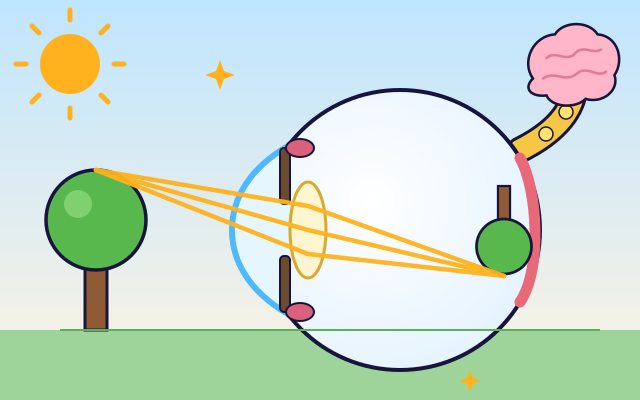
How do our eyes see?
Follow light through the pupil and lens to the retina, then trace signals toward the brain. Adjust focus for nearby and distant objects.
#88
Human body
How do our eyes see?
Follow light through the pupil and lens to the retina, then trace signals toward the brain. Adjust focus for nearby and distant objects.
 #89
Human body
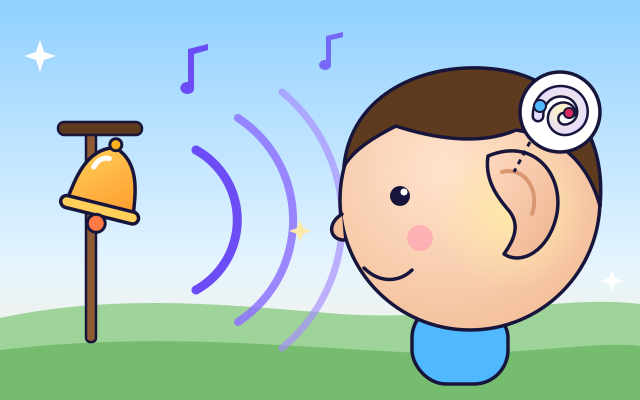
How do our ears hear?
Follow sound through the ear canal, eardrum, tiny bones, and inner ear. Compare how different pitches create different patterns of vibration.
#89
Human body
How do our ears hear?
Follow sound through the ear canal, eardrum, tiny bones, and inner ear. Compare how different pitches create different patterns of vibration.
 #90
Human body
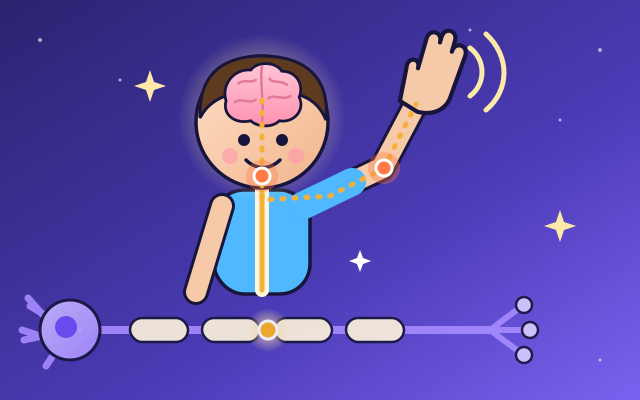
How does the brain send messages around the body?
Follow simplified signals through nerves and the spinal cord. Touch a virtual fingertip or choose an action and watch messages travel.
#90
Human body
How does the brain send messages around the body?
Follow simplified signals through nerves and the spinal cord. Touch a virtual fingertip or choose an action and watch messages travel.
 #91
Human body
How does the immune system protect us?
Explore protective barriers and different immune cells. Follow a simplified response to an invading microbe and learn how the body coordinates its defenses.
#91
Human body
How does the immune system protect us?
Explore protective barriers and different immune cells. Follow a simplified response to an invading microbe and learn how the body coordinates its defenses.
Keep exploring
Games to play next
- Body ExplorerTap, match and label your way around the amazing human body.
- Label LabPut the right labels on beautiful science diagrams, from bean plants to heart chambers.
- Science QuizzesOlly's Science Quiz Show: plants, animals, the body, weather, space and more, for every grade.
Guide for grown-ups
- How to start homeschooling: a step-by-step guide for familiesA guide for parents · 7 min read
Science games by grade
Science worksheets by grade
- Preschool Science Worksheets
- Pre-K Science Worksheets
- Kindergarten Science Worksheets
- 1st Grade Science Worksheets
- 2nd Grade Science Worksheets
- 3rd Grade Science Worksheets
- 4th Grade Science Worksheets
- 5th Grade Science Worksheets
- 6th Grade Science Worksheets
- 7th Grade Science Worksheets
- 8th Grade Science Worksheets