How does the brain send messages around the body?
Your brain, spinal cord and nerves send electrical messages around your body faster than a race car.
The big idea: Nerve cells pass tiny electrical messages along long, thin wires. Messages from your senses travel to your brain, and your brain sends messages back to move your muscles. For some emergencies, your spinal cord answers first, without waiting for your brain.
It's like
The interactive parts didn't load. The explanations below still work; try reloading the page.
Your body's message network
- Your brain is your body's control center. It connects to the spinal cord, a thick bundle of nerves down your back, and nerves branch out from there to every part of you.
- Nerves are made of nerve cells called neurons. Each one has little branches to catch messages and a long tail called an axon that carries a tiny electrical signal.
- Neurons don't touch each other. At the end of one, tiny chemical messengers float across a very small gap, called a synapse, and start a new signal in the next neuron.
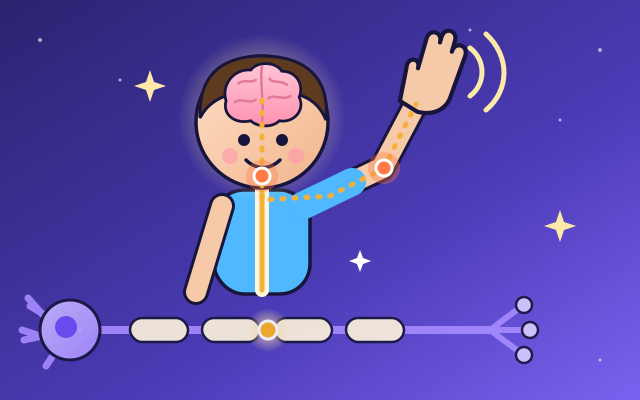
- When you touch a feather, sensors in your skin start a message. It races up the nerves in your arm, into your spinal cord and up to your brain, and you feel: soft!
- To wave, your brain decides and sends a message down the spinal cord and out along a motor nerve to your arm muscles. The muscles pull, and your hand waves!
- If you touch something too hot, the message reaches your spinal cord, which sends a 'move!' message straight back to your arm. Your hand jumps away before you even feel the heat. That's a reflex.
Inside the nervous system
Tap each part of the body's message system. Watch the messages move!
- Brain. The big wrinkly part of your brain (the cerebrum) lets you think, remember, see, hear and decide what to do. It sends commands to your muscles.
- Cerebellum. The cerebellum, at the back of your brain, helps you balance and makes your movements smooth and well timed, like when you ride a bike or catch a ball.
- Brainstem. The brainstem joins your brain to your spinal cord. It runs the things you don't think about, like breathing, heartbeat and swallowing.
- Spinal cord. The spinal cord is a thick bundle of nerves inside your backbone. It carries messages between your brain and body, and it can handle reflexes on its own.
- Sensory nerve. Sensory nerves carry messages from your senses (skin, eyes, ears, nose and tongue) toward your spinal cord and brain.
- Motor nerve. Motor nerves carry messages out from your brain and spinal cord to your muscles, telling them when to pull.
- Neuron. A neuron is a nerve cell. Its branches (dendrites) catch messages, and its long axon passes them on. Some axons in your legs are about a meter long!
- Myelin coat. Many axons wear a fatty coat called myelin, like the plastic on an electric wire. It helps messages travel much faster.
- Synapse. A synapse is a tiny gap between two neurons. The message crosses it as a puff of chemical messengers, then carries on as electricity.
Message race: reflex or decision?
Choose an action and send the message. Watch where it travels, and compare the times in the race chart.
Experiment: Which is faster: pulling your hand away from something hot (a reflex) or deciding to wave?
- Choose Hot mug! and send the message. Watch where it turns around.
- Now choose Wave hello and send it.
- Compare the two bars in the race chart.
What we found: The reflex wins easily. The message turns around in the spinal cord instead of going all the way to the brain and waiting for a decision. Your hand moves before you even feel the heat!
Turn on JavaScript to try it yourself.
Route the messages
Send each message along the right path. Tap the stops in order, from start to finish.
How your nerves send messages
Your nervous system is made of your brain, your spinal cord and lots of nerves. Nerves are bundles of nerve cells called neurons. A neuron has branches called dendrites that catch messages and a long, thin axon that sends them on. Messages travel along neurons as tiny electrical signals.
Neurons don't touch. Between them is a tiny gap called a synapse. When a message reaches the end of one neuron, chemical messengers float across the gap and start a new message in the next neuron. That's how messages hop from cell to cell.
Sensory nerves carry messages from your senses to your brain, so you can see, hear, taste, smell and feel. Motor nerves carry messages from your brain to your muscles, so you can move. Thinking about what to do takes a little time, about a quarter of a second to react to something you see.
Reflexes are faster. If you touch something too hot, the message only goes as far as your spinal cord, which sends a 'move!' message straight back to your arm. Your hand jumps away before your brain has even felt the heat. Reflexes protect you from getting hurt.
Key words
- Neuron
- A nerve cell that carries messages.
- Synapse
- The tiny gap between two neurons, crossed by chemical messengers.
- Reflex
- A very fast, automatic response that doesn't wait for your brain to decide.
- Spinal cord
- The thick bundle of nerves inside your backbone that links your brain to your body.
- Myelin
- A fatty coat on some nerve fibers that makes messages travel faster.
- Action potential
- The tiny electrical signal that travels along a neuron.
Check your thinking
-
Which two parts make up the central nervous system?
Show the answer
The brain and the spinal cord. The brain and spinal cord are the center of the network; nerves branch out from them.
-
Why is a reflex faster than deciding to move?
Show the answer
The message turns around in the spinal cord instead of waiting for the brain. Skipping the brain's decision saves the most time.
-
What carries a message across the gap between two neurons?
Show the answer
Chemical messengers. Chemical messengers float across the synapse and start a new signal.
-
Which kind of nerve carries messages from your brain to your muscles?
Show the answer
Motor nerves. Motor nerves carry commands out; sensory nerves carry information in.
-
When you see a ball coming, where does the message from your eyes go first?
Show the answer
Straight to the brain. The eyes connect directly to the brain by the optic nerves.
You're a Human body expert!
You watched, looked inside, tried it, solved the challenge and went deeper. Pick another question below, or switch the age at the top to see this topic another way.
More about human body
 #91
Human body
How does the immune system protect us?
Explore protective barriers and different immune cells. Follow a simplified response to an invading microbe and learn how the body coordinates its defenses.
#91
Human body
How does the immune system protect us?
Explore protective barriers and different immune cells. Follow a simplified response to an invading microbe and learn how the body coordinates its defenses.
 #92
Human body
How does a small cut heal?
Use a non-graphic time slider to watch clotting, cleanup, new tissue growth, and repair. Arrange the healing stages in the correct sequence.
#92
Human body
How does a small cut heal?
Use a non-graphic time slider to watch clotting, cleanup, new tissue growth, and repair. Arrange the healing stages in the correct sequence.
 #251
Human body
How do kidneys filter blood?
Follow a simplified kidney filter and sort substances retained or removed in urine.
#251
Human body
How do kidneys filter blood?
Follow a simplified kidney filter and sort substances retained or removed in urine.
 #252
Human body
How does the liver process and store substances?
Trace nutrients through storage, chemical processing, and bile production.
#252
Human body
How does the liver process and store substances?
Trace nutrients through storage, chemical processing, and bile production.
Keep exploring
Games to play next
- Body ExplorerTap, match and label your way around the amazing human body.
- Science QuizzesOlly's Science Quiz Show: plants, animals, the body, weather, space and more, for every grade.
- Label LabPut the right labels on beautiful science diagrams, from bean plants to heart chambers.
Guide for grown-ups
- How to start homeschooling: a step-by-step guide for familiesA guide for parents · 7 min read
Science games by grade
Science worksheets by grade
- Preschool Science Worksheets
- Pre-K Science Worksheets
- Kindergarten Science Worksheets
- 1st Grade Science Worksheets
- 2nd Grade Science Worksheets
- 3rd Grade Science Worksheets
- 4th Grade Science Worksheets
- 5th Grade Science Worksheets
- 6th Grade Science Worksheets
- 7th Grade Science Worksheets
- 8th Grade Science Worksheets