How do cams create repeating movements?
A cam is a shaped wheel. As it turns, a rod resting on it rises, pauses and falls, over and over, in a pattern set by the cam's shape.
The big idea: A cam is a wheel that is not round, or not centered. A rod called a follower rides on its edge, so the cam's shape decides how the follower moves: up, down, or staying still.
It's like riding a bike over speed bumps: you keep rolling forward, and the shape of each bump lifts you up and sets you down again.
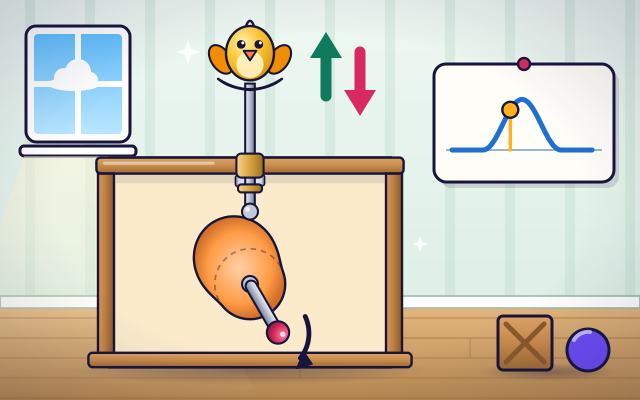
The interactive parts didn't load. The explanations below still work; try reloading the page.
How a cam makes things move
- Sam turns the crank of a wooden toy. The handle only goes around, but the bird on top goes up and down. Something inside must change the motion.
- Inside is a cam: a wheel that is not perfectly round. One side sticks out farther from the middle than the rest. The crank turns the cam around its axle.
- A rod called the follower rests on the cam's edge. A guide keeps it straight, and a spring holds it down against the cam. Whatever is under the follower decides how high it sits.
- When the bump comes around, the follower rises. When the bump moves on, it falls. While the round part passes underneath, the follower does not move at all: it pauses.
- Change the cam and you change the motion. An egg shape gives one smooth hop. A snail shape lifts slowly and then drops suddenly. Two bumps give two hops in every turn.
- Cams are busy all around us. In a car engine they push valves open at just the right moment. In a music box, tiny bumps on a turning drum pluck the notes of a tune.
Look inside a cam toy
The front of the toy is open. Tap each part to see what it does.
- Crank. The crank is the handle you turn. It is fixed to the axle, so turning it turns the cam.
- Axle. The axle is the pin the cam turns on. A cam does its job because its edge is not the same distance from the axle all the way around.
- Cam. The cam is the shaped wheel. The part that sticks out, called the lobe, pushes the follower up as it comes around.
- Follower. The follower is the rod that rests on the cam. It has a little roller at the bottom so it rides smoothly. It follows the cam's edge up and down.
- Guide. The guide is a hole that the follower slides through. It stops the rod from tipping sideways, so it can only move up and down.
- Spring. The spring pushes the follower down so it always stays touching the cam, even when the bump moves away quickly.
- Bird. The bird sits on top of the follower, so it copies the follower's motion exactly: it rises, pauses and falls once in every turn of the crank.
Swap the cam
Pick a cam and tap the crank. Watch the bird, and watch the line that shows how high it is during one turn.
Experiment: Which cam makes the bird rise slowly and then drop all at once?
- Tap the crank with the egg cam. Watch the bird go up and down.
- Pick the round cam and turn it. Does anything move?
- Now pick the snail cam. Move the crank angle slowly and find the drop.
What we found: The snail cam does it. Its edge gets farther from the axle a little at a time, so the bird rises slowly, and then there is a step where it drops. The egg cam gives one smooth hop, and the round cam gives no motion at all, because its edge is the same distance from the axle everywhere.
Turn on JavaScript to try it yourself.
The right cam for each toy
Three toys each need their own motion. Look at the dotted line, pick the cam that matches it, and turn the crank to test it.
How a cam's shape makes a motion
Many machines have a part that only spins, such as a motor or a crank. But often the job needs something that goes up and down, or back and forth, in a pattern. A cam is one of the simplest ways to turn spinning into that kind of repeating motion.
A cam is a wheel with a special shape. Its edge is not the same distance from the axle all the way around. A rod called a follower rests on the edge. Where the edge is far from the axle, the follower is pushed up. Where the edge is close, the follower comes back down, pushed by a spring or by its own weight.
The shape is like a set of instructions. A bump says rise and fall. A part of the edge that keeps the same distance from the axle says stay still, and that pause is called a dwell. A sudden step says drop. Two bumps mean two hops in every turn. So by cutting a different shape, a toy maker can make a figure nod, jump, wave or hammer.
Our bike comparison is not perfect. On a bike you travel along the road to meet each bump. With a cam, the follower stays in one place and the bumps come around to it, the same ones again and again.
Key words
- Cam
- A shaped wheel that pushes a follower as it turns.
- Follower
- The part that rests on the cam and is moved by it, usually in a straight line.
- Lobe
- The part of a cam that sticks out and lifts the follower.
- Lift
- How far the cam raises the follower, from its lowest point to its highest.
- Dwell
- A pause: a time when the cam is turning but the follower stays still.
- Displacement diagram
- A graph of the follower's height against the angle the cam has turned.
Check your thinking
-
Why does a perfectly round cam, with its axle in the middle, not move the follower?
Show the answer
Its edge is the same distance from the axle all the way around. The follower only moves when the edge under it gets closer to or farther from the axle.
-
What does the follower do while a part of the cam with constant distance from the axle passes under it?
Show the answer
It stays still. No change in distance means no change in height. That pause is called a dwell.
-
A toy frog must hop twice for every turn of the crank. Which cam does it need?
Show the answer
A cam with two bumps. Each bump lifts the follower once per turn, so two bumps give two hops.
-
What is the spring on the follower for?
Show the answer
It keeps the follower pressed against the cam. Without the spring, the follower could stay up in the air when the bump moves away.
-
A displacement diagram has a long flat section at its highest value. What feature of the cam makes it?
Show the answer
An arc of constant, maximum radius. While a constant-radius arc passes the follower, its height does not change. At the largest radius, that is a dwell at the top.
-
You turn the crank faster. What changes?
Show the answer
The bird moves the same way, but more often. The cam's shape decides the motion. Speed only decides how often it repeats.
You're a Forces & mechanisms expert!
You watched, looked inside, tried it, solved the challenge and went deeper. Pick another question below, or switch the age at the top to see this topic another way.
More about forces & mechanisms
 #110
Forces & mechanisms
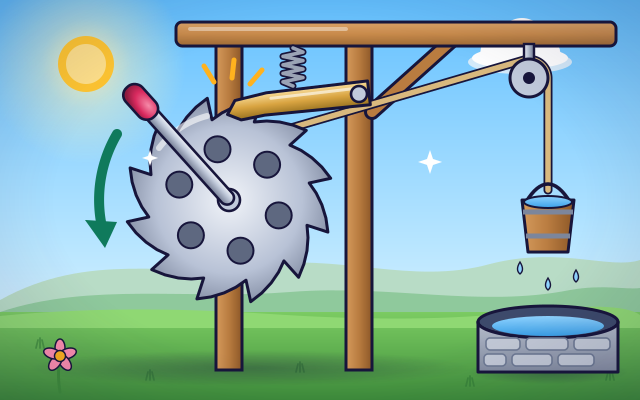
How do ratchets allow movement in only one direction?
Explore a toothed wheel and pawl, then build a mechanism that prevents backward movement.
#110
Forces & mechanisms
How do ratchets allow movement in only one direction?
Explore a toothed wheel and pawl, then build a mechanism that prevents backward movement.
 #111
Forces & mechanisms
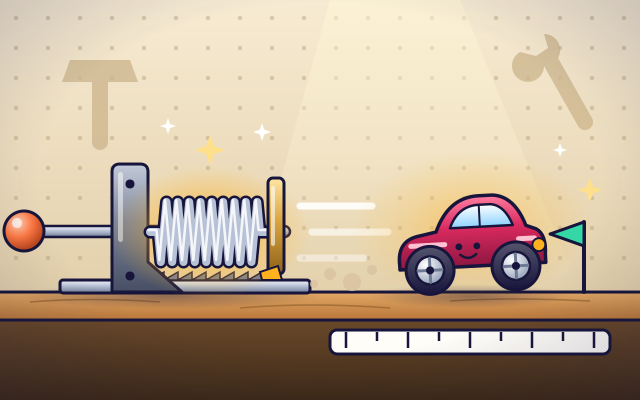
How do springs store and release energy?
Stretch or compress virtual springs and compare the movement produced when released.
#111
Forces & mechanisms
How do springs store and release energy?
Stretch or compress virtual springs and compare the movement produced when released.
 #112
Forces & mechanisms
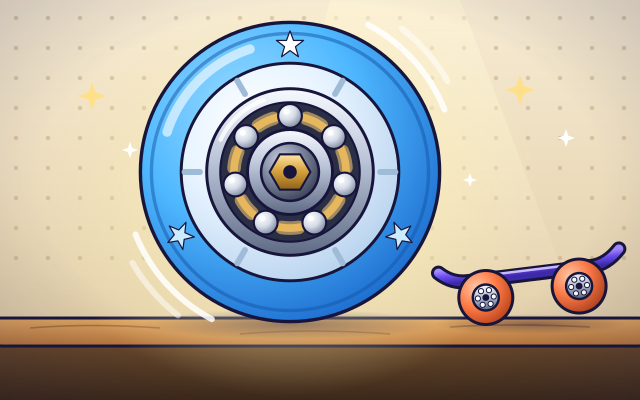
How do ball bearings help wheels turn smoothly?
Compare sliding surfaces with rolling bearings while moving the same load.
#112
Forces & mechanisms
How do ball bearings help wheels turn smoothly?
Compare sliding surfaces with rolling bearings while moving the same load.
 #113
Forces & mechanisms
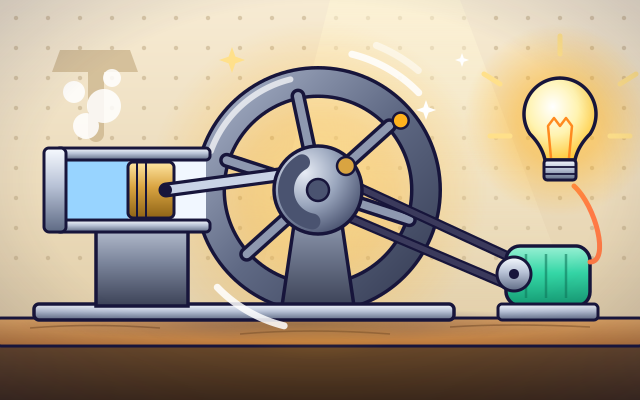
How do flywheels keep machines running smoothly?
Add a flywheel to a jerky mechanism and observe changes in rotational speed.
#113
Forces & mechanisms
How do flywheels keep machines running smoothly?
Add a flywheel to a jerky mechanism and observe changes in rotational speed.
Keep exploring
Games to play next
- Machine RepairFix levers, pulleys, gears and ramps so every contraption works.
- Marble MountainLay straights, curves, drops and splitters to roll marbles down the mountain.
- Bridge LabBuild a bridge from beams, brace it with triangles, and stay on budget.
Guide for grown-ups
- How to start homeschooling: a step-by-step guide for familiesA guide for parents · 7 min read
Science games by grade
Science worksheets by grade
- Preschool Science Worksheets
- Pre-K Science Worksheets
- Kindergarten Science Worksheets
- 1st Grade Science Worksheets
- 2nd Grade Science Worksheets
- 3rd Grade Science Worksheets
- 4th Grade Science Worksheets
- 5th Grade Science Worksheets
- 6th Grade Science Worksheets
- 7th Grade Science Worksheets
- 8th Grade Science Worksheets