How do capacitors store and release energy?
Charge a capacitor, watch the electrons crowd onto its plate, and release the stored energy in one bright flash.
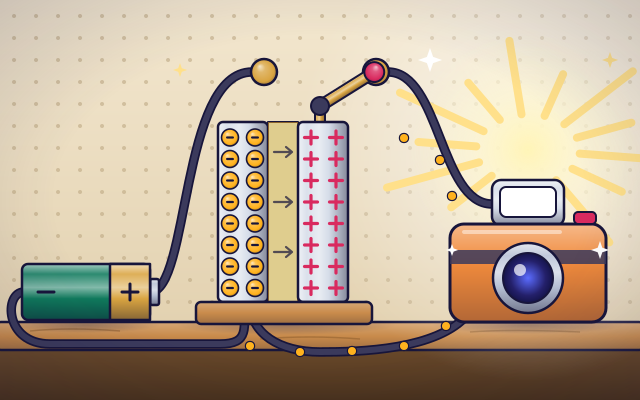
The big idea: A capacitor is two metal plates with a thin insulating layer between them. A battery crowds electrons onto one plate and takes them from the other. Give them a path, and they rush back, releasing their energy in a burst.
It's like blowing up a balloon: easy at first, harder as it fills. Let go, and the air rushes out in a moment. A capacitor fills and empties like that.
The interactive parts didn't load. The explanations below still work; try reloading the page.
Slow in, fast out
- A camera flash is a huge burst of light that lasts only a blink. A small battery cannot push out energy that fast. So the camera saves energy up first, in a part called a capacitor.
- Inside a capacitor are two metal plates, very close together, with a thin layer between them that electricity cannot cross. In real ones the plates are long strips, rolled up to fit in a little can.
- Connect a battery. It pushes electrons onto one plate and pulls them off the other. The plate fills quickly at first, then more slowly, because the electrons already there push back on the newcomers.
- Disconnect the battery and the charge stays put. The crowded electrons are pulled toward the other plate, but the insulating layer stops them. The energy waits, stored between the plates.
- Now connect the plates through a lamp. The electrons rush around through the wire to the other plate, all in a moment. Their stored energy comes out as a short, bright flash.
- Slow in, fast out: that is a capacitor's trick. Capacitors fire camera flashes, sense your finger on a touch screen, and smooth out bumpy electricity inside almost every gadget.
Look inside a capacitor
This capacitor is cut open to show its roll. The magnifier shows the layers of the roll, zoomed in. Tap each part.
- Metal can. The aluminum can protects the roll inside. A printed stripe on the sleeve shows which leg is the minus one.
- Rolled-up plates. The two plates are long strips of metal foil with a thin separator between them, rolled up tightly. Unrolled, they could be longer than your arm.
- Legs. Each leg is joined to one of the two plates. Electrons flow in through one leg and out through the other, but never straight through the capacitor.
- Plate with extra electrons. The battery pushes extra electrons onto this plate, so it becomes negatively charged. The more electrons arrive, the harder they push back.
- Plate with missing electrons. The battery pulls electrons away from this plate, leaving it positively charged. It attracts the electrons crowded on the other plate.
- Insulating layer. A very thin layer between the plates that electricity cannot cross. It keeps the opposite charges apart, and that is what lets the capacitor hold its energy.
Slow fill, quick flash
Tap Charge and watch the electrons crowd onto the plate. Tap Flash to let the energy out. Try a short charge and a long one, then a bigger capacitor.
Experiment: You charge for one second and flash. Then you charge for five seconds and flash. How do the two flashes compare?
- Tap Charge, wait about one second, then tap Flash.
- Tap Charge again and wait until the meter stops rising. Then tap Flash.
- Try the large capacitor. Does it take longer to fill?
What we found: The longer you charge, the more electrons crowd onto the plate and the brighter the flash, until the capacitor is full. It fills fast at first and then slows down. A bigger capacitor holds more, but takes longer to fill.
Turn on JavaScript to try it yourself.
Three perfect photos
Take three photos. Each needs a different amount of flash: flash when the meter is inside the green band. Too little is too dark, and too much is too bright.
How a capacitor stores and releases energy
A capacitor is one of the simplest electronic parts: two metal plates very close together, with a thin insulating layer between them so that they never touch. It does not make electricity. It stores a little of it, and it can give it back very quickly.
When you connect a battery, the battery pushes electrons onto one plate and pulls electrons off the other. One plate ends up with too many electrons and the other with too few. These opposite charges pull on each other across the gap, but the insulating layer keeps them apart. That pull is where the energy is stored.
Filling a capacitor is fast at first and then slows down. The first electrons arrive easily. Later ones are pushed back by the crowd already on the plate, a bit like blowing up a balloon that gets harder to blow as it fills. When the capacitor pushes back as hard as the battery pushes, it is full.
Give the electrons a path, such as a wire through a lamp, and they rush around to the other plate. All the stored energy comes out in a moment. That is the difference from a battery: a battery holds much more energy but gives it out steadily, while a capacitor holds less and can release it in a burst. That is why camera flashes use capacitors. The balloon comparison is not perfect, because nothing is pumped in from outside: electrons are moved from one plate to the other. One warning: big capacitors inside appliances can stay charged after they are unplugged, so never open one up.
Key words
- Capacitor
- A part that stores electrical energy on two plates and can release it quickly.
- Charge
- Extra electrons on one plate and missing electrons on the other. Also: to fill a capacitor.
- Capacitance
- How much charge a capacitor can hold for each volt. A bigger capacitor has more.
- Dielectric
- The thin insulating layer between a capacitor's plates.
- Time constant
- How long a capacitor takes to get about two thirds full.
- Discharge
- To let a capacitor's stored charge flow out through a circuit.
Check your thinking
-
How does a capacitor store energy?
Show the answer
By holding extra electrons on one plate and too few on the other. The opposite charges pull on each other across the gap. That pull holds the energy.
-
Why does a capacitor fill more slowly as it gets fuller?
Show the answer
The electrons already on the plate push back on the new ones. Electrons repel each other. The fuller the plate, the harder it is to add more.
-
What happens when the capacitor flashes?
Show the answer
The stored energy rushes out all at once. The electrons race around to the other plate, and their energy becomes a flash of light.
-
Why does a camera flash use a capacitor instead of taking energy straight from the battery?
Show the answer
A capacitor can release its energy much faster than a battery can. A battery holds more energy, but gives it out slowly. A capacitor can dump its energy in a blink.
-
What stops the charges on the two plates from simply jumping across?
Show the answer
The insulating layer between the plates. Electricity cannot cross the insulating layer, so the charges stay apart until you give them another path.
-
Which change doubles the time constant of a charging circuit?
Show the answer
Doubling the resistance. The time constant is R times C. The battery voltage changes how far the capacitor charges, not how long it takes.
You're a Electricity & energy expert!
You watched, looked inside, tried it, solved the challenge and went deeper. Pick another question below, or switch the age at the top to see this topic another way.
More about electricity & energy
 #381
Electricity & energy
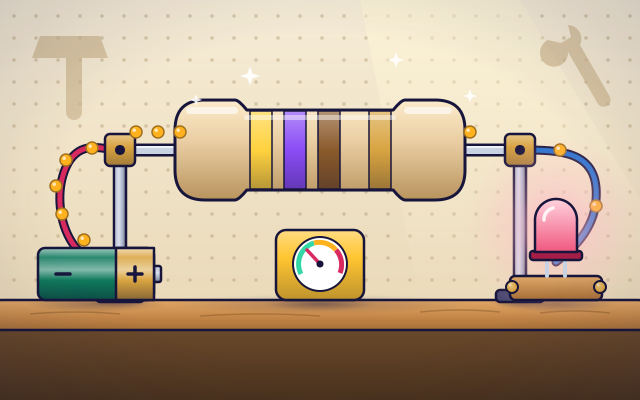
How do resistors control current?
Change resistance and observe corresponding changes on a virtual current meter.
#381
Electricity & energy
How do resistors control current?
Change resistance and observe corresponding changes on a virtual current meter.
 #382
Electricity & energy
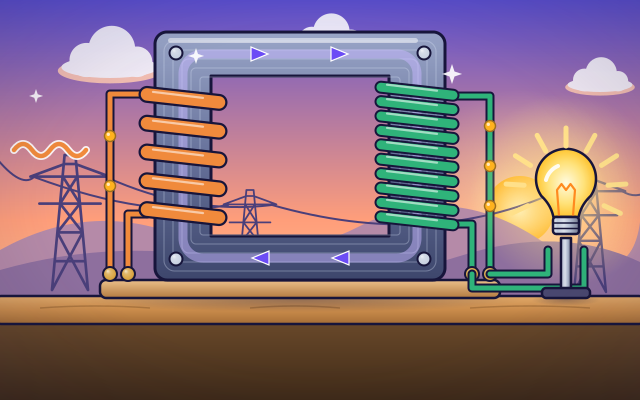
How do transformers change voltage?
Adjust turns in model coils and compare input and output voltages.
#382
Electricity & energy
How do transformers change voltage?
Adjust turns in model coils and compare input and output voltages.
 #383
Electricity & energy
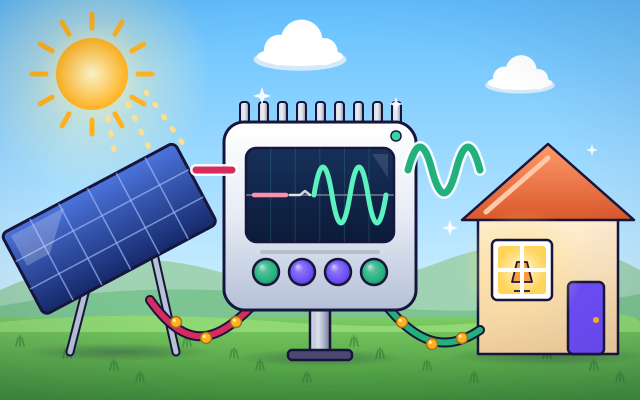
How do inverters change direct current into alternating current?
Follow a switching sequence and watch a steady supply become an alternating waveform.
#383
Electricity & energy
How do inverters change direct current into alternating current?
Follow a switching sequence and watch a steady supply become an alternating waveform.
 #384
Electricity & energy
How do circuit boards connect electronic parts?
Route connections across a transparent board and trace signals between components.
#384
Electricity & energy
How do circuit boards connect electronic parts?
Route connections across a transparent board and trace signals between components.
Keep exploring
Games to play next
- Circuit Workshop 3DWire up batteries, bulbs and switches on a 3D workbench.
- SwitchworksFlip switches to light the lamps in the target pattern — in as few presses as you can.
- Machine RepairFix levers, pulleys, gears and ramps so every contraption works.
Guide for grown-ups
- How to start homeschooling: a step-by-step guide for familiesA guide for parents · 7 min read
Science games by grade
Science worksheets by grade
- Preschool Science Worksheets
- Pre-K Science Worksheets
- Kindergarten Science Worksheets
- 1st Grade Science Worksheets
- 2nd Grade Science Worksheets
- 3rd Grade Science Worksheets
- 4th Grade Science Worksheets
- 5th Grade Science Worksheets
- 6th Grade Science Worksheets
- 7th Grade Science Worksheets
- 8th Grade Science Worksheets