How do circuit boards connect electronic parts?
Circuit boards hold the parts of every gadget and join them with flat copper roads instead of a tangle of wires.
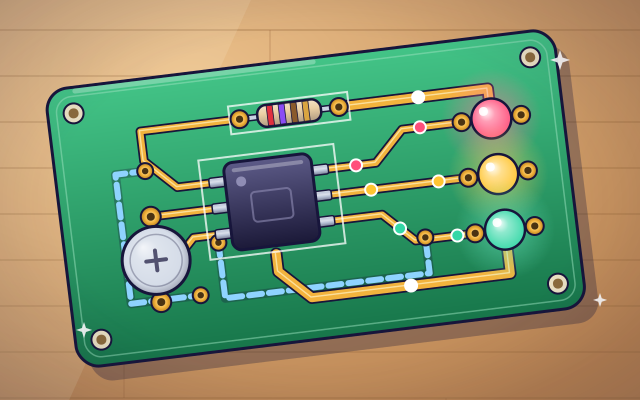
The big idea: A circuit board joins electronic parts with thin copper paths called traces. Paths on the same side must never touch, so some of them run on the other side of the board.
It's like the road map of a tiny city: copper roads link the buildings, and where two roads would crash, one goes through a tunnel underneath.
The interactive parts didn't load. The explanations below still work; try reloading the page.
From a tangle to a tidy board
- A gadget needs its parts joined together. Long ago, people joined them with loose wires, one at a time. It was slow, messy and easy to get wrong.
- Now we use a circuit board instead. It is a thin, stiff sheet that does not let electricity through, and every part has its own place on it.
- Thin paths of copper, called traces, run across the board from part to part. They work just like wires, but they are flat and stay exactly where they belong.
- Two traces on the same side must never touch, or their signals would mix. So one of them dives through a tiny copper-lined hole, called a via, and runs along the bottom.
- Each part's metal legs are joined to round copper pads with solder: a metal that melts easily, then cools into a shiny joint. It holds the part on and carries the electricity.
- Switch it on, and signals race along the traces to every part. One small, tidy board does the job of a whole nest of wires, and a factory can make thousands just the same.
A circuit board, up close
This is a corner of a board, much bigger than life. Tap each part to learn what it does.
- The board itself. The board is a stiff sheet made of glass threads and hard glue. Electricity cannot pass through it, so it keeps all the copper paths apart.
- Copper traces. Traces are the copper paths that join the parts. Each one carries electricity between two or more places, just like a wire.
- Pads and solder. Pads are small patches of bare copper where a part's legs are fixed with solder. The shiny solder holds the part on and joins it to the traces.
- Vias. A via is a tiny hole lined with copper. It lets a trace dive from the top of the board to the bottom, pass under other traces and come back up.
- Green coat. The green color is a thin protective coat called solder mask. It covers the traces so they cannot touch by accident, and leaves only the pads bare.
- Printed labels. White outlines and labels are printed on the board. They show where each part goes and which way round, like the picture on a jigsaw box.
- Parts. The parts, or components, sit on top: chips, resistors, lights and more. The board holds them still and joins them into one working circuit.
Route the board
Lay copper along the dotted lines: drag from a pad, or tap the line. Watch each signal travel. What happens when two traces cross?
Experiment: What happens if two copper traces cross each other on the same side of the board?
- With Top side chosen, lay the first trace. Follow its signal to the light.
- Lay the second trace on the top side too. Look where the two cross.
- Choose Bottom side and tap one of the two traces to move it underneath.
What we found: Traces on the same side are bare copper touching bare copper where they cross, so the signals mix: a short circuit. Moving one trace to the other side, through two vias, lets it pass underneath safely.
Turn on JavaScript to try it yourself.
Four signals, no crashes
Connect all four signals with no short circuits, then press Test the board. For 3 stars, use only two vias.
How circuit boards work
Open almost any gadget and you will find a flat board, usually green, covered in tiny parts. This is a printed circuit board. Its job is to hold every part in place and to connect the parts in exactly the right way.
The connections are thin paths of copper called traces. Electricity flows along a trace just as it does along a wire. Because the traces are printed by machines, every board comes out the same, with no wires to mix up.
Two traces must never touch unless they are meant to be joined. If they did, electricity would take the wrong path. That is called a short circuit. So when two traces need to cross, one of them goes through a small copper-lined hole, a via, and travels on the other side of the board.
The parts are fixed to copper pads with solder, which holds them on and lets electricity through. A green coat protects the copper, and white printed labels show where everything goes. The city map comparison has one weak spot: cars choose their roads, but electricity simply follows every piece of copper that is joined together.
Key words
- Trace
- A thin copper path on the board that carries electricity, like a flat wire.
- Via
- A tiny copper-lined hole that lets a trace go to the other side of the board.
- Short circuit
- When electricity takes a path it should not, because two things touch.
- Solder
- A metal that melts easily and joins a part to the board.
- Pad
- A small patch of bare copper where a part is soldered on.
Check your thinking
-
What are the copper paths on a circuit board called?
Show the answer
Traces. The thin copper paths are called traces. They do the job of wires.
-
Two traces need to cross. How does a board let them pass without touching?
Show the answer
One goes through a via and runs on the other side. A via takes one trace to the other side of the board, so the two never touch.
-
A trace must carry a large current to a motor. Which design gives it the lowest resistance?
Show the answer
Short and wide, on one layer. Resistance falls with width and rises with length, and every via adds a little more. Short and wide is best.
-
Why is the board itself made of a material that electricity cannot pass through?
Show the answer
To keep the copper paths apart, so electricity only goes where it should. If the board let electricity through, every trace would be joined to every other one.
-
What two jobs does solder do?
Show the answer
It holds a part on and lets electricity pass into it. A solder joint is like glue made of metal: strong, and a good path for electricity.
-
Why are circuit boards better than loose wires for making lots of gadgets?
Show the answer
Every board is printed the same, small and tidy, with nothing to mix up. Machines print and build thousands of identical boards, far faster than anyone could wire them by hand.
You're a Electricity & energy expert!
You watched, looked inside, tried it, solved the challenge and went deeper. Pick another question below, or switch the age at the top to see this topic another way.
More about electricity & energy
 #385
Electricity & energy
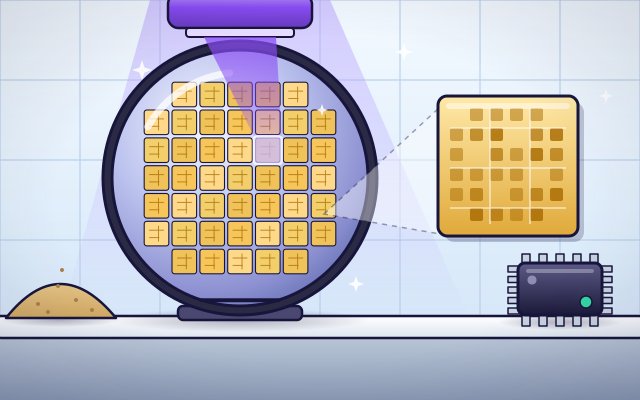
How are computer chips made?
Follow a silicon wafer through simplified patterning, repeated processing, cutting, packaging, and testing.
#385
Electricity & energy
How are computer chips made?
Follow a silicon wafer through simplified patterning, repeated processing, cutting, packaging, and testing.
 #386
Electricity & energy
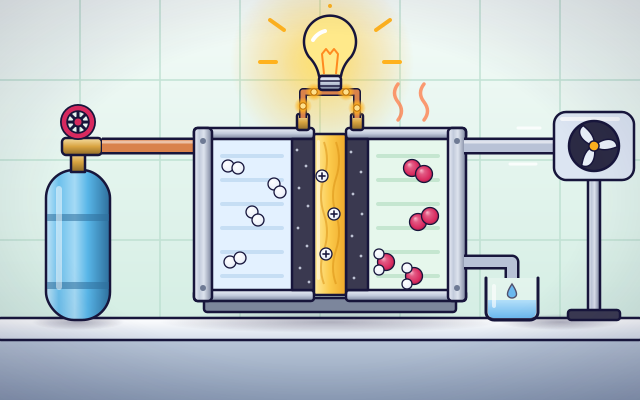
How do fuel cells generate electricity?
Follow hydrogen and oxygen through a model cell and identify its outputs.
#386
Electricity & energy
How do fuel cells generate electricity?
Follow hydrogen and oxygen through a model cell and identify its outputs.
 #387
Electricity & energy
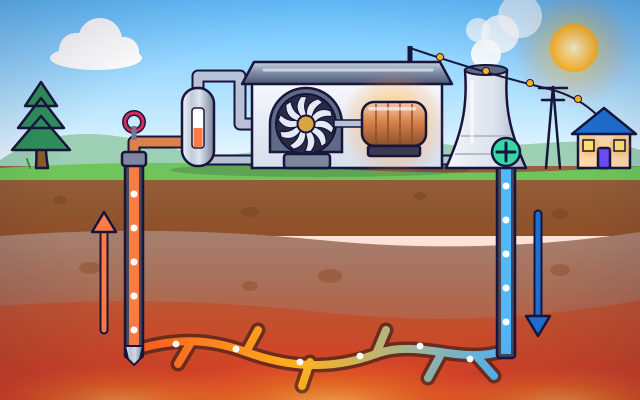
How do geothermal power plants use Earth's heat?
Follow underground heat through a power station and its circulating water system.
#387
Electricity & energy
How do geothermal power plants use Earth's heat?
Follow underground heat through a power station and its circulating water system.
 #388
Electricity & energy
How does a nuclear power reactor work?
Trace controlled fission, control rods, coolant, and heat transfer into electricity generation.
#388
Electricity & energy
How does a nuclear power reactor work?
Trace controlled fission, control rods, coolant, and heat transfer into electricity generation.
Keep exploring
Games to play next
- Circuit Workshop 3DWire up batteries, bulbs and switches on a 3D workbench.
- SwitchworksFlip switches to light the lamps in the target pattern — in as few presses as you can.
- Machine RepairFix levers, pulleys, gears and ramps so every contraption works.
Guide for grown-ups
- How to start homeschooling: a step-by-step guide for familiesA guide for parents · 7 min read
Science games by grade
Science worksheets by grade
- Preschool Science Worksheets
- Pre-K Science Worksheets
- Kindergarten Science Worksheets
- 1st Grade Science Worksheets
- 2nd Grade Science Worksheets
- 3rd Grade Science Worksheets
- 4th Grade Science Worksheets
- 5th Grade Science Worksheets
- 6th Grade Science Worksheets
- 7th Grade Science Worksheets
- 8th Grade Science Worksheets