How do inverters change direct current into alternating current?
An inverter turns the steady electricity from batteries and solar panels into the back-and-forth kind your home uses.
The big idea: An inverter uses switches to send steady electricity through a circuit first one way and then the other, many times each second. That makes alternating current.
It's like taking a battery out of a toy and putting it back in the other way round, over and over, very fast: each flip sends the electricity the opposite way.
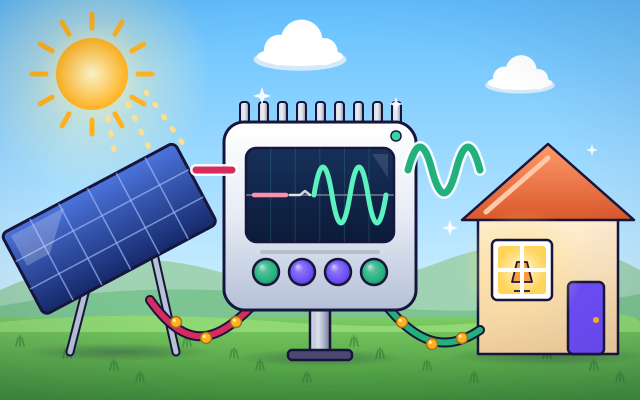
The interactive parts didn't load. The explanations below still work; try reloading the page.
From steady to back-and-forth
- A solar panel makes electricity that flows steadily in one direction. That kind is called direct current, or DC. Batteries make DC too.
- But homes are wired for alternating current, or AC, which flows back and forth many times a second. The steady kind will not do. Something has to change it.
- The job goes to this box on the wall: an inverter. Steady DC goes in from the panel, and back-and-forth AC comes out for the house. Let's look inside.
- Four switches sit around the lamp. Close one pair and electricity flows through the lamp from left to right. Open them and close the other pair, and it flows from right to left.
- A tiny computer flips the pairs over and over, many times a second. The steady supply has become back-and-forth electricity. On the screen it looks like square steps.
- Last, the inverter chops each push into quick pulses and passes them through a filter. The sharp steps melt into a smooth wave, just like mains electricity. The lamp glows on sunshine!
Look inside an inverter
The cover is off. Tap each part to see how steady electricity becomes a wave.
- DC input. Two thick cables bring in steady electricity (DC) from the solar panels or a battery: one for going in and one for coming back.
- Power switches. These four parts are electronic switches called transistors. They have no moving parts, so they can flip thousands of times a second without wearing out.
- Controller chip. A small computer chip is the brain. It tells each switch exactly when to open and close, keeping perfect time.
- Smoothing filter. A coil of wire and a capacitor work together as a filter. They soak up the sudden jumps, so the blocky pulses come out as a smooth wave.
- Cooling fins. The switches get warm as they work. They are bolted to a block of metal fins that passes the heat to the air.
- AC output. Smooth back-and-forth electricity (AC) leaves here for the sockets and lights in the house.
Make a wave with four switches
Tap the green pair, then the purple pair, and watch the screen. Then let the controller flip them for you and smooth the wave.
Experiment: The supply is steady. What will the screen show when you keep swapping from one pair of switches to the other?
- Tap a green switch. Which way does the arrow under the lamp point?
- Tap a purple switch. Look at the arrow and the line on the screen.
- Switch on automatic flipping, then switch on the smooth wave.
What we found: Swapping pairs sends the same steady supply through the lamp in opposite directions, so the screen shows steps going up and down: alternating current. Quick pulses and a filter turn the steps into a smooth wave.
Turn on JavaScript to try it yourself.
Match the wave
The dotted line is the wave the house needs. Make your wave match it, then press Connect.
How an inverter makes a wave
There are two kinds of electric current. Direct current, or DC, flows steadily one way. Batteries and solar panels make DC. Alternating current, or AC, flows back and forth many times a second. Power stations make AC, and the sockets in your home supply it.
An inverter changes DC into AC. Inside are four electronic switches arranged around the output. Closing one pair sends current through the output in one direction. Closing the other pair sends it in the opposite direction. Flip between the pairs 50 or 60 times a second and the output goes back and forth.
Simple flipping makes a blocky wave with sharp corners. Many machines prefer a smooth wave. So the inverter flips much faster, in quick pulses that are wide in the middle of each push and narrow at the ends. A coil and a capacitor smooth the pulses into gentle hills and valleys.
Inverters are everywhere: on houses with solar panels, in electric cars to drive the motors, and in camping power packs. The battery-flipping comparison is only a picture, though. Nothing inside an inverter turns around. The switches are transistors with no moving parts.
Key words
- Direct current (DC)
- Electricity that flows steadily in one direction, like from a battery.
- Alternating current (AC)
- Electricity that flows back and forth many times a second, like from a wall socket.
- Frequency
- How many times each second the electricity goes back and forth.
- H-bridge
- Four switches arranged so they can send electricity through something either way.
- Pulse-width modulation
- Making a smooth wave out of quick pulses by changing how long each pulse lasts.
Check your thinking
-
What does an inverter do?
Show the answer
It changes steady DC into back-and-forth AC. An inverter turns the steady electricity from panels or batteries into the alternating kind homes use.
-
How does an inverter make the current change direction?
Show the answer
It closes one pair of switches, then the other pair. Each pair of switches sends the current through the output in a different direction.
-
An H-bridge is switched so its output completes 60 full cycles each second. How many times does the current reverse direction in one second?
Show the answer
120 times. Each full cycle has two reversals: positive to negative and back again. 60 cycles means 120 reversals.
-
Why does the inverter use a coil and a capacitor after the switches?
Show the answer
To smooth the sharp steps into a gentle wave. The filter soaks up sudden jumps, so blocky pulses come out as a smooth wave.
-
Why are the switches in an inverter transistors and not ordinary light switches?
Show the answer
They must flip thousands of times a second with no moving parts. No finger or lever could flip that fast. Transistors switch with electricity and never wear out from moving.
-
Which of these makes steady DC electricity?
Show the answer
A solar panel. Solar panels and batteries make DC. Sockets and power lines carry AC.
You're a Electricity & energy expert!
You watched, looked inside, tried it, solved the challenge and went deeper. Pick another question below, or switch the age at the top to see this topic another way.
More about electricity & energy
 #384
Electricity & energy
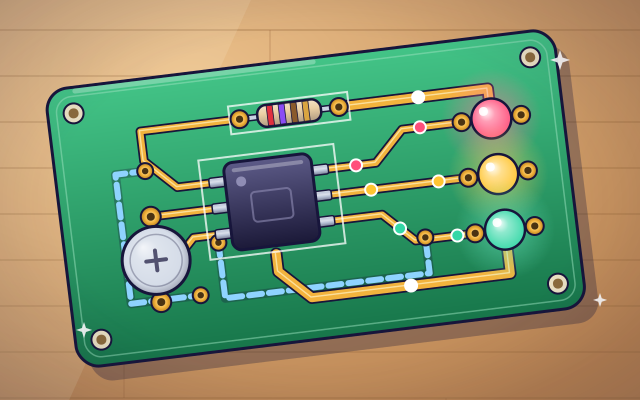
How do circuit boards connect electronic parts?
Route connections across a transparent board and trace signals between components.
#384
Electricity & energy
How do circuit boards connect electronic parts?
Route connections across a transparent board and trace signals between components.
 #385
Electricity & energy
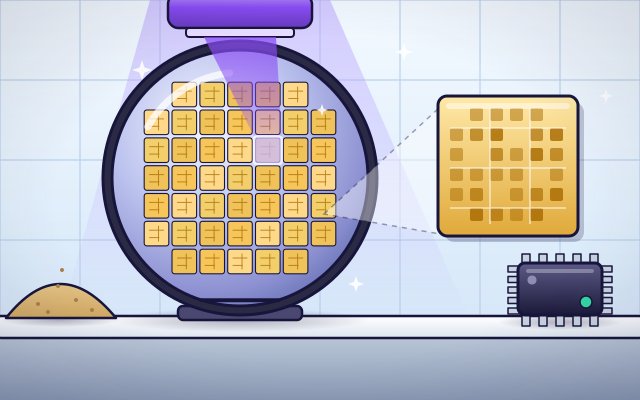
How are computer chips made?
Follow a silicon wafer through simplified patterning, repeated processing, cutting, packaging, and testing.
#385
Electricity & energy
How are computer chips made?
Follow a silicon wafer through simplified patterning, repeated processing, cutting, packaging, and testing.
 #386
Electricity & energy
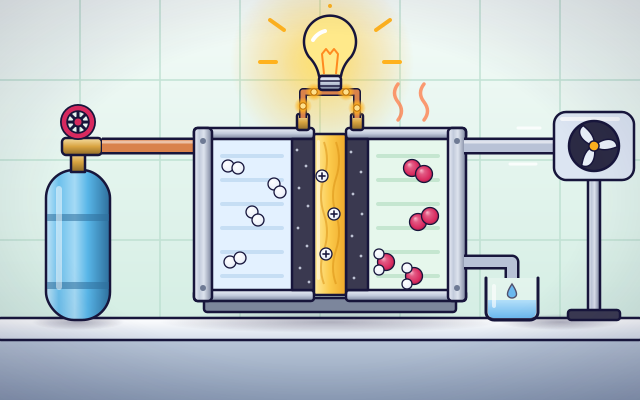
How do fuel cells generate electricity?
Follow hydrogen and oxygen through a model cell and identify its outputs.
#386
Electricity & energy
How do fuel cells generate electricity?
Follow hydrogen and oxygen through a model cell and identify its outputs.
 #387
Electricity & energy
How do geothermal power plants use Earth's heat?
Follow underground heat through a power station and its circulating water system.
#387
Electricity & energy
How do geothermal power plants use Earth's heat?
Follow underground heat through a power station and its circulating water system.
Keep exploring
Games to play next
- Circuit Workshop 3DWire up batteries, bulbs and switches on a 3D workbench.
- SwitchworksFlip switches to light the lamps in the target pattern — in as few presses as you can.
- Machine RepairFix levers, pulleys, gears and ramps so every contraption works.
Guide for grown-ups
- How to start homeschooling: a step-by-step guide for familiesA guide for parents · 7 min read
Science games by grade
Science worksheets by grade
- Preschool Science Worksheets
- Pre-K Science Worksheets
- Kindergarten Science Worksheets
- 1st Grade Science Worksheets
- 2nd Grade Science Worksheets
- 3rd Grade Science Worksheets
- 4th Grade Science Worksheets
- 5th Grade Science Worksheets
- 6th Grade Science Worksheets
- 7th Grade Science Worksheets
- 8th Grade Science Worksheets