How do resistors control current?
Resistors make electricity work harder to get through, so every part of a gadget gets just the right amount.
The big idea: A resistor is a hard path for electricity. The more resistance in a circuit, the smaller the current that flows through it.
It's like drinking through a skinny straw: the same suck moves less milkshake than a wide straw does. A resistor is the skinny straw for electricity.
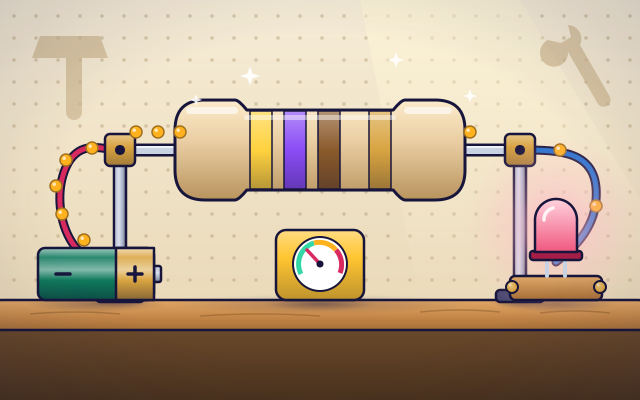
The interactive parts didn't load. The explanations below still work; try reloading the page.
The part that says "not so fast"
- Join a small light straight to a battery and electricity rushes through as fast as it can. The light glares, gets hot and would soon wear out. How can we slow the rush?
- This small striped part is a resistor. We put it in the loop, so all the electricity has to squeeze through it. Now the light glows gently.
- Inside, the path is a thin, twisty ribbon of carbon. The tiny moving bits of electricity, called electrons, keep bumping into it, so fewer get through each second.
- Swap in a resistor with more resistance. The battery pushes just as hard, but less current flows. The meter needle drops and the light dims.
- All those bumps turn some of the electricity's energy into heat, like rubbing your hands together. That is why a resistor feels warm when it works hard.
- Peek inside almost any gadget and you will find rows of resistors. Each one gives its part of the circuit just the right amount of electricity.
Look inside a resistor
This resistor has been cut open. Tap each part to see what it is for.
- Wire legs. Two wire legs, called leads, join the resistor to the rest of the circuit. Electricity goes in one and comes out the other.
- Metal end caps. A metal cap is pressed onto each end. It holds the leg on and passes the electricity onto the carbon path.
- Ceramic rod. The middle is a rod of ceramic, like a piece of a plate. Electricity cannot pass through it, so it must take the carbon path wrapped around it.
- Carbon path. A thin coat of carbon is cut into a long spiral. Electricity has to travel the whole twisty way, bumping as it goes. This is the part that resists.
- Painted coat. A tough coat of paint seals the resistor. It keeps out damp and dirt, and stops the carbon path from touching other parts.
- Color bands. The colored stripes are a code. Each color stands for a number, and together they tell you how much resistance this resistor has.
Change the resistance, watch the meter
Drag the slider to put more or less resistance in the loop. Watch the current meter, the moving dots and the lamp.
Experiment: The battery stays the same. What happens to the current when you add more resistance?
- Drag the slider all the way to the short end. Look at the meter and the lamp.
- Now drag it to the long end, so the electricity has a longer hard path.
- Compare the needle, the speed of the dots and the lamp.
What we found: More resistance means less current. The battery pushes just as hard, but the longer hard path lets fewer electrons through each second, so the needle drops and the lamp dims.
Turn on JavaScript to try it yourself.
Just the right glow
Each lamp needs its needle in the green zone. Choose a resistor for each battery, then press Test.
How resistors control electricity
Electricity is the flow of tiny particles called electrons. A battery gives them a push, and they travel around a loop of wire called a circuit. The push is called voltage, and the amount of electricity flowing past each second is called current.
Copper wire is an easy path, so electrons zip along it. A resistor is made from a material that is a hard path, such as a thin ribbon of carbon. Electrons keep bumping into it, so fewer can get through each second. More resistance means less current, as long as the push stays the same.
The bumping is not wasted on nothing: it turns into heat. That is how a toaster and an electric kettle work. Their heating wires are really resistors that are made to get hot. The small resistors in a gadget only get slightly warm.
The skinny straw comparison is helpful, but it is not perfect. Milkshake piles up and squeezes through a straw, while electrons fill the whole wire all the time and all start moving together. Still, the main idea holds: a harder path lets less through.
Key words
- Current
- How much electricity flows past each second.
- Voltage
- The push that makes electricity move around a circuit.
- Resistance
- How hard it is for electricity to get through something.
- Ohm's law
- The rule that more push gives more current and more resistance gives less.
- Series and parallel
- Parts joined one after another are in series. Parts joined side by side are in parallel.
Check your thinking
-
What does a resistor do in a circuit?
Show the answer
It makes the path harder, so less current flows. A resistor does not make or store electricity. It only makes the path harder, so the current is smaller.
-
A lamp is glowing too brightly. Which change will dim it?
Show the answer
Swap in a resistor with more resistance. More resistance means less current, and less current makes the lamp dimmer.
-
A 12 volt supply is connected across a 600 ohm resistor. What current flows?
Show the answer
20 milliamps. I = V / R = 12 ÷ 600 = 0.02 amps, which is 20 milliamps.
-
Why does a resistor get warm when it is working?
Show the answer
The electrons bump along the hard path, and the bumping makes heat. The bumps pass energy to the resistor, which warms up, just like your hands when you rub them.
-
You swap a weak battery for a stronger one but want the same current. What must you do?
Show the answer
Use more resistance. A stronger push would drive more current, so you need a harder path to bring it back down.
-
What do the colored bands on a resistor tell you?
Show the answer
How much resistance it has. Each color stands for a number, and together they give the resistance in ohms.
You're a Electricity & energy expert!
You watched, looked inside, tried it, solved the challenge and went deeper. Pick another question below, or switch the age at the top to see this topic another way.
More about electricity & energy
 #382
Electricity & energy
How do transformers change voltage?
Adjust turns in model coils and compare input and output voltages.
#382
Electricity & energy
How do transformers change voltage?
Adjust turns in model coils and compare input and output voltages.
 #383
Electricity & energy
How do inverters change direct current into alternating current?
Follow a switching sequence and watch a steady supply become an alternating waveform.
#383
Electricity & energy
How do inverters change direct current into alternating current?
Follow a switching sequence and watch a steady supply become an alternating waveform.
 #384
Electricity & energy
How do circuit boards connect electronic parts?
Route connections across a transparent board and trace signals between components.
#384
Electricity & energy
How do circuit boards connect electronic parts?
Route connections across a transparent board and trace signals between components.
 #385
Electricity & energy
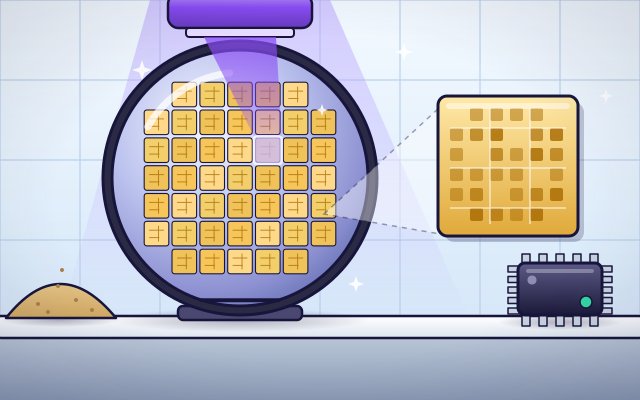
How are computer chips made?
Follow a silicon wafer through simplified patterning, repeated processing, cutting, packaging, and testing.
#385
Electricity & energy
How are computer chips made?
Follow a silicon wafer through simplified patterning, repeated processing, cutting, packaging, and testing.
Keep exploring
Games to play next
- Circuit Workshop 3DWire up batteries, bulbs and switches on a 3D workbench.
- SwitchworksFlip switches to light the lamps in the target pattern — in as few presses as you can.
- Machine RepairFix levers, pulleys, gears and ramps so every contraption works.
Guide for grown-ups
- How to start homeschooling: a step-by-step guide for familiesA guide for parents · 7 min read
Science games by grade
Science worksheets by grade
- Preschool Science Worksheets
- Pre-K Science Worksheets
- Kindergarten Science Worksheets
- 1st Grade Science Worksheets
- 2nd Grade Science Worksheets
- 3rd Grade Science Worksheets
- 4th Grade Science Worksheets
- 5th Grade Science Worksheets
- 6th Grade Science Worksheets
- 7th Grade Science Worksheets
- 8th Grade Science Worksheets