How do transformers change voltage?
A transformer uses two coils and a magnet field to turn a big voltage into a small one, or a small one into a big one.
The big idea: Electricity that flows back and forth in one coil makes a changing magnet field, and that field makes electricity in a second coil. The number of loops on each coil decides the voltage that comes out.
It's like the gears on a bike: change the two gear sizes and you swap a slow, strong push for a fast, light one. Coils do that for electricity.
The interactive parts didn't load. The explanations below still work; try reloading the page.
How electricity changes its push
- Electricity is made at a power station and travels a long way on tall power lines. On the trip its push, called voltage, is changed more than once. How?
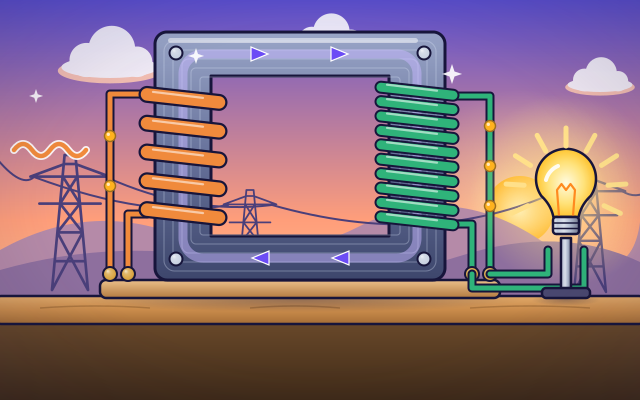
- This is a transformer: two coils of wire wound around a ring of iron. One coil brings electricity in and the other sends it out, but the two wires never touch.
- The electricity in the first coil flows back and forth. A coil carrying electricity is a magnet, so the iron ring fills with a magnet field that keeps growing, shrinking and flipping over.
- The changing magnet field passes through the second coil and pushes the electrons in its wire. Electricity flows there too, and the lamp lights, with no wire joining the coils.
- Wind more loops on the second coil than the first and the voltage steps up. Wind fewer and it steps down. The number of loops is the secret.
- At the power station a transformer steps the voltage up for the long trip. Near your street another one steps it down again, so it is right for your home.
Look inside a transformer
Tap each part of the transformer to find out what it does.
- Input coil. The input coil carries the electricity coming in. As that electricity flows back and forth, the coil becomes a magnet that keeps flipping.
- Iron core. The iron ring is called the core. Magnet fields pass through iron very easily, so the core guides the field from the input coil around to the output coil.
- Magnet field. The magnet field is invisible, so we have drawn it as dots. It loops around the core, and it only works because it keeps changing.
- Output coil. The changing field pushes electrons in the output coil, so electricity comes out here. More loops than the input coil means a higher voltage. Fewer loops means a lower one.
- Thin iron sheets. The core is not one solid block. It is a stack of thin iron sheets, each with a thin coat between. That stops electricity from swirling around inside the iron and wasting energy as heat.
- Screw terminals. The ends of each coil are fixed under screws. One pair joins the supply and the other pair joins whatever the transformer is powering.
Change the loops, change the voltage
Drag the gold knobs to wind loops on or off each coil. Compare the voltage going in with the voltage coming out.
Experiment: What happens to the voltage coming out when the output coil has more loops than the input coil?
- Give both coils the same number of loops. Look at the two meters.
- Wind more loops onto the output coil. What do the meter and the lamp do?
- Now make the output coil the one with fewer loops.
What we found: More loops on the output coil than the input coil steps the voltage up. Fewer loops steps it down. Equal loops give the same voltage out as in.
Turn on JavaScript to try it yourself.
The right voltage
Each gadget needs its own voltage. Wind the coils to make it from the 12 volt supply, then press Switch on.
How a transformer changes voltage
Electricity and magnets are close cousins. When electricity flows through a coil of wire, the coil becomes a magnet. And when a magnet's field changes near a coil of wire, it pushes electricity through the wire. A transformer uses both tricks, one after the other.
The electricity from a wall socket flows back and forth many times each second. In the input coil it makes a magnet field that keeps flipping. The iron core carries that changing field around to the output coil, where it pushes electrons and makes electricity again.
Each loop of the output coil gets the same little push, and the pushes add up. So more loops than the input coil gives a higher voltage, and fewer loops gives a lower one. A phone charger steps the voltage a long way down. A power station steps it a long way up.
Transformers cannot make extra energy. A higher voltage always comes with a smaller current. And the bike gear comparison only goes so far: gears turn, but nothing in a transformer moves except the electricity and the invisible field.
Key words
- Coil
- Wire wound round and round in many loops.
- Alternating current (AC)
- Electricity that flows back and forth, many times each second.
- Induction
- Making electricity in a wire with a changing magnet field.
- Step up and step down
- Step up means the voltage comes out higher. Step down means it comes out lower.
- Turns ratio
- How the number of loops on one coil compares with the other.
Check your thinking
-
What joins the two coils of a transformer together?
Show the answer
A changing magnet field in the iron core. The coils never touch. The changing magnet field in the core carries the energy across.
-
The output coil has fewer loops than the input coil. What comes out?
Show the answer
A lower voltage. Fewer loops pick up less push from the field, so the voltage steps down.
-
A transformer has 200 primary turns and 50 secondary turns. The input is 120 volts. What is the output?
Show the answer
30 volts. The turns ratio is 50 ÷ 200 = one quarter, so the output is a quarter of 120 volts: 30 volts.
-
Why can't a battery on its own run a transformer?
Show the answer
Its electricity is steady, so the magnet field does not change. Only a changing magnet field pushes electrons in the second coil. Steady electricity makes a steady field.
-
Why is the voltage stepped up before electricity travels a long way?
Show the answer
So less energy is wasted as heat in the long wires. A high voltage needs only a small current to carry the same power, and a small current wastes less heat in the wires.
-
Why is the core built from thin iron sheets instead of one block?
Show the answer
To stop electricity swirling in the iron and wasting energy as heat. The thin coat between the sheets blocks swirling currents, so less energy turns into heat.
You're a Electricity & energy expert!
You watched, looked inside, tried it, solved the challenge and went deeper. Pick another question below, or switch the age at the top to see this topic another way.
More about electricity & energy
 #383
Electricity & energy
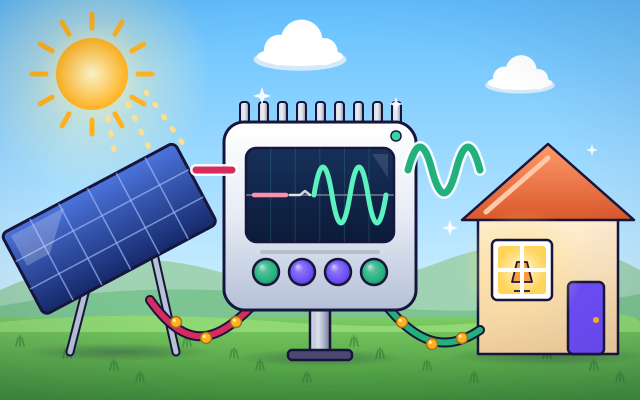
How do inverters change direct current into alternating current?
Follow a switching sequence and watch a steady supply become an alternating waveform.
#383
Electricity & energy
How do inverters change direct current into alternating current?
Follow a switching sequence and watch a steady supply become an alternating waveform.
 #384
Electricity & energy
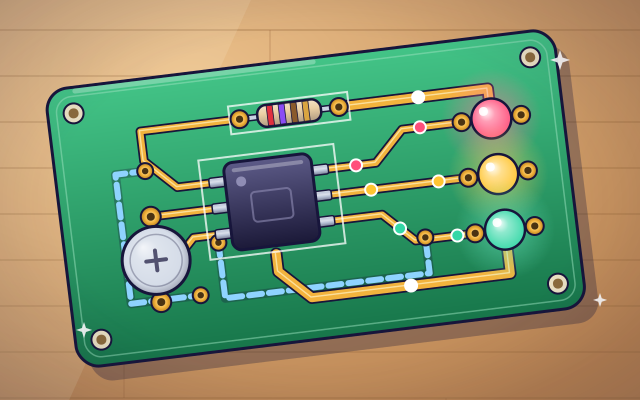
How do circuit boards connect electronic parts?
Route connections across a transparent board and trace signals between components.
#384
Electricity & energy
How do circuit boards connect electronic parts?
Route connections across a transparent board and trace signals between components.
 #385
Electricity & energy
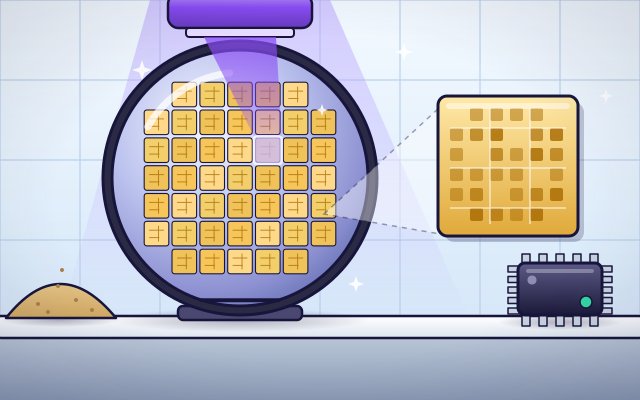
How are computer chips made?
Follow a silicon wafer through simplified patterning, repeated processing, cutting, packaging, and testing.
#385
Electricity & energy
How are computer chips made?
Follow a silicon wafer through simplified patterning, repeated processing, cutting, packaging, and testing.
 #386
Electricity & energy
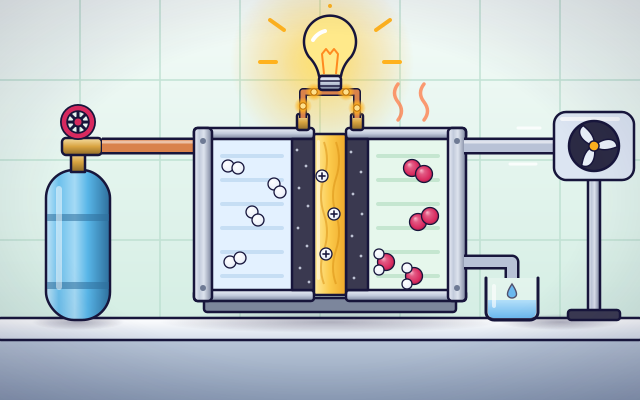
How do fuel cells generate electricity?
Follow hydrogen and oxygen through a model cell and identify its outputs.
#386
Electricity & energy
How do fuel cells generate electricity?
Follow hydrogen and oxygen through a model cell and identify its outputs.
Keep exploring
Games to play next
- Circuit Workshop 3DWire up batteries, bulbs and switches on a 3D workbench.
- SwitchworksFlip switches to light the lamps in the target pattern — in as few presses as you can.
- Machine RepairFix levers, pulleys, gears and ramps so every contraption works.
Guide for grown-ups
- How to start homeschooling: a step-by-step guide for familiesA guide for parents · 7 min read
Science games by grade
Science worksheets by grade
- Preschool Science Worksheets
- Pre-K Science Worksheets
- Kindergarten Science Worksheets
- 1st Grade Science Worksheets
- 2nd Grade Science Worksheets
- 3rd Grade Science Worksheets
- 4th Grade Science Worksheets
- 5th Grade Science Worksheets
- 6th Grade Science Worksheets
- 7th Grade Science Worksheets
- 8th Grade Science Worksheets