How do inherited traits pass through families?
Genes are instructions passed from parents to children. Mix the gene versions of make-believe fuzzles and see what hatches.
The big idea: Every living thing carries two versions of each gene, one from each parent. Which two versions a baby gets decides how a trait turns out.
It's like being dealt two cards for each trait, one from each parent. If either card is the bold one, the bold one is what you see.
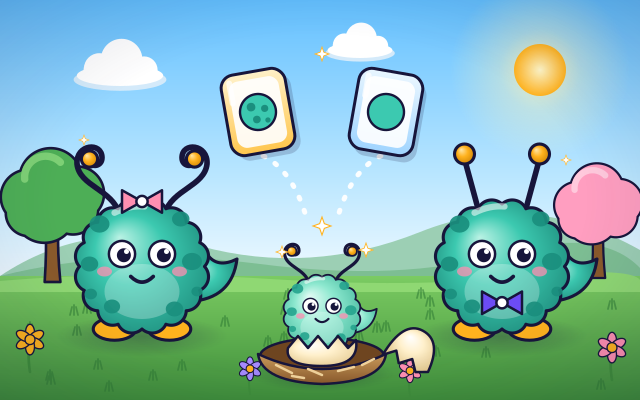
The interactive parts didn't load. The explanations below still work; try reloading the page.
How traits pass down
- Meet the fuzzles, make-believe animals we invented for this model. A baby hatches with spots like its parents. Why do babies look like their families?
- Zoom in on one tiny cell. Inside is a long, twisted ladder called DNA. A stretch of DNA that carries one instruction is called a gene.
- A gene can come in different versions. Each fuzzle carries two versions of the spots gene. We draw them as two cards.
- Each parent passes on just one of its two cards, picked by chance. The baby ends up with two cards: one from mom and one from dad.
- This baby got a spots card and a plain card. The spots version is dominant, so spots show. The plain version is still there, just hidden.
- If both parents happen to pass on their hidden plain card, the baby has two plain cards and no spots. That is how a trait can skip a generation.
Where the instructions live
Tap each part. We zoom from the whole fuzzle down to its DNA.
- A trait you can see. A trait is a feature of a living thing, like this fuzzle's spots or its curly feelers. Some traits are passed down from parents.
- A cell. Living things are built from tiny cells, far too small to see without a microscope. Almost every cell carries a full copy of the instructions.
- The nucleus. The nucleus is like the cell's library. It keeps the instructions safe in one place.
- A pair of chromosomes. DNA is packed into bundles called chromosomes. They come in matching pairs: one of each pair came from mom and the other from dad.
- A gene. A gene is one instruction on a chromosome. The same gene sits at the same place on both chromosomes of a pair, but the two versions can differ.
- DNA. Unwind a chromosome and you find DNA, a very long twisted ladder. The order of its rungs spells out the instructions, like letters in a word.
The fuzzle nursery
Each parent has two spots cards. Tap one from each parent to hatch a baby, or let chance pick. Watch the square fill up.
Experiment: Mom and dad both have spots, but each carries one hidden plain card. Can they have a baby with no spots?
- Tap a spots card from mom and a plain card from dad. Look at the baby.
- Now tap the plain card from both parents.
- Press Let chance pick a few times and watch which boxes fill up.
What we found: A baby needs only one spots card to have spots, because the spots version is dominant. But if both parents pass on their hidden plain card, the baby is plain. With these parents that happens about one time in four.
Turn on JavaScript to try it yourself.
Fill the nursery orders
Hatch the baby shown in each order. Pick one spots card and one feelers card from each parent, then press Hatch.
How traits are passed on
Living things are built from instructions called genes. Genes are made of DNA and are packed inside your cells. You have two copies of almost every gene: one from each birth parent. That is why children often look a bit like the people they were born to, and a bit like brothers, sisters and grandparents too. Families are made in many ways, and looking alike is not what makes a family.
A gene can come in different versions. In our make-believe fuzzles, the spots gene has a spots version and a plain version. The spots version is dominant: one copy is enough for spots to show. The plain version is recessive: it only shows when both copies are plain. A recessive version can ride along hidden for generations.
Which copy a parent passes on is up to chance, like flipping a coin. That is why brothers and sisters can look different even with the same parents. Chance has no memory: each new baby is a fresh flip.
The fuzzle model is much simpler than real life. Most real traits, such as how tall you grow, depend on many genes working together, and also on food, sleep, sunshine and the things that happen to you. The card game breaks down there: real genes are not single cards with one clear winner. Genes are a starting plan, not the whole story.
Key words
- Trait
- A feature of a living thing, such as a fuzzle's spots.
- Gene
- One instruction for building a living thing, made of DNA.
- Allele
- One version of a gene. We draw alleles as cards.
- Dominant
- A gene version that shows even when there is only one copy of it.
- Recessive
- A gene version that shows only when both copies are the same.
- Punnett square
- A grid that lists every pair of gene versions a baby could get from two parents.
Check your thinking
-
How many versions of each gene does a baby get, and from whom?
Show the answer
Two: one from mom and one from dad. Each parent passes on just one of its two versions, so the baby has two again.
-
A baby fuzzle gets one spots version and one plain version. What do you see?
Show the answer
Spots, because the spots version is dominant. One dominant version is enough for the trait to show. The plain version stays hidden.
-
Two spotted fuzzles have a baby with no spots. How can that happen?
Show the answer
Each parent had a hidden plain version and passed it on. A recessive version can hide behind a dominant one. Two hidden plain versions together make a plain baby.
-
Both parents are Ss. Over a very large number of babies, about what share would you expect to be plain?
Show the answer
About one in four. The four equally likely pairs are SS, Ss, sS and ss. Only ss is plain, so the chance is 1 in 4, or 25%.
-
Does dominant mean a gene version is better?
Show the answer
No. It only means it shows when the two versions are different. Dominant is only about which version you can see. It says nothing about better or worse.
-
Why do we call the fuzzle cards a simplified model?
Show the answer
Most real traits depend on many genes and on the environment. Height, for example, is shaped by many genes plus things like nutrition. One gene with a clear winner is the simplest case, not the usual one.
You're a Human body expert!
You watched, looked inside, tried it, solved the challenge and went deeper. Pick another question below, or switch the age at the top to see this topic another way.
More about human body
 #262
Human body
How does a baby develop before birth?
Follow a gentle developmental timeline exploring growth, the placenta, and changing proportions.
#262
Human body
How does a baby develop before birth?
Follow a gentle developmental timeline exploring growth, the placenta, and changing proportions.
 #263
Human body
How do adult teeth replace baby teeth?
Reveal changes above and below the gums through a dental-development timeline.
#263
Human body
How do adult teeth replace baby teeth?
Reveal changes above and below the gums through a dental-development timeline.
 #264
Human body
How does tooth decay develop?
Explore plaque, acids, enamel damage, and protective saliva on a model tooth.
#264
Human body
How does tooth decay develop?
Explore plaque, acids, enamel damage, and protective saliva on a model tooth.
 #265
Human body
How do hair and nails grow?
Follow newly produced cells into growing hair and nails beneath a skin cutaway.
#265
Human body
How do hair and nails grow?
Follow newly produced cells into growing hair and nails beneath a skin cutaway.
Keep exploring
Games to play next
- Body ExplorerTap, match and label your way around the amazing human body.
- Label LabPut the right labels on beautiful science diagrams, from bean plants to heart chambers.
- Science QuizzesOlly's Science Quiz Show: plants, animals, the body, weather, space and more, for every grade.
Guide for grown-ups
- How to start homeschooling: a step-by-step guide for familiesA guide for parents · 7 min read
Science games by grade
Science worksheets by grade
- Preschool Science Worksheets
- Pre-K Science Worksheets
- Kindergarten Science Worksheets
- 1st Grade Science Worksheets
- 2nd Grade Science Worksheets
- 3rd Grade Science Worksheets
- 4th Grade Science Worksheets
- 5th Grade Science Worksheets
- 6th Grade Science Worksheets
- 7th Grade Science Worksheets
- 8th Grade Science Worksheets