How are computer chips made?
Follow a slice of pure silicon as light prints tiny patterns on it, layer after layer, until it becomes hundreds of computer chips.
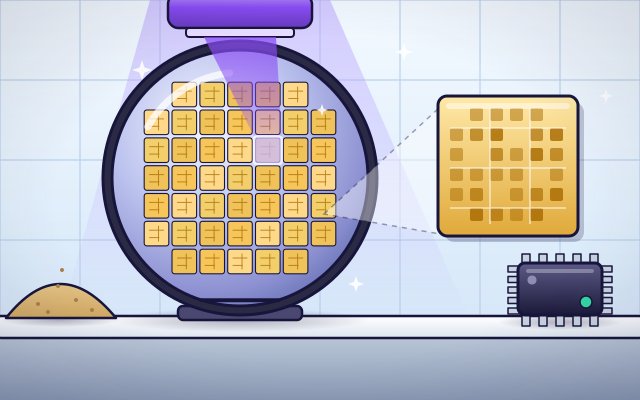
The big idea: Chips are built on a thin disc of silicon called a wafer. Light shines through a pattern to print each layer, and the steps are repeated many times before the wafer is cut into chips.
It's like decorating a cake with stencils: lay one on, dust sugar through the holes, lift it off, then add another stencil on top. Chips are built from many stenciled layers.
The interactive parts didn't load. The explanations below still work; try reloading the page.
How a chip is made
- Inside every phone, tablet and computer are chips. A chip no bigger than a fingernail can hold billions of tiny switches. How can anything so small be made?
- It starts with sand, which is rich in silicon. The silicon is purified, melted and slowly pulled up into one big, perfect crystal. Then it is sliced into thin discs called wafers and polished like mirrors.
- The wafer is coated with a liquid that reacts to light. Then light shines through a mask, a see-through plate with a pattern on it. Only the parts under the gaps are lit.
- A wash removes the coating wherever the light touched it. Now the uncovered parts of the wafer can be carved away, while the covered parts stay safe. The pattern is in the wafer!
- New material is added, such as metal for wires, and the printing steps are done all over again with a different mask. Dozens of layers stack up, each lined up with the one below.
- One finished wafer holds hundreds of identical chips, side by side like stamps on a sheet. A very fine saw cuts them apart.
- Each chip is sealed in a protective case with metal contacts, so it can be joined to a circuit board. Machines test every single one, and only the chips that work go out into the world.
Follow the wafer, step by step
Go through the steps one at a time. Watch the wafer on the left and the close-up on the right.
- Grow a crystal. Pure silicon is melted in a pot. A small seed crystal is dipped in and pulled up very slowly while it turns. The silicon freezes onto it and grows into one long, perfect crystal.
- Slice the wafers. A wire saw slices the crystal into thin discs called wafers. Each wafer is ground and polished until it is flatter and smoother than a mirror.
- Coat. A few drops of a light-sensitive liquid, called resist, land on the wafer. The wafer spins fast and the liquid spreads into a thin, even coat.
- Shine the light. Light shines through a mask with the circuit pattern on it. The resist under the clear parts is changed by the light. The resist in the shadows is not.
- Wash and carve. A wash removes the resist that the light changed. Then the uncovered parts of the layer are carved away. Last, the rest of the resist is cleaned off, leaving the pattern.
- Add a layer, and repeat. New material is added: metal fills the carved lines to make wires. Then the wafer goes round again for the next layer: coat, light, wash, carve, fill. This happens dozens of times.
- Cut the wafer. The finished wafer is covered in a grid of identical chips. A thin saw cuts along the lines between them, and each little square is lifted out.
- Package. Each chip is fixed into a case. Tiny gold wires or bumps join the chip to the case's metal contacts, and a lid seals it up safe from dust and knocks.
- Test. A machine sends test signals through every chip. The ones that give the right answers pass. The few that fail are set aside.
Print a layer, with and without dust
Coat the wafer, shine light through the mask, then wash and carve. Then switch the air filters off and print another wafer. What changes?
Experiment: What happens if specks of dust land on the wafer before the light shines?
- With the air filters on, tap the coater, the lamp and the washer in turn.
- Look at the close-up and at the map of the whole wafer. Press Next wafer.
- Switch the air filters off and print again. Compare the two wafers.
What we found: A speck of dust casts a shadow, so the pattern under it is missing or broken and that chip does not work. That is why chips are made in cleanrooms, where the air is filtered again and again and people wear suits that cover them from head to toe.
Turn on JavaScript to try it yourself.
Put the factory in order
The machines are mixed up. Tap them in the right order to turn a bare wafer into packed chips.
How a chip is made
A computer chip is a thin sliver of silicon covered in billions of tiny switches called transistors, joined by even tinier wires. No tool could ever put them in place one at a time. Instead, they are all printed at once, using light.
The work is done on a wafer, a thin disc sliced from a crystal of very pure silicon. The wafer is coated with a liquid called resist. Light is shone through a mask, a plate that carries the pattern for one layer. A wash then removes the resist the light touched, and the bare places are carved away or filled with metal.
One round of coating, lighting, washing and carving makes one layer. A finished chip needs dozens of layers, each lined up exactly on top of the last. It can take three months for a wafer to go through every step.
Because the parts are so tiny, one speck of dust is like a boulder dropped on a road. So chips are made in cleanrooms with filtered air, by people in suits that cover them from head to toe. At the end, the wafer is cut into chips, and each chip is put in a case and tested. The cake stencil comparison helps, but real stencils touch the cake. In a chip factory the pattern is carried by light, shrunk through lenses.
Key words
- Wafer
- A thin, shiny disc of silicon that chips are built on.
- Mask
- A see-through plate with a pattern on it. Light shines through the clear parts.
- Resist
- A coating that changes when light shines on it.
- Etching
- Carving away the parts of a layer that are not covered.
- Cleanroom
- A room with air so well filtered that it has almost no dust.
- Yield
- How many of the chips on a wafer work.
Check your thinking
-
What is the shiny disc that chips are built on called?
Show the answer
A wafer. The thin silicon disc is called a wafer. Hundreds of chips are made on each one.
-
What does the mask do?
Show the answer
It lets light through only where the pattern should be. The mask is like a stencil for light: clear where light should pass, dark where it should not.
-
In the simplified model on this page, light can print features down to about a quarter of its wavelength. Roughly what is the smallest feature for 193 nanometer light?
Show the answer
About 48 nanometers. A quarter of 193 nanometers is about 48 nanometers. Printing anything finer needs a shorter wavelength.
-
Why must the wafer be coated before the light shines on it?
Show the answer
The coating is what the light changes, so the pattern can be washed out. Bare silicon does not react to the light. The resist does, and the wash then opens up the pattern.
-
Why are chips made in super-clean rooms?
Show the answer
One speck of dust can block the light and spoil a chip. The parts on a chip are far smaller than dust, so a single speck can break a pattern.
-
Why does a chip need its steps repeated so many times?
Show the answer
It is built from dozens of layers, and each layer needs its own printing. Each layer of switches or wires has its own pattern, so the whole print-and-carve cycle is repeated for each.
You're a Electricity & energy expert!
You watched, looked inside, tried it, solved the challenge and went deeper. Pick another question below, or switch the age at the top to see this topic another way.
More about electricity & energy
 #386
Electricity & energy
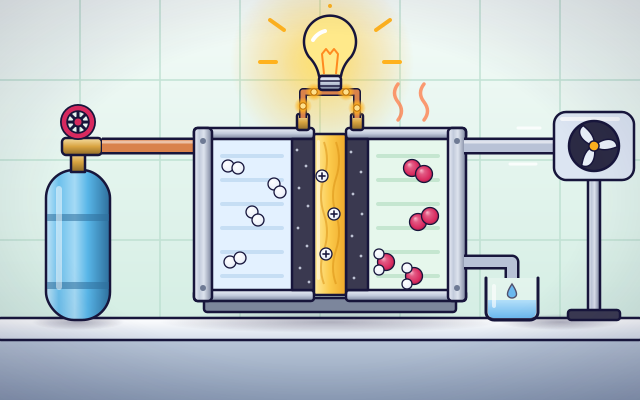
How do fuel cells generate electricity?
Follow hydrogen and oxygen through a model cell and identify its outputs.
#386
Electricity & energy
How do fuel cells generate electricity?
Follow hydrogen and oxygen through a model cell and identify its outputs.
 #387
Electricity & energy
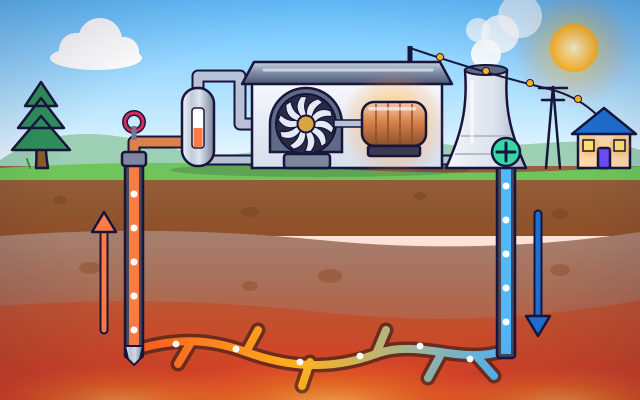
How do geothermal power plants use Earth's heat?
Follow underground heat through a power station and its circulating water system.
#387
Electricity & energy
How do geothermal power plants use Earth's heat?
Follow underground heat through a power station and its circulating water system.
 #388
Electricity & energy
How does a nuclear power reactor work?
Trace controlled fission, control rods, coolant, and heat transfer into electricity generation.
#388
Electricity & energy
How does a nuclear power reactor work?
Trace controlled fission, control rods, coolant, and heat transfer into electricity generation.
 #389
Electricity & energy
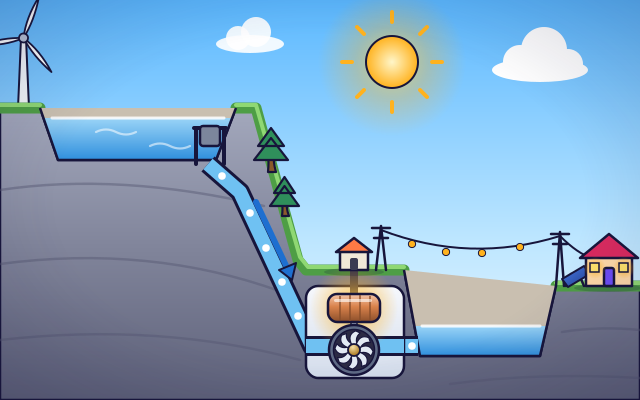
How do pumped-storage stations store energy?
Pump water uphill, then release it through turbines when electricity is needed.
#389
Electricity & energy
How do pumped-storage stations store energy?
Pump water uphill, then release it through turbines when electricity is needed.
Keep exploring
Games to play next
- SwitchworksFlip switches to light the lamps in the target pattern — in as few presses as you can.
- Circuit Workshop 3DWire up batteries, bulbs and switches on a 3D workbench.
- Machine RepairFix levers, pulleys, gears and ramps so every contraption works.
Guide for grown-ups
- How to start homeschooling: a step-by-step guide for familiesA guide for parents · 7 min read
Science games by grade
Science worksheets by grade
- Preschool Science Worksheets
- Pre-K Science Worksheets
- Kindergarten Science Worksheets
- 1st Grade Science Worksheets
- 2nd Grade Science Worksheets
- 3rd Grade Science Worksheets
- 4th Grade Science Worksheets
- 5th Grade Science Worksheets
- 6th Grade Science Worksheets
- 7th Grade Science Worksheets
- 8th Grade Science Worksheets