How do fuel cells generate electricity?
A fuel cell joins hydrogen and oxygen without burning them, and makes electricity, water and a little warmth.
The big idea: A fuel cell pulls each hydrogen atom into two pieces. One piece slips through a thin sheet. The other piece has to go around through a wire, and that moving stream is electricity.
It's like a gate that lets walkers through but sends every bike around a long loop road. The bikes on the loop are the electricity; the thin sheet is the gate.
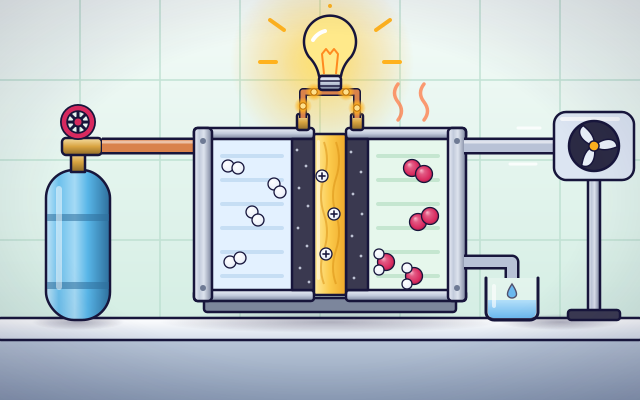
The interactive parts didn't load. The explanations below still work; try reloading the page.
Electricity from hydrogen
- This bus runs on hydrogen gas. It hums along quietly, and the only thing that leaves its tailpipe is water. Inside is a machine called a fuel cell.
- A fuel cell is built like a sandwich. Hydrogen flows along one side and air flows along the other. In the middle is a very thin sheet that keeps the two gases apart.
- When hydrogen touches the dark layer, each atom splits into two pieces: a bigger piece called a proton and a tiny, speedy piece called an electron.
- The thin sheet lets protons through, but it stops electrons. So the electrons rush the long way around, through a wire. Electrons moving in a wire are electricity, and the lamp lights up!
- On the air side, the protons and electrons meet oxygen. They all join together and make water. The water drips out, and the cell feels a little warm.
- One cell makes only a little push. So hundreds are stacked side by side, like slices in a loaf. Hydrogen and oxygen go in. Electricity, water and warmth come out.
Look inside a model fuel cell
Tap each part. Follow the hydrogen from the tank all the way to a drop of water.
- Hydrogen inlet. Hydrogen gas flows in from a strong tank and spreads along thin grooves, so it touches the whole dark layer.
- Anode (the splitting side). The anode is a dark, sooty layer sprinkled with a special metal. It pulls each hydrogen atom apart into a proton and an electron.
- Membrane (the picky gate). This thin plastic sheet is the heart of the cell. Protons can wriggle through it. Electrons and gases cannot.
- Wire and lamp (the circuit). Electrons cannot pass the sheet, so they flow around through the wire. On the way they give their energy to the lamp.
- Cathode (the joining side). On the cathode, protons from the sheet, electrons from the wire and oxygen from the air all join up. Together they make water.
- Air inlet. A small fan pushes ordinary air in. About one fifth of air is oxygen, and that is the part the cell uses.
- Water outlet. The water that was made runs out here, together with warm, damp air. There is no smoke and no soot.
Run the model fuel cell
Open the hydrogen valve and switch on the air fan. Watch the tiny pieces travel. Then try the cell with only one gas.
Experiment: The lamp is shining. What will happen if you switch off the air fan but leave the hydrogen on?
- Open the hydrogen valve and switch on the fan. The lamp lights.
- Now switch the fan off and watch the lamp and the water drops.
- Switch the fan back on, then close the hydrogen instead.
What we found: The cell needs both gases. Hydrogen gives up the electrons, but oxygen has to be waiting on the far side to take them. Take either gas away and the electrons stop moving, so the lamp goes out and no water is made.
Turn on JavaScript to try it yourself.
Power the motor and name what comes out
The motor needs at least 3 volts. Turn on both gases, stack enough cells, then choose the three things a fuel cell gives out and press Check.
How a fuel cell makes electricity
When hydrogen burns in air, it joins with oxygen, makes water and gives out its energy as heat. A fuel cell lets the very same joining happen, but in a sneaky way that takes the energy out as electricity instead of a flame.
The trick is to keep the hydrogen and the oxygen on opposite sides of a thin sheet. On the hydrogen side, a special metal splits each atom into a proton and an electron. The sheet lets protons through but not electrons. The electrons still want to get to the oxygen, so they rush around through a wire. That stream of electrons is an electric current, and it can light a lamp or spin a motor on the way.
On the oxygen side, everything meets again. Protons, electrons and oxygen join up and make water. The cell also gets warm, because not all of the energy becomes electricity.
A fuel cell is a bit like a battery that never runs flat, as long as you keep feeding it hydrogen and air. The gate picture is not perfect, though. A real proton does not walk through a door. It hops from one damp spot in the sheet to the next. And the hydrogen has to be made somewhere first, which takes energy too.
Key words
- Fuel cell
- A machine that makes electricity by joining a fuel, such as hydrogen, with oxygen, without burning it.
- Electron
- A tiny piece of an atom. Electrons moving along a wire are electricity.
- Proton
- What is left of a hydrogen atom when its electron is taken away.
- Membrane
- A thin sheet that lets some things through and stops others.
- Catalyst
- A helper that makes a change happen faster without being used up.
- Stack
- Many fuel cells joined side by side so their small voltages add up.
Check your thinking
-
What comes out of a hydrogen fuel cell besides electricity and warmth?
Show the answer
Water. Hydrogen and oxygen join to make water. Nothing is burned, so there is no smoke.
-
Why do the electrons travel through the wire?
Show the answer
The thin sheet blocks them, so the wire is the only way across. The sheet lets protons through but stops electrons, so the electrons must go around through the wire.
-
The hydrogen is on but the air is switched off. What happens to the lamp?
Show the answer
It goes out, because no oxygen is waiting to take the electrons. Both sides must work together. With no oxygen on the far side, the electrons stop moving.
-
Why does a bus use hundreds of cells instead of one big one?
Show the answer
Each cell gives only a small push, and the pushes add up. One cell makes less than one volt. Stacking them adds the pushes together.
-
As more current is drawn from a fuel cell, its voltage falls. Where does the missing energy go?
Show the answer
It leaves as heat. Losses at the catalyst and in the membrane's resistance turn part of the fuel's energy into heat, which is why stacks need cooling.
-
What two gases does this fuel cell need to keep working?
Show the answer
Hydrogen and oxygen. Hydrogen gives up electrons and oxygen takes them. Without either one the cell stops.
You're a Electricity & energy expert!
You watched, looked inside, tried it, solved the challenge and went deeper. Pick another question below, or switch the age at the top to see this topic another way.
More about electricity & energy
 #387
Electricity & energy
How do geothermal power plants use Earth's heat?
Follow underground heat through a power station and its circulating water system.
#387
Electricity & energy
How do geothermal power plants use Earth's heat?
Follow underground heat through a power station and its circulating water system.
 #388
Electricity & energy
How does a nuclear power reactor work?
Trace controlled fission, control rods, coolant, and heat transfer into electricity generation.
#388
Electricity & energy
How does a nuclear power reactor work?
Trace controlled fission, control rods, coolant, and heat transfer into electricity generation.
 #389
Electricity & energy
How do pumped-storage stations store energy?
Pump water uphill, then release it through turbines when electricity is needed.
#389
Electricity & energy
How do pumped-storage stations store energy?
Pump water uphill, then release it through turbines when electricity is needed.
 #390
Electricity & energy
How do electricity meters measure household use?
Switch appliances on and off and watch their energy use accumulate.
#390
Electricity & energy
How do electricity meters measure household use?
Switch appliances on and off and watch their energy use accumulate.
Keep exploring
Games to play next
- Circuit Workshop 3DWire up batteries, bulbs and switches on a 3D workbench.
- Garden AutomationProgram a garden robot with sensor rules — then watch a whole day play out.
- SwitchworksFlip switches to light the lamps in the target pattern — in as few presses as you can.
Guide for grown-ups
- How to start homeschooling: a step-by-step guide for familiesA guide for parents · 7 min read
Science games by grade
Science worksheets by grade
- Preschool Science Worksheets
- Pre-K Science Worksheets
- Kindergarten Science Worksheets
- 1st Grade Science Worksheets
- 2nd Grade Science Worksheets
- 3rd Grade Science Worksheets
- 4th Grade Science Worksheets
- 5th Grade Science Worksheets
- 6th Grade Science Worksheets
- 7th Grade Science Worksheets
- 8th Grade Science Worksheets