How do circuit breakers interrupt excessive current?
A circuit breaker is an automatic switch. When too much electricity flows, it snaps open and stops it before the wires overheat.
The big idea: The more things you switch on, the more electricity flows and the warmer the wires get. A breaker feels that and switches the circuit off in time. You can switch it back on.
It's like a lifeguard at a crowded pool: when too many swimmers get in, the whistle blows and everyone must get out. Later the pool opens again.
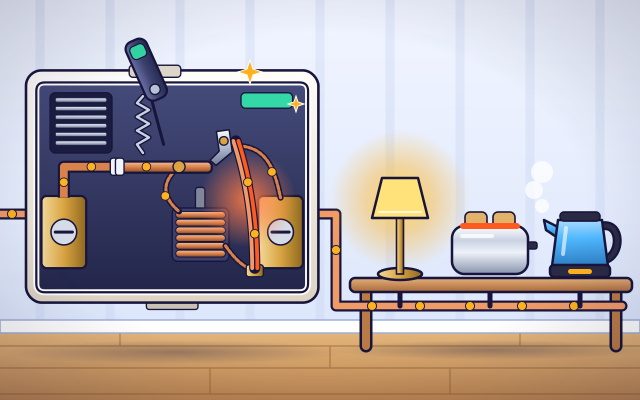
The interactive parts didn't load. The explanations below still work; try reloading the page.
Why the power clicked off
- The lamp, the toaster and the kettle are all on. Then someone switches on the heater as well. Click! Everything goes off at once. Nothing is broken, so what happened?
- All those things share one wire. Each one you switch on adds to the flow of electricity, called the current. Four at once is a very big current.
- Electricity flowing through a wire warms it up. A little current is fine. Too much makes the wire far too hot, so every circuit has a guard that watches the current.
- The guard is a circuit breaker. All the current passes through a strip made of two metals stuck together. As the strip warms, one metal grows more than the other, so the strip bends.
- The bending strip pushes a catch. A spring snaps the metal contacts apart, leaving a gap that electricity cannot cross. The current stops and the wires cool down.
- First switch off or unplug something. Then a grown-up flips the breaker's handle back on. The light returns, and the breaker is ready to guard the wires again.
Look inside a circuit breaker
Tap each part of the breaker. Watch how it helps switch the power off.
- Handle. The lever on the front. You can switch it by hand, and it flips to off by itself when the breaker trips.
- Contacts. Two pieces of metal that press together to let electricity through. When they are pulled apart, the gap stops the current.
- Latch and spring. A small catch holds the moving contact shut against a stretched spring. When the catch is nudged, the spring snaps the contacts apart.
- Bimetal strip. A strip of two metals stuck together. Too much current warms it, it bends over and pushes the catch. It is slow, which suits a small overload.
- Magnet coil. A coil of wire that becomes a magnet when current flows. A huge, sudden current makes it strong enough to shoot a pin at the catch right away.
- Spark catcher. When the contacts part, a small spark jumps across. This stack of metal plates pulls the spark in, splits it up and cools it until it goes out.
- Terminals. Screw clamps where the wires are fixed. Power comes in on one side and goes out to the room on the other. Only electricians touch these.
Switch things on until it trips
Tap the appliances to switch them on. Watch the current, the wire and the strip in the breaker. Tap the handle to switch the breaker back on.
Experiment: The breaker lets 15 amps flow. What happens if you switch on things that need more than that?
- Switch on the lamp and the toaster. Is the breaker happy?
- Now add the kettle. Watch the strip bend.
- Switch something off, then tap the handle to reset the breaker.
What we found: Below 15 amps the strip only warms a little and nothing happens. Above it, the strip keeps heating and bending until it trips the catch, and everything on the circuit goes off.
Turn on JavaScript to try it yourself.
Party time, no trips
Make the toast, boil the kettle and warm the room. Finish all three jobs without tripping the breaker.
How a breaker protects the wires
Electricity flows from the supply, through wires inside the walls, to the things you plug in. The size of that flow is called the current, and it is measured in amperes, or amps. Each thing you switch on adds its own current to the wire they share. A lamp adds very little. A kettle or a heater adds a lot.
Whenever current flows, the wire warms up a little. That is normal. But if far too much current flows, the wire could get hot enough to damage itself and the things around it. So every circuit in a building has a guard: a circuit breaker, which is a switch that turns itself off.
Inside the breaker, the current runs through a strip made of two different metals stuck together. When the strip warms up, one metal grows a tiny bit more than the other, so the strip bends. If it bends far enough, it pushes a catch, and a spring snaps two metal contacts apart. Now there is a gap, electricity cannot cross it, and everything on that circuit switches off.
If a breaker trips at home, tell a grown-up. The fix is to switch off or unplug some things, then flip the breaker's handle back on. If it trips again and again, something is wrong and an electrician should check it. A breaker is a helper: it is doing its job when it clicks off.
Key words
- Current
- How much electricity is flowing. It is measured in amps.
- Overload
- More current than the wire and breaker are meant to carry, usually from too many things switched on at once.
- Short circuit
- A fault that gives electricity a shortcut, so a huge current flows all at once.
- Trip
- When a breaker switches itself off.
- Bimetal strip
- Two metals stuck together that bend when they warm up.
- Rating
- The largest current a breaker will carry without ever tripping, such as 15 amps.
Check your thinking
-
What makes a circuit breaker trip?
Show the answer
More current flowing than the circuit is meant to carry. Too much current warms the strip inside until it bends and trips the catch.
-
A breaker has tripped at home. What is the right thing to do first?
Show the answer
Tell a grown-up, and switch off some of the things on that circuit. The breaker tripped because too much was on. Reduce the load first, then a grown-up can reset it.
-
Why does the bimetal strip bend when it gets warm?
Show the answer
One of its two metals grows more than the other. The two metals are stuck together, so when one grows more, the strip has to curl.
-
A breaker allows 15 amps. The lamp uses 1, the toaster 8 and the kettle 12. Which pair is too much?
Show the answer
Toaster and kettle. 8 and 12 make 20 amps, which is more than 15. The other pairs make 9 and 13.
-
On a 120 volt supply, about how much current does a 1,200 watt microwave draw?
Show the answer
10 amperes. Current is power divided by voltage: 1,200 ÷ 120 = 10 amperes.
You're a Electricity & energy expert!
You watched, looked inside, tried it, solved the challenge and went deeper. Pick another question below, or switch the age at the top to see this topic another way.
More about electricity & energy
 #399
Electricity & energy
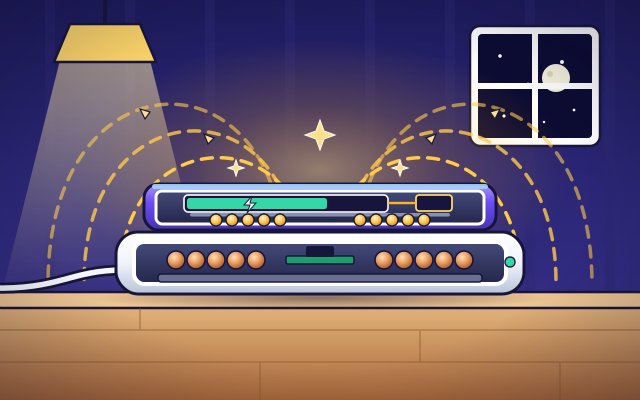
How does wireless charging recharge a device?
Align coils and follow energy transfer between a charging pad and device.
#399
Electricity & energy
How does wireless charging recharge a device?
Align coils and follow energy transfer between a charging pad and device.
 #41
Electricity & energy
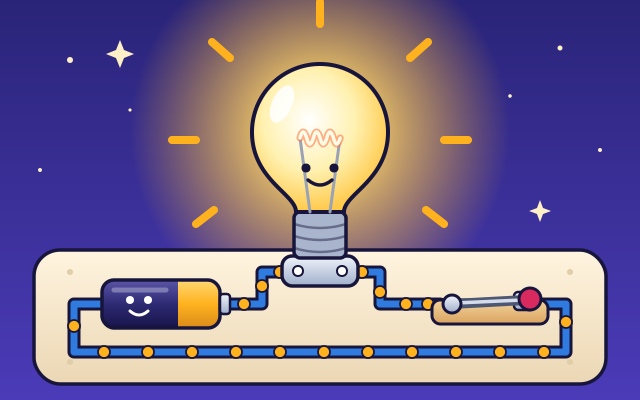
How does electricity turn on a light?
Build virtual circuits using batteries, wires, switches, and bulbs. Find breaks in a circuit and compare simple series and parallel arrangements.
#41
Electricity & energy
How does electricity turn on a light?
Build virtual circuits using batteries, wires, switches, and bulbs. Find breaks in a circuit and compare simple series and parallel arrangements.
 #42
Electricity & energy
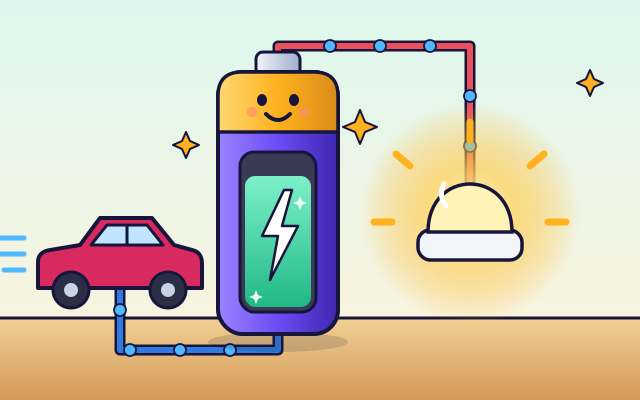
How do batteries power things?
Look inside a simplified battery and explore chemical energy becoming electrical energy. Connect different devices and compare how quickly they use its stored energy.
#42
Electricity & energy
How do batteries power things?
Look inside a simplified battery and explore chemical energy becoming electrical energy. Connect different devices and compare how quickly they use its stored energy.
 #43
Electricity & energy
How do solar panels make electricity?
Explore a solar cell and follow sunlight becoming electrical energy. Adjust shade, panel direction, and time of day while watching output change.
#43
Electricity & energy
How do solar panels make electricity?
Explore a solar cell and follow sunlight becoming electrical energy. Adjust shade, panel direction, and time of day while watching output change.
Keep exploring
Games to play next
- Circuit Workshop 3DWire up batteries, bulbs and switches on a 3D workbench.
- SwitchworksFlip switches to light the lamps in the target pattern — in as few presses as you can.
- Machine RepairFix levers, pulleys, gears and ramps so every contraption works.
Guide for grown-ups
- How to start homeschooling: a step-by-step guide for familiesA guide for parents · 7 min read
Science games by grade
Science worksheets by grade
- Preschool Science Worksheets
- Pre-K Science Worksheets
- Kindergarten Science Worksheets
- 1st Grade Science Worksheets
- 2nd Grade Science Worksheets
- 3rd Grade Science Worksheets
- 4th Grade Science Worksheets
- 5th Grade Science Worksheets
- 6th Grade Science Worksheets
- 7th Grade Science Worksheets
- 8th Grade Science Worksheets