How do solar panels make electricity?
Follow sunlight into a solar cell, then turn the panel, move the shade and change the time of day to watch the power change.
The big idea: A solar cell is made of two layers of silicon. When light hits it, it knocks electrons loose, and the layers push them out into a wire as an electric current. More sunlight, hitting straight on, means more power.
It's like
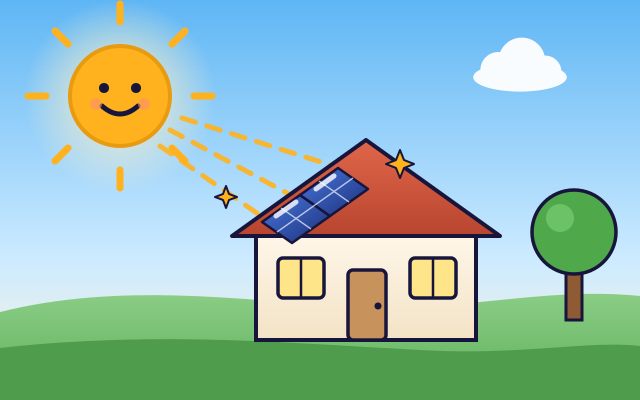
The interactive parts didn't load. The explanations below still work; try reloading the page.
From sunlight to electricity
- Every morning the sun rises and floods the Earth with light. The dark panels on this roof are waiting to catch it.
- A solar panel is a grid of many solar cells, wired together. Thin silver lines on each cell collect the electricity it makes.
- Each cell has two layers of silicon. Light knocks electrons loose, and the boundary between the layers pushes them one way, out through a wire, as an electric current.
- Angle matters. When the panel faces the sun straight on, it catches the most light. Tilted away, the same light is spread thinly over the panel.
- Clouds and shadows block sunlight, so the power drops. Even shading a small part of a panel can cut its output a lot, because the cells are connected in a chain.
- Through the day the power rises in the morning, peaks around noon when the sun is highest, and falls to zero at night. Batteries can store energy for after dark.
Inside a solar panel
This simplified cross-section shows the layers of a solar panel. Tap each one to see its job.
- Glass cover. Tough, clear glass on top lets sunlight in and protects the delicate cells from rain, hail and dirt.
- Anti-reflective coating. A very thin coating stops light from bouncing off the shiny silicon. It's what makes cells look dark blue or black.
- Metal fingers. Thin silver lines across the top of each cell collect the electrons and carry them to the wires. They are thin so they don't block much light.
- N-type silicon. The top layer of silicon has a tiny bit of another element added, giving it extra electrons. Freed electrons collect here.
- The junction. Where the two silicon layers meet, there is a built-in push. It sends freed electrons up and out, which is what makes the current flow one way.
- P-type silicon. The thicker bottom layer has a different element added, giving it 'holes' where electrons are missing. Most of the light is absorbed here.
- Back contact. A metal layer covers the back of the cell. Electrons that have gone around the circuit come back in here.
- Frame. An aluminum frame holds the layers together and lets the panel be bolted onto a roof or a stand.
- Junction box. A box on the back connects the panel's cells to the cables that carry the electricity away.
Sun, shade and angle
Change the time of day and the way the panel faces. Drag the cloud in front of the sun. Watch the power and the fountain.
Experiment: When does a solar panel make the most power?
- Set the time to noon and lay the panel flat. Note the power.
- Turn the panel to face east, then west. What happens?
- Try early morning. Then turn the panel to face the low sun.
What we found: A panel makes the most power when the sun shines straight onto it, without shade. When the sun is low or the panel faces away, the same light is spread thinly across the panel, so it makes less power. That's why some panels tilt to follow the sun.
Turn on JavaScript to try it yourself.
Sun tracker
Fill the battery before sunset. Keep turning the panel to face the sun, and drag clouds away from it.
Turning light into electricity
Sunlight is made of tiny packets of energy called photons. A solar cell is a thin slice of silicon, the same material used in computer chips, made in two layers. Each layer has a pinch of a different element added, so one layer has extra electrons and the other has spaces where electrons are missing.
When a photon hits the silicon, it can knock an electron loose. Where the two layers meet, there's a built-in push that sends the loose electrons one way. If a wire connects the top and bottom of the cell, the electrons flow around it as an electric current, which can power a light, charge a battery or join the electricity grid.
A panel makes the most power when sunlight hits it straight on. If the sun is low in the sky, or the panel faces away, the same light is spread across a bigger area, so less of it lands on each cell. That's why panels are tilted toward the sun, and some even turn to follow it.
Panels don't work at night, and they make less on cloudy days or in shade. Homes with solar panels use batteries or the electricity grid when the sun isn't shining. Solar power is renewable: the sun will keep shining for billions of years.
Key words
- Photon
- A tiny packet of light energy.
- Solar cell
- A thin slice of silicon that turns light into electricity.
- P-n junction
- The boundary between the two silicon layers, where there's a built-in push.
- Angle of incidence
- The angle between incoming sunlight and a line sticking straight out of the panel (its normal).
- Irradiance
- How much sunlight power lands on each square meter.
- Renewable energy
- Energy from a source that won't run out, like sunlight or wind.
Check your thinking
-
What does a solar panel turn into electricity?
Show the answer
Light. Photons of light knock electrons loose in the silicon.
-
When does a solar panel make the most power?
Show the answer
When sunlight hits it straight on. Facing the sun, the light is concentrated on the panel instead of spread thinly.
-
Why might a whole panel make much less power when only a corner is shaded?
Show the answer
Its cells are connected in a chain, so one weak cell slows the rest. In a chain (series), the same current flows through every cell, so the shaded cell limits all of them.
-
How can a house with solar panels have lights at night?
Show the answer
Store daytime energy in batteries or use the grid. Batteries store extra energy from sunny hours, and the grid can supply power at night.
-
Why do panels in snowy, northern places usually tilt steeply toward the south?
Show the answer
To face the low winter sun more directly. The winter sun stays low in the southern sky, so a steep tilt reduces the angle of incidence (and sheds snow).
You're a Electricity & energy expert!
You watched, looked inside, tried it, solved the challenge and went deeper. Pick another question below, or switch the age at the top to see this topic another way.
More about electricity & energy
 #44
Electricity & energy
How do wind turbines make electricity?
Follow wind turning the blades and driving a generator. Explore the inside of a turbine and power a model village under different wind conditions.
#44
Electricity & energy
How do wind turbines make electricity?
Follow wind turning the blades and driving a generator. Explore the inside of a turbine and power a model village under different wind conditions.
 #45
Electricity & energy
How do electric motors make things move?
Explore magnets, coils, and a turning shaft in a simplified motor. Use it to drive a fan, toy car, or conveyor belt.
#45
Electricity & energy
How do electric motors make things move?
Explore magnets, coils, and a turning shaft in a simplified motor. Use it to drive a fan, toy car, or conveyor belt.
 #46
Electricity & energy
How do generators make electricity?
Move magnets and coils in a simulation to explore electricity generation. Turn a virtual hand crank and compare how connected devices respond.
#46
Electricity & energy
How do generators make electricity?
Move magnets and coils in a simulation to explore electricity generation. Turn a virtual hand crank and compare how connected devices respond.
 #47
Electricity & energy
How does electricity reach our homes?
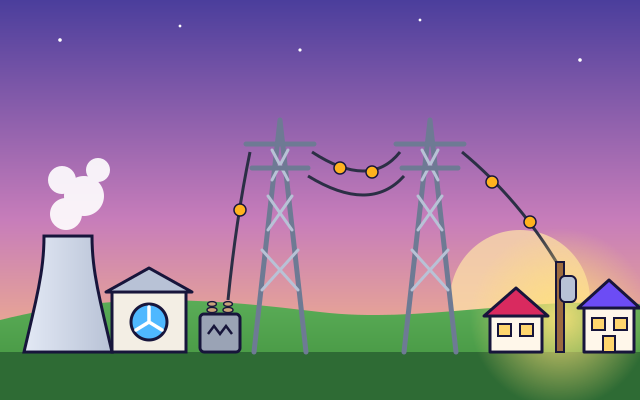
Follow electricity through generators, substations, power lines, and neighborhood connections. Connect a model town and restore power after a simulated fault.
#47
Electricity & energy
How does electricity reach our homes?
Follow electricity through generators, substations, power lines, and neighborhood connections. Connect a model town and restore power after a simulated fault.
Keep exploring
Games to play next
- Circuit Workshop 3DWire up batteries, bulbs and switches on a 3D workbench.
- SwitchworksFlip switches to light the lamps in the target pattern — in as few presses as you can.
- Machine RepairFix levers, pulleys, gears and ramps so every contraption works.
Guide for grown-ups
- How to start homeschooling: a step-by-step guide for familiesA guide for parents · 7 min read
Science games by grade
Science worksheets by grade
- Preschool Science Worksheets
- Pre-K Science Worksheets
- Kindergarten Science Worksheets
- 1st Grade Science Worksheets
- 2nd Grade Science Worksheets
- 3rd Grade Science Worksheets
- 4th Grade Science Worksheets
- 5th Grade Science Worksheets
- 6th Grade Science Worksheets
- 7th Grade Science Worksheets
- 8th Grade Science Worksheets